The pitot-static system is among the most elegant engineering solutions in aviation: it requires no electricity, no moving mechanical parts, and no complex sensors—only the pressure of air to drive three instruments that together paint an accurate picture of an aircraft's performance. On a Light-Sport Aircraft (LSA), where the panel is often stripped to essentials, the pitot-static system and the airspeed indicator (ASI) it powers can be the primary—sometimes the only—reference a pilot has for speed, altitude, and vertical trend. That simplicity is both a strength and a vulnerability, and understanding it deeply is essential both for the FAA Sport Pilot Knowledge Test and for real-world safety at the low airspeeds where LSAs routinely operate.
How the Pitot-Static System Is Constructed
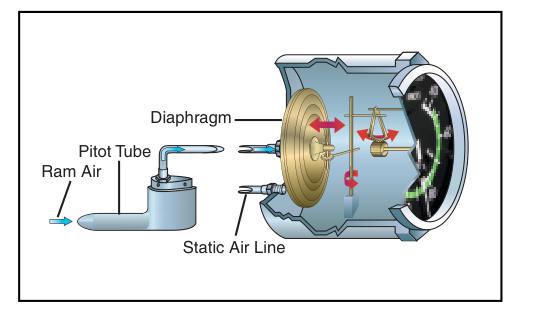
The system has two pressure-sensing inputs and three instrument outputs. The pitot tube is a small open-ended tube oriented directly into the relative wind, usually mounted on a wing leading edge, the nose, or a dedicated mast. Its job is to capture ram air pressure—also called impact pressure or dynamic pressure—which rises with airspeed. The pitot tube connects exclusively to the airspeed indicator; no other instrument uses pitot pressure.
The static port is a small, flush opening—sometimes a ring of tiny holes—located on a relatively undisturbed part of the fuselage, wing, or pitot mast. It senses ambient atmospheric (static) pressure, which is unaffected by the aircraft's forward motion. Static pressure lines run to all three pressure instruments: the ASI, the altimeter, and the vertical speed indicator (VSI). On many basic LSAs, a single static port serves all three; more sophisticated aircraft may have dual ports on opposing sides of the fuselage to minimize position error in slipping flight.
Inside the airspeed indicator, the pitot line feeds into an expandable aneroid capsule (diaphragm) while the static line fills the sealed instrument case surrounding it. The capsule expands or contracts based on the difference between ram pressure and static pressure—this differential is called dynamic pressure (q), expressed by the aerodynamic formula q = ½ρV², where ρ is air density and V is true airspeed. A mechanical linkage translates the capsule movement into needle deflection on the calibrated dial, giving the pilot indicated airspeed.
The Airspeed Indicator in Detail
From Indicated to True Airspeed
The number on the ASI dial is indicated airspeed (IAS)—the raw instrument reading. IAS contains small errors: instrument error from manufacturing tolerance, and position error (also called installation error) caused by disturbed airflow around the static port at certain attitudes and configurations. Correcting IAS for position and instrument error gives calibrated airspeed (CAS). On most light aircraft and LSAs, IAS and CAS differ by only a few knots, but the difference can grow at very low speeds or with full flap deflection. For the Sport Pilot Knowledge Test, you are expected to know that CAS is the more accurate reference for structural and performance limits.
Correcting CAS further for the effect of air density (altitude and temperature) yields true airspeed (TAS)—the actual speed of the aircraft through the air mass. At sea level in International Standard Atmosphere (ISA) conditions, IAS and TAS are essentially equal. As altitude increases and density decreases, TAS grows progressively higher than IAS for the same throttle setting. A practical rule of thumb from the PHAK: TAS increases approximately 2 percent above IAS for every 1,000 feet of altitude in standard conditions.
Color-Coded ASI Arcs and Lines
FAA regulations require specific color markings on the ASI to communicate speed limits at a glance. For Sport Pilot operations, knowing each marking's meaning is a tested knowledge item:
- White arc — Flap operating range. The lower limit is Vso, the stalling speed or minimum steady flight speed in the landing configuration (full flaps). The upper limit is Vfe, the maximum speed with flaps extended. Operating above Vfe with flaps deployed risks structural damage to the flap hinges and wing.
- Green arc — Normal operating range. The lower limit is Vs1, stalling speed in the clean configuration (flaps up). The upper limit is Vno, the maximum structural cruising speed. The aircraft can be flown at any speed in the green arc in all air conditions.
- Yellow arc — Caution range, between Vno and Vne. Flight here is permitted only in smooth air. In turbulence, gusts can momentarily spike loads above the aircraft's design limit, risking structural failure.
- Red radial line — Vne, the never-exceed speed. Exceeding Vne risks catastrophic structural failure. The red line must never be reached, even briefly.
- Blue radial line (multi-engine) — Best single-engine climb speed (Vyse). Not applicable to most LSAs, but may appear on knowledge test distractors.
System Failures and Their Instrument Effects
Blocked Pitot Tube
Pitot blockage most commonly results from insects nesting in the tube during ground time, moisture freezing at altitude, or a forgotten pitot cover. When the pitot tube is blocked while the static port remains open, the ASI does not drop to zero—this is the most common misconception. Instead, the capsule inside the ASI now holds a trapped, fixed ram pressure while static pressure continues to change with altitude. The net effect is that the ASI acts like an altimeter: the needle rises during a climb (decreasing static pressure makes the differential appear larger) and falls during a descent (increasing static pressure makes the differential appear smaller). A pilot unaware of the blockage who then chases airspeed could enter a dangerously nose-low attitude while the false ASI reading climbs. During preflight, physically verify the pitot tube is unobstructed and that any pitot cover is removed.
Blocked Static Port
A blocked static port traps pressure from the moment of blockage. This affects all three instruments simultaneously. The altimeter freezes at the altitude where the port blocked. The VSI drops to zero and remains there regardless of actual vertical movement. The ASI reads incorrectly: during a climb (where ambient pressure decreases below the trapped value), the capsule differential is artificially reduced, causing the ASI to read lower than actual airspeed. During a descent, the reverse occurs and the ASI reads higher than actual airspeed. This is a particularly insidious failure because the airspeed error is in the most dangerous direction during approach and landing—the pilot may believe they are flying faster than they actually are, increasing stall risk.
Using the Alternate Static Source
Many LSAs incorporate an alternate static source—a valve the pilot can open to draw cabin air into the static lines when the external port is blocked. Cabin pressure is typically slightly lower than outside ambient pressure because of airflow patterns around the fuselage and slight pressurization effects of ram air. When alternate static is selected, the altimeter reads slightly higher than actual altitude, airspeed reads slightly higher than actual, and the VSI momentarily shows a brief climb before stabilizing. The pilot must be aware of these biases. The Aircraft Flight Manual (AFM) or Pilot's Operating Handbook (POH) for the specific aircraft will list the correction values to apply. If no alternate static source exists, breaking the glass of the VSI (if placarded for this procedure) can vent the static system to cabin air as an emergency measure—but only if the AFM authorizes it.
Preflight and Operational Considerations for LSA Pilots
Because LSAs operate at low speeds with narrow margins between cruise and stall, accurate airspeed data is non-negotiable. During preflight, follow these steps: visually inspect the pitot tube opening for obstructions and confirm the pitot cover is removed; check the static port for mud, paint, tape, or insect blockage; if pitot heat is installed, verify it functions (the tube should become warm within seconds); and confirm the ASI reads zero (or very close to zero) before engine start. In flight, be alert to any airspeed reading that seems inconsistent with attitude, power, and feel of the aircraft—that inconsistency is the first clue of a system fault. Cross-check with GPS groundspeed when possible, keeping in mind that groundspeed reflects wind effects and is not a direct substitute for IAS.
Key Numbers and Rules
- TAS increases approximately 2% above IAS per 1,000 ft in standard conditions (PHAK rule of thumb).
- White arc bottom = Vso; white arc top = Vfe.
- Green arc bottom = Vs1; green arc top = Vno.
- Yellow arc = caution; red line = Vne.
- Pitot blocked → ASI mimics an altimeter; static blocked → ASI, altimeter, and VSI all affected.
- Alternate static → expect slightly high altimeter and airspeed readings.
Common Test Traps
- Pitot blockage does not zero the ASI. It causes the ASI to climb in a climb and descend in a descent—it behaves like a crude altimeter, not a dead instrument.
- Static blockage in a climb makes the ASI read LOW, not high. Students frequently reverse this. Trapped higher pressure reduces the apparent differential as the aircraft climbs.
- Alternate static always adds a slight positive bias to altimeter and airspeed. Never assume the reading is accurate; apply AFM correction values.
- CAS, not IAS, is the reference for structural limits printed in the AFM. For most LSAs the difference is small, but examiners may test whether you know which value is more accurate.
- Not all LSAs have pitot heat. Know your specific aircraft's equipment. If there is no pitot heat and you encounter icing conditions, you have no protection—pitot icing is rapid and silent.
- A pitot cover left in place will produce no airspeed indication at all during the takeoff roll—a clearly abnormal condition that demands an immediate abort.
Memory Aid
Use the phrase "Pitot feeds ONE, static feeds ALL." The pitot tube supplies pressure to one instrument only—the ASI. The static port supplies pressure to all three instruments—the ASI, the altimeter, and the VSI. This helps you quickly reason through any blockage scenario: block the pitot and only airspeed is disrupted; block the static and all three instruments fail simultaneously.