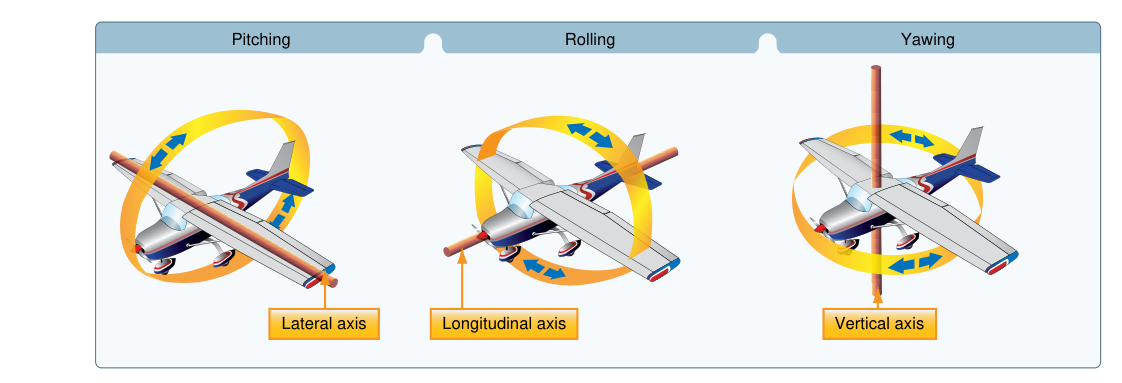
Every time you deflect a control surface on a light-sport aircraft (LSA), you are commanding the airplane to rotate around one of three imaginary reference lines that intersect at the center of gravity (CG). These lines—the longitudinal axis, the lateral axis, and the directional (vertical) axis—form the geometric framework for every discussion of flight control, stability, and aerodynamic coordination in the FAA Pilot's Handbook of Aeronautical Knowledge (PHAK, FAA-H-8083-25). Mastering the axes is not optional for sport pilots: questions about axis-control pairings, stability types, and adverse yaw appear consistently on the FAA Sport Pilot Airman Knowledge Test, and the concepts are directly applied every time you take the controls.
The Three Axes Defined
Longitudinal Axis — Roll
The longitudinal axis passes through the aircraft from nose to tail, directly through the CG. Rotation around this axis is called roll, and it is commanded by the ailerons. When you move the control stick or yoke to the right, the right aileron deflects upward (reducing camber and lift on the right wing) while the left aileron deflects downward (increasing camber and lift), causing the aircraft to roll to the right. The stability quality that resists unwanted roll and tends to return the aircraft to wings-level after a disturbance is called lateral stability—a somewhat counterintuitive name because lateral stability is the stability about the longitudinal axis, not about the lateral axis.
The primary design feature that provides lateral stability in most LSAs is dihedral—the upward angle of the wings relative to the horizontal. When a gust rolls one wing down, the low wing meets the relative wind at a higher effective angle of attack than the high wing, generating more lift and creating a restoring roll moment back toward level flight. Many LSAs also benefit from wing sweep and high-wing placement (which lowers the CG relative to the lift vector), both of which contribute additional lateral stability.
Lateral Axis — Pitch
The lateral axis runs wingtip-to-wingtip through the CG. Rotation around this axis is called pitch, and it is controlled by the elevator or, on aircraft with a one-piece movable horizontal tail, the stabilator. Pulling back on the controls raises the elevator, increasing the downward force on the tail and rotating the nose upward around the lateral axis; pushing forward does the opposite.
Stability about the lateral axis is called longitudinal stability—again, a name that trips up many students. A properly designed LSA is positively longitudinally stable: if turbulence pitches the nose up, the aircraft slows, the horizontal tail's restoring moment exceeds the wing's destabilizing moment, and the nose drops back toward the trimmed attitude without pilot input. The horizontal stabilizer acts as a tail-heavy counterweight. CG position is critical here: a CG too far aft reduces or eliminates this restoring moment, while a CG too far forward increases stability but requires more elevator authority to rotate, potentially making the aircraft difficult to flare.
Directional (Vertical) Axis — Yaw
The directional axis—also called the vertical axis—runs from the top of the aircraft to the bottom through the CG. Rotation around this axis is called yaw, and it is controlled by the rudder. Stability about this axis is called directional stability, sometimes described informally as weathervane stability because the large surface area of the vertical fin and rudder acts exactly like a weathervane: if the nose swings to one side of the relative wind, the greater aerodynamic force on the fin pushes the tail downwind and aligns the nose back into the relative wind. The size and moment arm of the vertical fin are the primary design variables controlling directional stability in an LSA.
Static and Dynamic Stability
The PHAK distinguishes two layers of stability that apply to all three axes, and both are tested on the knowledge exam.
Static stability describes the aircraft's initial tendency immediately after a disturbance. A positively statically stable aircraft will begin moving back toward its original attitude as soon as the disturbing force is removed. A neutrally statically stable aircraft will simply stay wherever it ends up. A negatively statically stable aircraft will continue to diverge away from the original attitude, demanding immediate pilot correction.
Dynamic stability describes the aircraft's long-term behavior—whether the oscillations produced after a disturbance damp out over time, remain constant, or grow larger. An aircraft can be positively statically stable (it initially tries to return to equilibrium) yet dynamically unstable (each oscillation is larger than the last). Most LSAs are designed to be positively stable in both the static and dynamic sense for all three axes, keeping workload appropriate for the sport pilot certificate.
The Phugoid Oscillation
A classic example of the static-dynamic distinction is the phugoid oscillation—a long, slow, porpoising pitch cycle that can last tens of seconds per cycle. The aircraft is statically stable (it keeps trying to return to the trimmed airspeed), but the dynamic damping is weak, so the nose-high/nose-low cycle continues for many repetitions before dying out. Recognizing a phugoid and understanding why it occurs—an exchange between kinetic energy (airspeed) and potential energy (altitude) at roughly constant angle of attack—is the kind of depth the FAA expects beyond simple axis memorization.
Adverse Yaw and Coordinated Flight
One of the most practically important interactions among the three axes is adverse yaw. When you roll into a turn by deflecting the ailerons, the down-going aileron on the rising wing increases drag more than the up-going aileron on the descending wing, momentarily yawing the nose away from the intended turn direction. This yaw occurs around the directional axis while the pilot's primary input was around the longitudinal axis—demonstrating that all three axes interact simultaneously in real flight. The corrective technique is to apply coordinated rudder in the direction of the turn at the same moment the aileron input is made, keeping the ball in the inclinometer centered and producing a smooth, skid-free turn entry.
LSAs are particularly susceptible to adverse yaw because of their light wing loading and responsive ailerons. Many LSA designs incorporate differential ailerons—the down aileron travels through a smaller arc than the up aileron—to reduce adverse yaw mechanically and lower the amount of coordinating rudder required.
Key Numbers and Rules
- CG forward limit: Increases longitudinal stability and stall speed; reduces elevator effectiveness for the flare — always verify the loading is within the POH envelope.
- CG aft limit: Reduces longitudinal stability; can produce a dangerous condition in which the aircraft diverges in pitch with little or no restoring moment.
- Dihedral angle: Provides lateral (roll) stability, not directional (yaw) stability — a common exam distractor.
- Vertical fin: Primary source of directional (yaw/weathervane) stability; size and moment arm are the key design variables.
- Phugoid period: Can be a minute or more in slow aircraft; the pilot can correct it easily with minor pitch inputs, but should understand it is a normal aerodynamic behavior in a statically stable design.
Common Test Traps
- Axis name versus motion name: The lateral axis produces pitch motion; the longitudinal axis produces roll motion. These are counterintuitive to many students — visualize tilting over a wingtip-to-wingtip axle (lateral axis) to see how it tips the nose up or down.
- Lateral stability versus longitudinal stability: Lateral stability resists unwanted roll and is associated with the longitudinal axis and ailerons. Longitudinal stability resists unwanted pitch and is associated with the lateral axis and elevator. Mixing these up is one of the most common Sport Pilot exam errors.
- Dihedral does not provide directional stability: A question may credit dihedral with yaw stability. Dihedral helps with roll (lateral stability); the vertical fin provides directional stability.
- Static stable but dynamically unstable is possible: These are independent properties. Do not assume that positive static stability guarantees positive dynamic stability.
- Adverse yaw direction: The nose initially yaws away from the direction of the intended turn — opposite to what many students expect — because the rising wing's down aileron generates more induced drag.
Memory Aid
Use the acronym RPY — pronounced "RPY" like the letters — to lock in the pairings:
- Roll → longitudinal axis → ailerons → lateral stability
- Pitch → lateral axis → elevator → longitudinal stability
- Yaw → directional (vertical) axis → rudder → directional stability
Once RPY is memorized, the cross-referenced stability names follow logically: the axis that controls roll is the longitudinal axis, so roll stability is called lateral stability — named for the other axis. Apply the same logic to pitch and yaw and the naming convention becomes a system rather than a set of random facts to memorize.