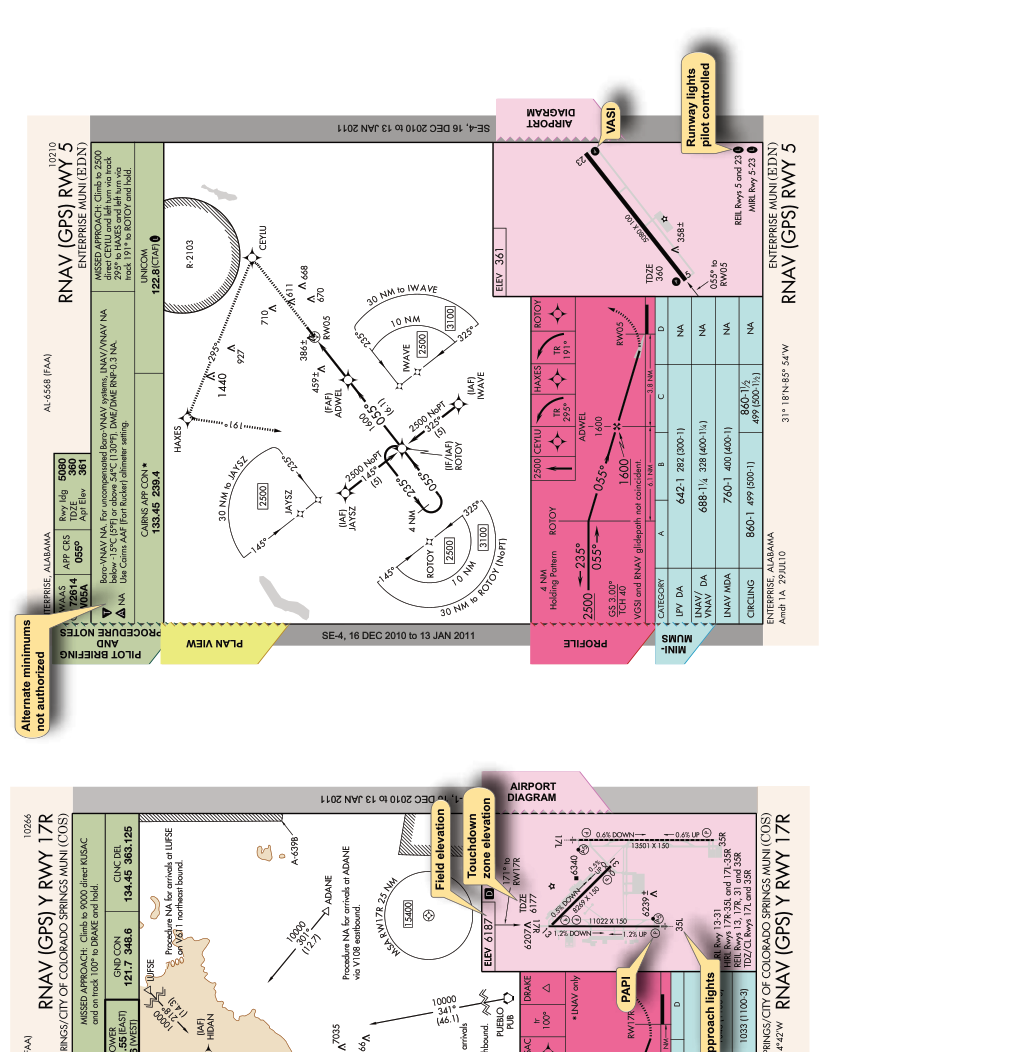
When you file an IFR flight plan and your destination is forecast to be marginal, regulations require you to name an alternate airport — a backup you can legally divert to if things go wrong. But not every airport qualifies as a legal alternate, and even those that do may impose ceiling and visibility requirements that differ significantly from the standard values most pilots memorize first. The alternate minimums printed on instrument approach charts, and the accompanying NA (Not Authorized) notation, are the FAA's formal mechanism for communicating those restrictions. Understanding them deeply will keep you legal, keep your passengers safe, and earn you correct answers on the Instrument Rating knowledge test.
This article walks through the regulatory framework, explains how to find and read alternate minimums on Jeppesen-style and FAA Terminal Procedures Publication (TPP) charts, examines when the NA notation applies, and highlights the practical planning decisions you need to make before every IFR flight.
The Regulatory Foundation
The requirement to carry an alternate appears in 14 CFR 91.169 for Part 91 operations (and in 14 CFR 121 and 135 for commercial operations, which impose even stricter rules). Under Part 91, you must file an alternate whenever the destination airport's forecast weather, from one hour before to one hour after your estimated time of arrival (the "1-2-3 rule"), is less than a ceiling of 2,000 feet or visibility of 3 statute miles. If the forecast meets or exceeds those values for that three-hour window, no alternate is required — but you may always file one voluntarily for extra margin.
Once you've determined an alternate is required, you must choose an airport that actually qualifies. That qualification is governed by the same regulation: the alternate must have an approved instrument approach procedure, and the forecast weather at the alternate must meet either the standard alternate minimums or any higher non-standard alternate minimums published for that airport.
Standard Alternate Minimums
The FAA establishes two tiers of standard alternate minimums based on approach type:
- Precision approach (ILS, GLS, PAR): Ceiling 600 feet and visibility 2 statute miles.
- Non-precision approach (VOR, LOC, NDB, RNAV/GPS without vertical guidance): Ceiling 800 feet and visibility 2 statute miles.
These numbers apply when an airport has not published non-standard alternate minimums and the approach is otherwise usable. Think of them as the FAA's baseline: if the approach is a simple VOR and nothing special has been noted, 800-2 is the floor for that airport to count as your alternate. If the only approach available is an ILS and the standard 600-2 is met in the forecast, you're legal.
It is vital to remember that these minimums apply to the forecast weather at the alternate — not the actual weather you observe during flight. You evaluate alternate legality at planning time, using the TAF (Terminal Aerodrome Forecast) for the alternate airport covering your estimated time of arrival.
Non-Standard Alternate Minimums and the Alternate Minimums Page
Many airports have unique characteristics — terrain, limited NAVAID coverage, non-standard obstacle environments, or approaches that simply aren't reliable enough for alternate use — that lead the FAA to publish higher-than-standard alternate minimums. These appear in a dedicated section of the FAA Terminal Procedures Publication called the Alternate Minimums pages (sometimes informally called the "A" pages), located at the front of each TPP volume. Jeppesen charts integrate this information differently, typically appearing on a separate alternates page or coded directly on the approach chart header.
When an airport has non-standard alternate minimums, a bold "A" symbol with a surrounding box (or similar chart notation depending on the chart provider) appears in the briefing strip of the approach chart. That symbol is your cue to flip to the alternate minimums section and read the specific requirements before using that airport as an alternate.
Non-standard alternate minimums might read something like: "ILS Rwy 28L: 900-2½" or "VOR Rwy 15: NA." In the first example, the ILS approach at that airport requires a ceiling of 900 feet and 2½ miles visibility when used for alternate planning — higher than the standard 600-2 for a precision approach. In the second example, the VOR approach to Runway 15 cannot be used for alternate planning at all.
The NA Notation: What It Really Means
The NA notation — standing for Not Authorized — is arguably the most critical marking a pilot can encounter on the alternate minimums page, yet it is frequently misunderstood. NA does not mean the approach itself is prohibited. You may still fly that approach as a destination. NA means specifically that this approach may not be used to qualify the airport as your IFR alternate for flight planning purposes.
Common reasons the FAA designates an approach as NA for alternate use include:
- No weather reporting: If the airport lacks an approved weather observation service (such as an ASOS, AWOS, or human observer), the forecast weather cannot be reliably assessed, so alternate use is prohibited.
- NAVAID limitations: The NAVAID may be unmonitored, have limited hours of operation, or have a reliability record that makes it unsuitable as a guaranteed backup.
- Procedure design constraints: Terrain, obstacles, or the geometry of the procedure may make it unsuitable for the conservative margins assumed in alternate planning.
- Part-time control tower or lighting: If pilot-controlled lighting or tower operations are required and not guaranteed available, the approach may be NA.
When an entire airport entry on the alternate minimums page reads simply "NA" with no specific approach breakdown, it means no approach at that airport may be used to qualify it as an alternate under IFR. You must choose a different alternate airport entirely.
Applying This in Flight Planning
A practical alternate planning workflow looks like this: First, check whether the 1-2-3 rule requires you to file an alternate at all. If it does, identify candidate alternate airports. For each candidate, pull up the approach chart and look for the boxed "A" notation in the briefing strip. If present, go to the alternate minimums page. Read the specific ceiling and visibility requirements for each approach listed. Compare those requirements against the TAF for that airport during your estimated arrival window. If the TAF meets or exceeds those values — and the approach is not marked NA — the airport qualifies.
If no boxed "A" appears on the approach chart, apply the standard alternate minimums (600-2 for precision, 800-2 for non-precision) directly. This is a legal shortcut: absence of the special notation means the standard values govern.
Remember also that qualifying an alternate legally is a minimum standard. Sound aeronautical decision-making (ADM) often demands you pick an alternate with considerably better forecast weather and a robust approach procedure, not just one that barely clears the legal threshold.
Key Numbers and Rules
- 1-2-3 rule (destination): Alternate required if forecast ceiling is below 2,000 feet OR visibility below 3 SM during the period from 1 hour before to 1 hour after ETA.
- Standard alternate minimums — precision approach: Ceiling 600 feet, visibility 2 SM.
- Standard alternate minimums — non-precision approach: Ceiling 800 feet, visibility 2 SM.
- Non-standard minimums: Found on the Alternate Minimums page; triggered by the boxed "A" on the approach chart briefing strip.
- NA: That specific approach (or entire airport) cannot be used for alternate qualification — not a prohibition on flying the approach to a destination.
- Weather source for alternates: TAF, evaluated for the estimated arrival time at the alternate.
- Part 91 vs. Part 121/135: Commercial operations apply stricter alternate rules; Part 91 pilots use 91.169 minimums.
Common Test Traps
- Confusing NA with "approach prohibited": NA applies only to alternate planning. The approach itself may still be flown to a destination. Many students incorrectly conclude an NA approach cannot be flown at all.
- Forgetting the boxed A lookup: Applying the standard 600-2 or 800-2 values to an airport that actually has higher non-standard minimums is a planning error — and a frequent test question. Always check for the special notation.
- Mixing up destination and alternate minimums: The 1-2-3 rule uses 2,000 feet and 3 SM for determining whether an alternate is required at the destination. These numbers have nothing to do with what the alternate itself requires.
- Using actual weather instead of forecast: Alternate legality is evaluated on forecast weather (TAF) at the alternate, not actual conditions at the time of planning or flight.
- Assuming no notation means no restriction: If an airport has no entry at all on the alternate minimums page, the standard values apply. But if there is an entry and it says NA, that distinction is critical — do not skim past it.
Mastering alternate minimums and the NA notation reflects exactly the kind of disciplined, chart-literate thinking the IFR system demands. These rules exist because an alternate is your safety net — and a safety net that looks good on paper but fails in the air is no safety net at all. Study the alternate minimums pages of your TPP as carefully as the approach plates themselves, and your IFR flight planning will be both legal and genuinely safe.