When an aeronautical engineer draws the outline of a wing as seen from above, that outline—the planform—determines far more than aesthetics. It governs the spanwise distribution of lift, the location where flow separation begins during a stall, the degree of aileron authority available at low speed, and whether the aircraft's nose will drop or pitch upward when the stall arrives. For the commercial pilot candidate, this is not abstract theory. Every transition to a new aircraft type, every low-speed maneuvering decision, and every spin-avoidance judgment is shaped by how that aircraft's wing planform behaves at and beyond the critical angle of attack. The Pilot's Handbook of Aeronautical Knowledge (PHAK, FAA-H-8083-25) treats planform effects as a core advanced aerodynamics topic, and the FAA Commercial Pilot Airman Certification Standards explicitly tests the ability to explain and apply these principles.
The Aerodynamic Foundation: Local Angle of Attack and Spanwise Loading
To understand planform effects, start with the concept of local angle of attack. Every station along the span—root, mid-span, tip—experiences a slightly different effective angle of attack based on the local chord length, the induced downwash from the trailing vortex system, and any geometric or aerodynamic twist built into the wing. A stall begins wherever the local angle of attack first exceeds the critical value; that location is entirely a function of planform geometry and any intentional twist the designer has added.
Equally important is the concept of spanwise lift distribution. Induced drag is minimized when lift is distributed elliptically across the span—high in the middle, tapering smoothly to zero at both tips. How closely a given planform approximates that ideal ellipse determines its aerodynamic efficiency, but it also determines the stall character. The two goals—efficiency and benign stall behavior—are often in tension, and understanding that tension is the heart of this topic.
Rectangular Wings: The Forgiving Trainer Standard
A rectangular wing maintains a constant chord from root to tip. This geometry causes the root section to carry a disproportionately high local lift coefficient because induced downwash is greatest at the tips, raising the effective angle of attack at the root relative to the tip. The practical result is that the root reaches the critical angle of attack first, and the stall propagates spanwise outward toward the tips.
This progression is enormously favorable for pilot control and warning. As the root separates, turbulent wake strikes the horizontal stabilizer and produces a buffet the pilot can feel through the airframe. More critically, the ailerons—mounted outboard near the tips—remain in attached, unseparated flow and retain full effectiveness throughout the initial stall. The pilot can roll level even as the stall develops, and recovery is straightforward. This is precisely why virtually every primary trainer uses a rectangular or near-rectangular planform.
The tradeoff is efficiency. A rectangular wing's lift distribution is far from elliptical, which means higher induced drag at any given lift coefficient. For a low-speed trainer, that is an acceptable compromise. For a high-performance aircraft, it is not.
Tapered Wings: Balancing Efficiency Against Tip-Stall Risk
A tapered wing narrows from root to tip, expressed numerically as the taper ratio—the ratio of tip chord to root chord. A taper ratio of 1.0 is rectangular; 0.0 is a pure delta; most general aviation and transport wings fall between 0.3 and 0.6. As taper increases (the ratio decreases), the local lift loading shifts progressively outboard. The tips carry more of the total lift, and their local angle of attack rises relative to the root.
A moderate taper ratio (roughly 0.4–0.5) achieves a spanwise lift distribution that closely approaches the elliptical ideal, yielding low induced drag with only a modest increase in tip-stall tendency. Designers manage this tendency through washout—geometric twist that reduces the tip's angle of incidence by two to four degrees relative to the root—or through aerodynamic changes such as increased camber near the tip, leading-edge slots, or stall strips near the root to trigger root separation first.
A high taper ratio (tip chord very small compared to root) produces dangerous tip-stall characteristics. The tips separate before the root, the ailerons become ineffective at the worst possible moment, and the stall may be abrupt and asymmetric. High taper requires aggressive design mitigation, and its stall behavior demands precise airspeed discipline from the pilot.
Elliptical Wings: Aerodynamic Perfection With a Hidden Cost
The elliptical planform—chord length varying as an elliptical function from root to tip—produces the theoretically perfect spanwise lift distribution. Induced downwash is constant across the entire span, induced drag is minimized for a given span and lift, and the local angle of attack is essentially uniform everywhere. This is the aerodynamic ideal described in classical wing theory and in the PHAK's discussion of induced drag.
The hidden cost surfaces at the stall. Because every spanwise station reaches the critical angle of attack at virtually the same moment, the entire wing stalls nearly simultaneously. There is no gradual root-to-tip progression, no early buffet from root separation, and no reservoir of attached flow near the tips to preserve aileron authority. The stall is abrupt and the loss of lateral control is immediate. The elliptical wing also presents formidable manufacturing challenges: every rib has a different shape, making production costly and time-consuming. The Supermarine Spitfire remains the iconic example—brilliant aerodynamic performance, exceptional efficiency, but an unforgiving stall. Modern designers instead use tapered wings with washout to approximate elliptical lift distribution while retaining acceptable stall behavior.
Swept Wings: Spanwise Flow and the Pitch-Up Trap
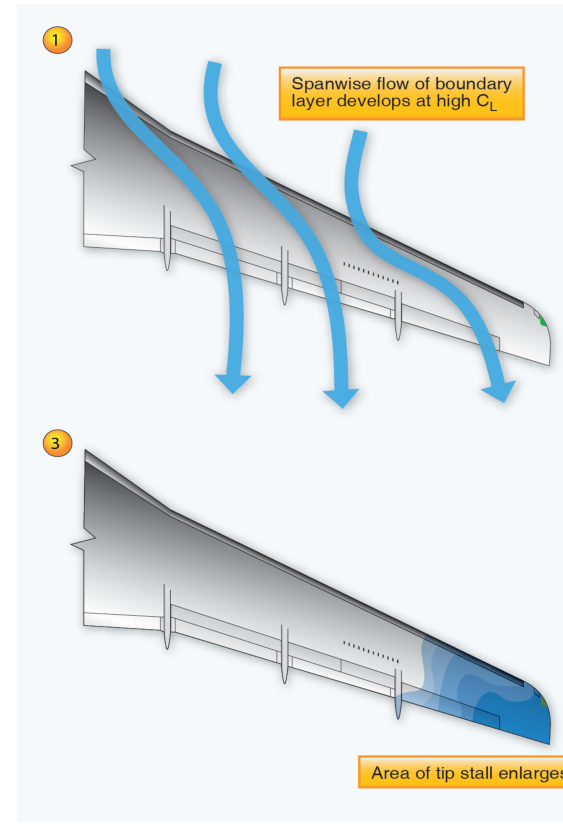
Sweep introduces a component of airflow directed spanwise—from root toward tip—along the upper wing surface. This spanwise flow carries low-energy boundary-layer air outboard, thickening it and making the tips the most likely location for early separation. The result is an accelerated tip-stall tendency that in many respects is more dangerous than that produced by a highly tapered wing.
When tip flow separates first on a swept wing, the effective center of pressure—the spanwise centroid of remaining lift—shifts inboard and forward. This forward shift of the lift vector produces a pitch-up moment: the nose rotates upward, increasing the angle of attack and deepening the stall rather than providing the nose-drop recovery cue that a rectangular wing delivers. This self-reinforcing pitch-up is specifically called out in FAA advanced aerodynamics material and is a common focus of commercial-level knowledge test questions.
Engineers counter the swept-wing tip-stall tendency with several tools: washout reduces the tip's incidence; leading-edge devices such as slats or Krueger flaps increase tip camber and delay local separation; vortex generators energize the boundary layer and delay separation; boundary-layer fences block spanwise flow migration; and wing contouring (twist distribution and airfoil section changes) tailors the local lift curve across the span. Understanding why these devices exist reinforces the underlying aerodynamics rather than treating them as arbitrary engineering choices.
Comparing the Four Planforms: Key Numbers and Design Rules
- Rectangular (taper ratio = 1.0): Stalls root-first; best aileron retention and buffet warning; highest induced drag for a given span; standard for trainers.
- Tapered (taper ratio ≈ 0.4–0.5): Near-elliptical efficiency; moderate tip-stall tendency managed by 2–4° of washout; used on most single-engine and light twin GA aircraft.
- Elliptical (variable chord): Minimum induced drag; nearly simultaneous span stall; abrupt loss of lateral control; manufacturing complexity limits modern use.
- Swept (sweep angle typically 15–45° in GA/transport designs): Spanwise flow causes tip stall; pitch-up moment on stall entry; requires leading-edge devices, washout, or vortex generators for acceptable behavior.
- Washout: Typically 2–4° geometric twist, root higher incidence than tip; universally applied to tapered and swept designs to bias the stall toward the root.
Common Test Traps for the Commercial Knowledge Examination
- Efficiency ≠ Safety at the stall. The elliptical planform is the most aerodynamically efficient and the least forgiving at the stall. The rectangular planform is the least efficient and the most forgiving. Do not confuse the two qualities.
- Tapered wings are not inherently dangerous. Moderate taper with appropriate washout is the industry standard—the danger arises only with high taper ratios and inadequate design mitigation.
- Swept wings pitch up, not down. Unlike a rectangular wing, which drops its nose and signals recovery, a swept wing's tip stall shifts lift forward and commands a deeper stall. This pitch-up is specifically tested at the commercial level.
- Aileron authority is the critical variable. Any planform that stalls tip-first—high taper, elliptical, or swept—compromises lateral control at the exact moment low-speed margins are smallest. Washout and leading-edge devices exist to restore that margin.
- Washout reduces tip angle of incidence—not tip dihedral. Geometric twist is a chordwise change, not a spanwise one; do not confuse washout with dihedral or anhedral effects on stability.
Memory Aid
"Roots First, Tips Trouble, Everywhere Abrupt, Swept Sneaks Up" — Rectangular wings stall at the roots first (safest, ailerons survive); tapered or elliptical wings push the stall toward the tips (trouble for lateral control); elliptical wings stall everywhere at once (abrupt, no warning); swept wings let the tip stall and the nose sneaks up (pitch-up deepens the stall).
The In-the-Cockpit Significance
A commercial pilot operates across a wider performance envelope than a private pilot and routinely transitions to aircraft with tapered or moderately swept wings. Recognizing that the stall characteristics described in the aircraft's Pilot's Operating Handbook—the airspeeds, the control response, the recovery technique—are direct consequences of the planform explains why those numbers and procedures are non-negotiable. An aircraft with a highly tapered wing may demonstrate aileron sluggishness near the stall long before the stall warning activates; a swept-wing aircraft may pitch up with little warning if penetrated well below maneuvering speed in turbulence. The FAA Risk Management Handbook (FAA-H-8083-2) emphasizes that genuine aeronautical decision-making rests on understanding actual aircraft behavior, not merely memorizing V-speeds. Wing planform knowledge is a foundational element of that understanding.