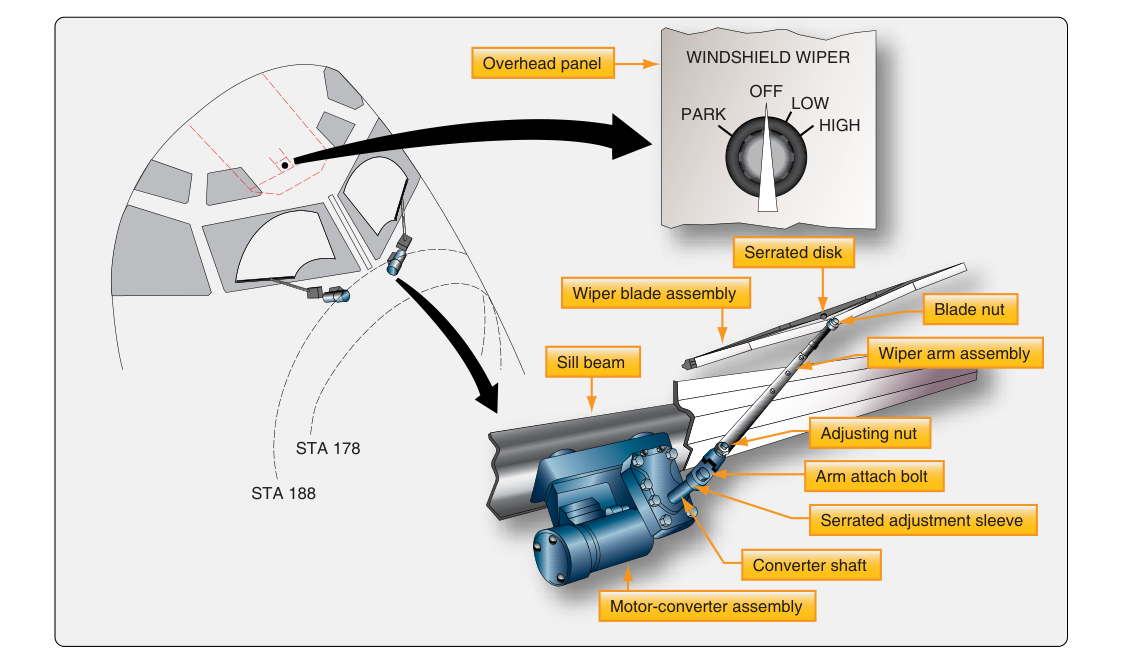
Windshield wiper systems on aircraft serve the same fundamental purpose as those on ground vehicles — keeping the pilot's forward field of view clear during rain — but the engineering demands are far more stringent. At cruise speeds even a light aircraft can encounter rain hard enough to blur vision entirely, and a wiper blade that skips, chatters, or parks in the wrong position can be as dangerous as having no wiper at all. Understanding how these systems work, how to maintain them correctly, and how to rig them precisely is essential knowledge for every airframe technician and a consistently tested subject on the FAA AMT Airframe knowledge exam.
Most transport-category and many general aviation aircraft use either electric motor-driven or pneumatic (air-driven) wiper systems. Electric systems dominate modern light aircraft and many regional airliners; pneumatic systems, often using engine-driven vacuum pumps rather than bleed air, were historically used on some piston and early turbine aircraft and are generally considered an older, less common technology. Regardless of the drive source, the mechanical principles of rigging and blade care are largely the same.
How the System Works
An electric windshield wiper system consists of a reversible DC motor (or sometimes a permanent-magnet motor with an internal gear-driven reversing mechanism), a transmission or converter assembly, a wiper arm, and a blade with a rubber squeegee element. The motor converts electrical energy into a reciprocating arc motion. A park switch built into the motor or converter assembly ensures the blade returns to its stowed (park) position when the system is turned off, preventing the blade from stopping mid-arc where it could obstruct vision or be damaged by wind loads in flight.
Pneumatic wiper systems use regulated engine bleed air or dedicated compressed air to drive a rotary air motor. The air motor output is converted to the familiar back-and-forth arc by a crank and linkage assembly. Because bleed-air pressure varies with engine power setting and altitude, pneumatic systems typically include a pressure regulator to maintain consistent wiper speed regardless of throttle position.
The wiper arm connects the output shaft of the converter or drive unit to the blade assembly. The arm applies a controlled spring tension — typically measured in ounces or newtons — against the windshield glass. This spring tension is critical: too little and the blade lifts off at speed and fails to clear water; too much and the blade drags excessively, causing squeegee wear and scratching the glass. The arm pivots on a splined or keyed output shaft, and the angular position of that attachment point is the heart of the rigging process.
The blade assembly consists of a metal or composite superstructure (the reflex frame or vertebrae) and the rubber squeegee element. Modern blades are contoured to maintain even pressure along their entire length, which is crucial because uneven pressure produces streaks. The squeegee element is consumable and must be replaced on a regular basis or whenever it shows cuts, tears, hardening, or deformation.
Maintenance Procedures
Routine wiper system maintenance centers on three areas: the squeegee element, the wiper arm spring tension, and the drive unit inspection.
Squeegee inspection and replacement should follow the aircraft manufacturer's maintenance manual interval, but technicians should also inspect blades any time a pilot reports streaking, skipping, or chattering. A serviceable squeegee has a clean, sharp wiping edge free of nicks, embedded grit, hardened spots, or permanent bends. Rubber degrades from ultraviolet exposure and ozone even when the aircraft sits in a dry hangar, so age-based replacement is appropriate regardless of apparent condition. Always use the manufacturer-approved replacement element — blade geometry is matched to the arm and windshield curvature, and a wrong-profile blade will streak no matter how well it is rigged.
When cleaning wiper blades during a preflight or maintenance inspection, use only clean water or an approved windshield cleaning solution. Petroleum-based solvents, MEK, acetone, and many general-purpose cleaners will swell or harden rubber squeegees and can craze plastic windshields — a double hazard that can destroy an expensive transparency in seconds.
Wiper arm spring tension is measured with a small spring scale or tension gauge positioned at the tip of the blade, perpendicular to the glass surface. The aircraft maintenance manual specifies the acceptable range, and technicians must always obtain the exact tension value from that manual rather than relying on a generic figure, since acceptable spring tension is aircraft-specific and varies by airframe and blade design. If tension is below minimum, the blade lifts at speed. If tension is above maximum, expect accelerated squeegee wear and possible glass scratching. Most arms have an adjustable tension spring, and adjustment is straightforward once the correct specification is located in the maintenance manual.
Drive unit inspection includes checking the motor or air motor for secure mounting, inspecting all linkage attachment points for looseness or wear, and verifying that pivot bearings move freely without binding. On electric systems, verify that electrical connectors are clean, tight, and properly supported to prevent chafing. On pneumatic systems, check the supply and exhaust lines for security, condition of the fittings, and freedom from kinks.
Rigging the Wiper System
Rigging is the process of setting the correct arc of travel and the park position of the blade. Improper rigging is one of the most common wiper-related write-ups and one of the easiest to prevent if the technician follows the maintenance manual systematically.
The park position is where the blade rests when the system is off. This position must place the blade entirely below the pilot's critical field of view, usually near the bottom edge of the windshield. If the park position is set too high, the blade obstructs vision. If set too low, the blade may contact the windshield frame or cowling structure during operation, causing immediate damage to the blade and potential damage to the aircraft structure.
To set the park position, the arm is loosened on its output shaft spline or keyway, the wiper motor is energized until the park switch stops the output shaft in its park detent, and then the arm is physically positioned on the shaft so the blade rests in the correct location. The arm attachment fastener is then torqued to specification. This sequence is critical: the shaft must be in its park position before the arm is attached, or every arc of travel will be offset by the error.
The arc of travel must sweep the area of the windshield specified in the aircraft type design. On most aircraft this is the entire width of the captain's or pilot's primary view area. The blade must not travel so far that it runs off the glass on either end of the arc — a blade that contacts the windshield seal or frame will quickly destroy both the blade and the seal. After rigging, cycle the system through several complete arcs on a wet windshield (never run wipers dry on any windshield) and observe that the blade tracks smoothly and returns to park correctly every time the system is shut off.
Why It Matters
A malfunctioning or incorrectly rigged wiper system can directly compromise safety of flight by reducing the pilot's ability to see and avoid terrain, obstacles, or other aircraft during rain. Beyond the obvious visibility concern, a blade that chatters, skips, or is run dry can scratch and degrade the windshield surface and accelerate wear of the squeegee edge. Keeping wiper systems correctly maintained is therefore not just a comfort item — it is a protection measure for the windshield surface itself.
Key Numbers and Rules
- Never run wipers on a dry windshield. Running blades dry scratches the windshield surface and rapidly degrades the squeegee edge, even for a brief test cycle.
- Spring tension must match the maintenance manual specification — measured at the blade tip perpendicular to the glass with an appropriate spring scale. Values are aircraft-specific; always consult the manufacturer's maintenance manual rather than a generic figure.
- Park position is set with the output shaft in its park detent, then the arm is installed and torqued; never adjust arm position while the shaft is in an arbitrary mid-arc position.
- Approved cleaning agents only. Petroleum solvents and many common cleaners damage both rubber squeegees and plastic windshields.
- Blade replacement is condition- and age-based; UV and ozone degradation occur even with zero operating hours.
- Verify arc limits — the blade must not contact the windshield frame, seal, or cowling at either end of its sweep.
Common Test Traps
- Running wipers dry for a quick operational check is never acceptable, even momentarily. FAA test questions may frame this as a time-saving shortcut; the correct answer is always to wet the windshield first.
- Setting park position without placing the motor shaft in the park detent first is the leading rigging error. Students sometimes think they can install the arm in the desired position at any point in the motor's cycle — this is wrong and will offset every subsequent arc of travel.
- Confusing arm spring tension with blade-to-glass contact pressure: pressure is the result of spring tension acting through the arm geometry; the specification in the maintenance manual is usually given as a force measured at a specific point (blade tip), not as a spring preload.
- Using any available rubber or blade from a different aircraft type to replace a worn squeegee is not acceptable; blade profile, length, and pressure distribution are aircraft-specific and must match the approved part.
- Assuming a pneumatic wiper system requires no pressure regulation: bleed-air pressure varies with power and altitude, so a pressure regulator is a required component; removing or bypassing it will cause erratic wiper speed and possible over-speed damage to the air motor.