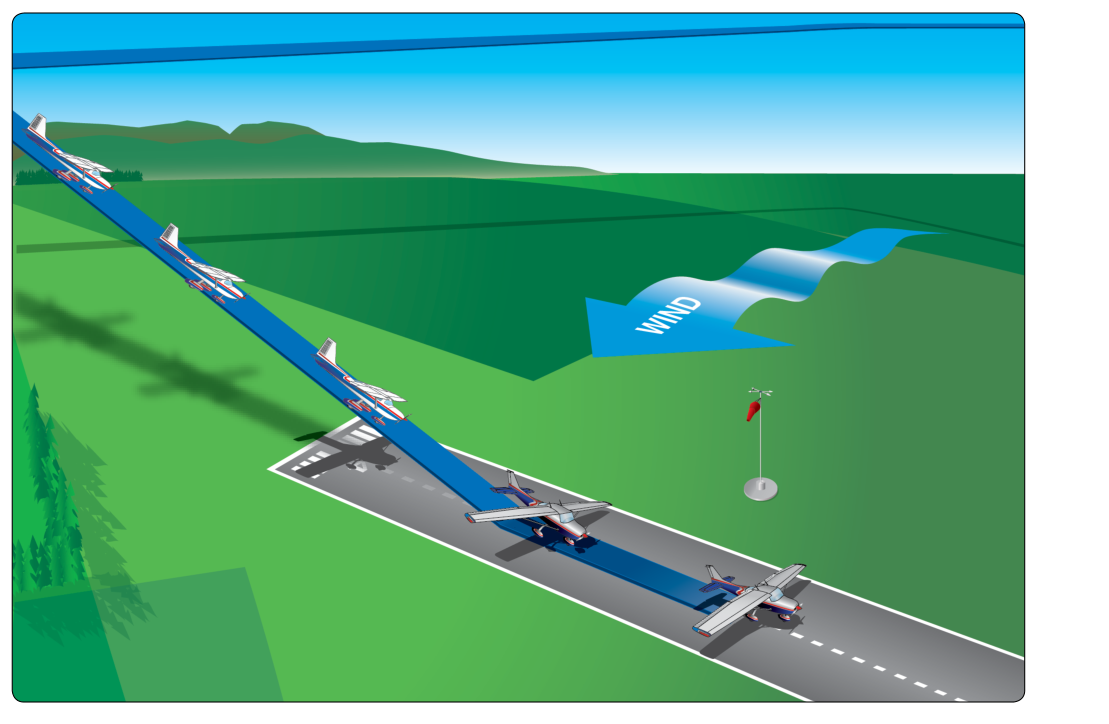
Crosswind operations are among the most demanding skills tested at the commercial pilot level. While private pilots learn the basics of crabbing and side-slipping, the commercial standard demands a higher degree of precision: consistent runway centerline tracking, smooth control coordination, and a touchdown that is aligned with the runway heading with minimal side drift. Understanding the aerodynamics behind these techniques — not just the mechanics — is what separates a commercial applicant from a recreational flyer.
There are two accepted crosswind correction methods, and most commercial applicants must be fluent in both. The crab method involves pointing the nose into the wind during the approach so the ground track remains aligned with the runway centerline. This method is efficient and reduces structural stress, but the aircraft must be straightened just before touchdown to avoid landing with side load on the gear. The side-slip (wing-low) method uses aileron into the wind to bank the upwind wing down while applying opposite (downwind) rudder to keep the fuselage aligned with the runway. Many commercial pilots use a combination technique: crab during most of the approach to maintain track efficiently, then transition to a side-slip just before flare to ensure the aircraft touches down aligned with the centerline.
Why it matters
Landing with side drift at commercial weights and speeds places significant lateral stress on the landing gear and can lead to loss of directional control, a tire blowout, or a runway excursion. The Airplane Flying Handbook (FAA-H-8083-3) emphasizes that the upwind main wheel should touch first in a side-slip crosswind landing, followed by the downwind main wheel, and then the nose wheel. This sequence minimizes side-loading and keeps the aircraft tracking straight down the centerline after touchdown. Maintaining directional control through the rollout — using rudder and aileron into the wind — is just as critical as the landing itself, since crosswind effects persist until the aircraft decelerates.
During a crosswind takeoff, the technique is the mirror image of the landing. Full aileron deflection into the wind is applied at the start of the roll, then gradually reduced as airspeed increases and the control surfaces become more effective. Lifting off at a slightly higher-than-normal airspeed helps prevent the aircraft from becoming airborne prematurely and drifting sideways. Once airborne, a crab into the wind is established immediately to track the runway extended centerline. The Airplane Flying Handbook notes that in strong crosswinds, allowing the upwind wing to rise during the takeoff roll can cause the downwind wing to contact the runway — a serious hazard that demands early, proactive aileron input.
Memory aid
For the crosswind landing sequence, think: "Aileron into wind, opposite rudder, upwind wheel first." This three-part reminder covers the control inputs and the correct touchdown sequence. Some instructors also use "Bank and Yank" informally to describe the aileron-then-rudder coordination, though the correct term is simply a side-slip. For takeoff, remember: full aileron at the start, reduce as you accelerate — sometimes recalled as "Full then fade."
Common test traps
- Forgetting aileron after touchdown: The crosswind does not stop at the moment of landing. The aileron must continue to be held into the wind throughout the entire rollout to prevent the upwind wing from lifting.
- Confusing crab vs. side-slip touchdown: The FAA knowledge test may ask which technique requires straightening the aircraft just before touchdown — that is the crab method. The side-slip keeps the aircraft aligned throughout the approach, so no last-second correction is needed.
- Upwind wheel contact: The correct sequence for a side-slip crosswind landing is upwind main wheel first, then downwind main wheel, then nose wheel. A common distractor answer reverses this order.
- Demonstrated vs. maximum crosswind component: The POH lists a demonstrated crosswind component, not a regulatory maximum. The FAA does not establish a maximum crosswind limit by regulation for most GA aircraft; the demonstrated value is a test condition, not an absolute ceiling, though exceeding it is inadvisable without thorough experience and judgment.