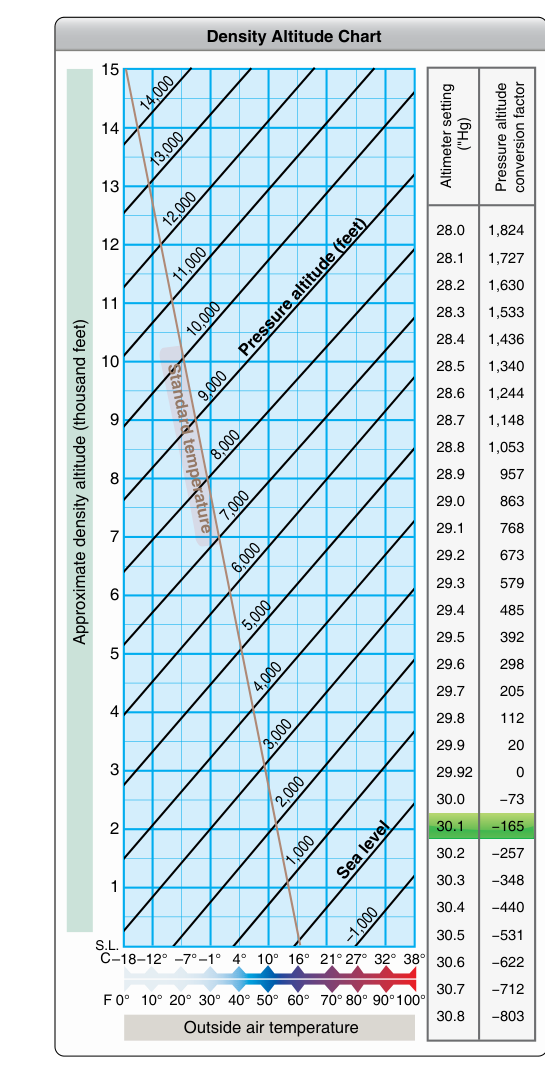
Density altitude is one of the most operationally critical concepts a commercial pilot must master, because it translates the abstract idea of atmospheric thinning into concrete, measurable reductions in aircraft performance. The Pilot's Handbook of Aeronautical Knowledge (PHAK, FAA-H-8083-25) defines density altitude as pressure altitude corrected for non-standard temperature. In practical terms, it represents the altitude in the International Standard Atmosphere (ISA) at which the prevailing air density would be found. When density altitude is high, the airplane performs as though it is operating at that higher altitude — even if the runway is at a comparatively modest field elevation.
Understanding density altitude is not merely an academic exercise. Commercial pilots routinely operate heavier airplanes from shorter runways at higher gross weights, leaving far smaller performance margins than a student pilot faces. A thorough grasp of what drives density altitude, how it degrades performance, and how to plan around it is essential both for the FAA Commercial Pilot Airplane Knowledge Test and, more importantly, for safe flight operations.
What Creates High Density Altitude
Air density is governed by three interrelated atmospheric variables: pressure, temperature, and humidity. The ISA defines standard conditions as 29.92 in Hg of pressure, 15 °C at sea level, with temperature decreasing approximately 2 °C per 1,000 feet. Any departure from these standards that reduces air density will raise density altitude.
- Elevation and pressure altitude: As field elevation increases, atmospheric pressure decreases and air molecules spread further apart. Pressure altitude — the altimeter reading when 29.92 in Hg is set — quantifies this. A field at 5,000 feet MSL already starts with substantially thinner air than a sea-level airport.
- Temperature above ISA standard: Heat causes air molecules to expand and separate. For every 1 °C above the standard temperature at a given pressure altitude, density altitude rises approximately 120 feet above pressure altitude. On a 35 °C (95 °F) afternoon at a 5,000-foot field where standard temperature would be 5 °C, the temperature deviation is +30 °C — adding roughly 3,600 feet to the pressure altitude, yielding a density altitude near 8,600 feet. The aircraft is performing as if it were almost 9,000 feet in the air while sitting on a 5,000-foot runway.
- Humidity: Water vapor (H₂O, molecular weight ≈ 18) is lighter than dry air (average molecular weight ≈ 29). High relative humidity therefore displaces heavier nitrogen and oxygen molecules, reducing overall air density. The PHAK acknowledges this effect, noting it is real but smaller in magnitude than temperature and elevation effects; it is nonetheless additive and should not be ignored during hot, humid summer conditions.
The Three-Pronged Attack on Takeoff Performance
High density altitude simultaneously degrades three distinct physical mechanisms that a propeller-driven airplane relies upon for takeoff acceleration and climb. Commercial pilot candidates must be able to explain each separately.
1. Engine Power Loss
A normally aspirated (non-turbocharged) piston engine is essentially an air pump. Power output depends on the mass of oxygen-fuel mixture that can be burned each power stroke. Thinner air contains fewer oxygen molecules per unit volume, so less fuel can be efficiently burned, and brake horsepower decreases. A frequently cited rule of thumb, consistent with performance data in typical POH documents, is that a normally aspirated engine loses approximately 3% of its rated sea-level power for every 1,000 feet of density altitude. At a density altitude of 8,000 feet, that represents roughly a 24% power deficit before the pilot even releases the brakes. A 300-hp engine is now producing closer to 228 hp — a significant reduction in the energy available to accelerate the aircraft.
2. Propeller Thrust Reduction
A propeller is a rotating airfoil system that accelerates a mass of air rearward to produce thrust. Thrust is proportional to the mass flow of air through the propeller disk multiplied by the velocity increase imparted to it. In thinner air, even at the same RPM, the propeller moves less air mass per revolution, and thrust output drops accordingly. A fixed-pitch propeller compounds this problem: it is designed for optimum efficiency at a specific density, and at high density altitude it may also be operating at a less favorable blade angle of attack relative to the reduced inflow velocity. The net result is reduced forward force during the takeoff roll and during the subsequent climb.
3. Aerodynamic Lift Reduction and Longer Ground Roll
Lift is defined by the lift equation: L = ½ρV²SC_L, where ρ is air density. At lower air density, achieving the same lift force requires a higher velocity (V). Because the airspeed indicator measures dynamic pressure (½ρV²) and is calibrated to sea-level standard density, it reads indicated airspeed — not true airspeed. The aircraft will always lift off at roughly the same indicated airspeed as specified in the POH, regardless of density altitude. However, at high density altitude the true airspeed at rotation is significantly higher than the indicated airspeed, meaning the aircraft must attain a higher actual ground speed before it can fly. This longer ground acceleration, combined with reduced engine and propeller output, produces dramatically extended takeoff roll distances. Takeoff distance can increase 50% or more compared to standard sea-level performance, and obstacle clearance performance degrades proportionally.
Climb Performance Degradation
Once airborne, density altitude continues to extract a penalty. Both rate of climb (feet per minute) and climb gradient (feet gained per horizontal distance) decrease. Rate of climb depends on excess thrust horsepower — the power available above that required for level flight. As density altitude rises, power available decreases while power required stays relatively constant in indicated airspeed terms, squeezing the excess power margin. The result can be a climb rate that is entirely inadequate to clear rising terrain or obstacles beyond the departure end of the runway. The PHAK and the Airplane Flying Handbook (FAA-H-8083-3) both emphasize using the POH performance charts to determine actual climb performance under prevailing density altitude conditions, not relying on memory or standard-day figures.
Turbocharged and Turbine Engines
Turbocharging partially addresses the engine-power component of the density altitude problem. A turbocharged engine uses exhaust-driven compressors to pressurize intake air, maintaining sea-level manifold pressure up to the engine's critical altitude — the altitude above which the turbocharger can no longer maintain rated manifold pressure. Below the critical altitude, a turbocharged engine can produce near-rated power output. Above it, power falls off similarly to a normally aspirated engine. Critically, even a turbocharged engine does not overcome propeller efficiency losses or aerodynamic lift losses at high density altitude; those performance penalties still apply regardless of engine type.
Key Numbers and Rules to Know
- Standard lapse rate: approximately 2 °C per 1,000 feet of altitude.
- Density altitude increase for temperature above standard: approximately 120 feet per 1 °C above ISA.
- Normally aspirated engine power loss: approximately 3% per 1,000 feet of density altitude.
- Takeoff distance increase: can exceed 50% at high density altitude compared to standard sea-level conditions.
- Always use the POH performance section with actual pressure altitude and temperature inputs — or the POH's density altitude chart — rather than estimating from rules of thumb alone.
- Above the critical altitude of a turbocharged engine, power loss resumes at rates similar to a normally aspirated engine.
Common Test Traps
- Confusing pressure altitude with density altitude: Pressure altitude is altimeter indication at 29.92 in Hg — it accounts for pressure only. Density altitude corrects pressure altitude for temperature. A cold day pushes density altitude below pressure altitude; a hot day raises it above.
- Indicated vs. true airspeed at liftoff: Rotation occurs at the same indicated airspeed regardless of density altitude. The trap is forgetting that this corresponds to a much higher true airspeed and ground speed, which directly explains the longer takeoff roll.
- Assuming turbocharging solves all density altitude problems: It addresses only the engine-power component below critical altitude. Wing and propeller losses still apply.
- Neglecting humidity: The Commercial Pilot knowledge test may include scenarios with high temperature and humidity; both increase density altitude and must be considered together.
- Using field elevation instead of density altitude: Always convert to density altitude before entering performance charts. Field elevation and density altitude may differ by thousands of feet on a hot day.
Memory Aid
Use EPL — Engine power down, Propeller thrust down, Lift reduced — to recall the three simultaneous performance penalties imposed by high density altitude. All three act together every time density altitude rises, and no single system change (such as turbocharging) addresses all three at once.