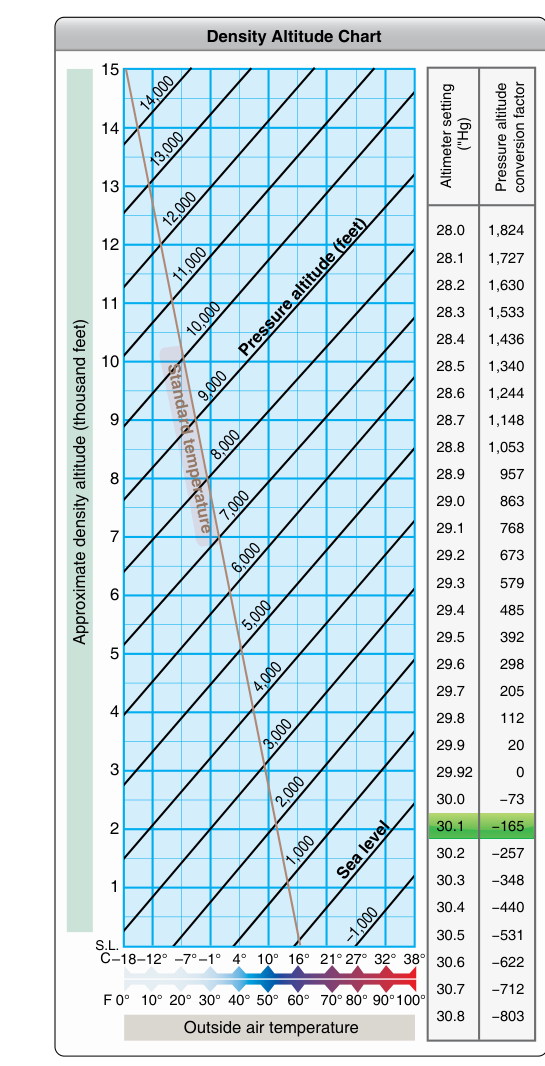
Every pilot has heard the phrase "high, hot, and humid" used as a warning. Behind those three words lies the concept of density altitude — one of the most critical performance factors you will face as a private pilot, and one of the most deadly when ignored. Understanding density altitude is not just about passing the knowledge test; it is about knowing whether your aircraft can safely clear the trees at the end of a short mountain runway on a hot summer afternoon.
Density altitude is defined as pressure altitude corrected for non-standard temperature. It represents the altitude in the International Standard Atmosphere (ISA) that corresponds to the actual air density your aircraft is experiencing. When density altitude is high, the air is thin — and thin air means degraded engine power, reduced propeller efficiency, and diminished aerodynamic lift. The airplane performs as if it were at a much higher altitude than it actually is.
Understanding the Standard Atmosphere
To grasp density altitude, you first need a baseline. The International Standard Atmosphere (ISA) — the model the FAA uses — defines sea-level conditions as 59°F (15°C) temperature, 29.92 inches of mercury (inHg) pressure, and a standard lapse rate of approximately 3.5°F (2°C) per 1,000 feet of altitude gain. When actual conditions match the ISA, pressure altitude and density altitude are identical.
Pressure altitude is the altitude indicated on your altimeter when it is set to 29.92 inHg. It represents how the atmospheric pressure at your location compares to the standard. Density altitude builds on this: it adjusts pressure altitude upward when the temperature is warmer than standard, and downward when it is cooler. The warmer the air, the less dense it is, and the higher your effective density altitude climbs.
How Density Altitude Is Calculated
The most practical cockpit method is to use a flight computer (E6-B) or the performance charts in your aircraft's Pilot's Operating Handbook (POH). The FAA also provides a simple rule of thumb: for every 1°C that the outside air temperature exceeds the standard temperature at a given pressure altitude, density altitude increases by approximately 120 feet. This approximation helps you quickly sense the magnitude of the problem.
For example, suppose you are departing from an airport at a field elevation of 5,000 feet MSL. The altimeter setting is 29.82 inHg, making your pressure altitude approximately 5,100 feet (each 0.01 inHg deviation from 29.92 equals roughly 10 feet). The standard temperature at 5,100 feet pressure altitude is about 5°C. If the actual temperature is 35°C — a hot summer day in the western United States — you are 30°C above standard. Multiply 30 × 120 = 3,600 feet. Add that to your pressure altitude: 5,100 + 3,600 = approximately 8,700 feet density altitude. Your airplane at that mountain airport will perform as though it is trying to take off from an 8,700-foot elevation on a standard day. That is a profound performance penalty.
How High Density Altitude Degrades Performance
Three interconnected mechanisms combine to degrade aircraft performance when density altitude rises:
- Reduced engine power: Normally aspirated (non-turbocharged) piston engines are air-breathing. They develop power by burning a mixture of fuel and air. Thin air contains fewer oxygen molecules per volume, so the engine cannot burn as much fuel efficiently and produces significantly less horsepower. A rule of thumb from the Pilot's Handbook of Aeronautical Knowledge (PHAK) is that a normally aspirated engine loses approximately 3 percent of its power for every 1,000 feet of density altitude.
- Reduced propeller efficiency: A propeller is an airfoil. Like wings, it generates thrust by accelerating air rearward. In thin air, each propeller revolution moves less air mass, so thrust decreases even if the engine were somehow maintaining full power — which it is not.
- Reduced aerodynamic lift: Wings generate lift proportional to air density. At high density altitude, the wings must move through a faster true airspeed to generate the same lift at a given indicated airspeed. This means the aircraft lifts off at a higher true airspeed, uses more runway, and climbs more slowly.
The combined effect on takeoff performance can be dramatic. Takeoff roll and total distance to clear a 50-foot obstacle can increase by 50 percent or more compared to sea-level standard conditions, depending on specific conditions. Climb rate may be cut in half or worse. These are not hypothetical figures — they reflect real accident chains in the NTSB database.
The Role of Humidity
Humidity adds to the problem, though it is sometimes misunderstood. Water vapor (H₂O) has a lower molecular weight than the nitrogen and oxygen it displaces in humid air. As humidity increases, moist air is actually less dense than dry air at the same temperature and pressure. The FAA's Aviation Weather Handbook notes that while humidity's direct effect on density is relatively small compared to temperature and pressure, it contributes measurably — particularly at already-high density altitudes. In performance charts, the FAA typically uses dry air values; humid conditions may cause actual performance to fall short of even the charted figures.
Why Density Altitude Matters — Real-World Consequences
High density altitude accidents follow a predictable pattern: a pilot trained at a low-elevation airport flies into a high-altitude or high-temperature environment, uses performance numbers from memory rather than from the POH charts for the actual conditions, and attempts a takeoff the aircraft cannot safely complete. The result may be a runway overrun, failure to climb, or inability to clear terrain.
Density altitude can also affect landing. While lift still exists for landing (you are descending, not climbing), the higher true airspeed at a given indicated airspeed means greater kinetic energy on touchdown, longer landing rolls, and reduced go-around capability. A planned go-around in high density altitude conditions may not be possible.
Turbocharged engines help by maintaining sea-level manifold pressure up to their critical altitude, but they do not restore full propeller efficiency or aerodynamic lift — density altitude still matters for those factors. Turbocharging addresses only the engine power loss portion of the problem.
Key Numbers and Rules
- Standard sea-level conditions: 59°F (15°C), 29.92 inHg. Density altitude equals pressure altitude under these conditions.
- Temperature lapse rate: Approximately 3.5°F (2°C) per 1,000 feet in a standard atmosphere.
- Power loss rule of thumb: Normally aspirated engines lose approximately 3% of power per 1,000 feet of density altitude increase.
- Density altitude approximation: Density altitude increases about 120 feet for each 1°C above standard temperature at a given pressure altitude.
- Altimeter correction: Each 0.01 inHg deviation from 29.92 equals approximately 10 feet of pressure altitude correction.
- Always use the POH charts for actual go/no-go decisions — rules of thumb are for awareness, not authorization.
Memory Aid
The classic reminder for density altitude is the phrase "High, Hot, and Humid" — each word points to one of the three conditions that raise density altitude and degrade performance:
- High: High field elevation means lower pressure, which raises density altitude.
- Hot: High temperature reduces air density, raising density altitude significantly.
- Humid: High humidity further reduces air density, compounding the other two factors.
If any one of these is present, pay extra attention to performance charts. If all three are present simultaneously, treat the flight planning phase with the same rigor you would apply to an instrument departure in IMC.
Common Test Traps
- Confusing pressure altitude and density altitude: They are equal only under standard temperature conditions. When the temperature is above standard, density altitude is higher than pressure altitude. Many students miss this distinction on the exam.
- Thinking density altitude is only a mountain flying concern: A hot, humid day at a low-elevation airport can produce surprisingly high density altitudes. A sea-level airport on a 100°F day can easily see density altitudes above 3,000 feet.
- Ignoring humidity entirely: While humidity has a smaller effect than temperature, it is real and additive. The FAA tests the concept that humid air is less dense than dry air at the same temperature and pressure.
- Using memory instead of the POH charts: The FAA knowledge test frequently asks which source provides authoritative performance data. The answer is always the aircraft's POH or AFM performance charts, not rules of thumb.
- Assuming turbocharging solves all density altitude problems: Turbocharging compensates for power loss but does not restore propeller efficiency or aerodynamic lift. Turbocharged aircraft still experience degraded performance at high density altitudes — they just lose less engine power up to their critical altitude.