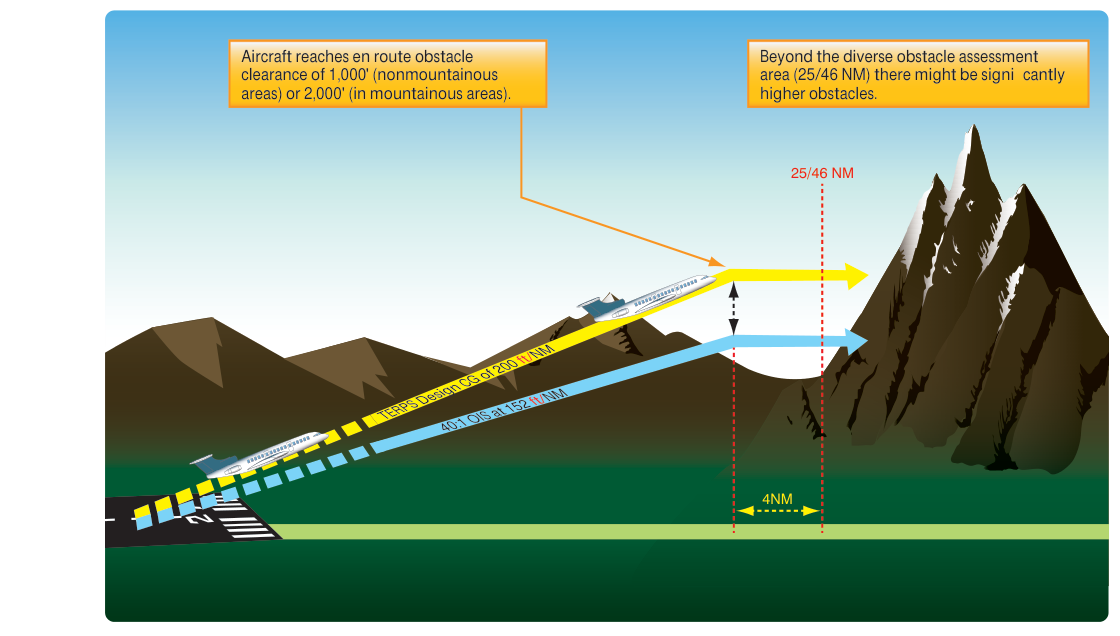
When an aircraft departs an airport, the crew faces a critical window of vulnerability: the airplane is heavy, climbing at reduced performance, and the terrain and obstacles immediately surrounding the airport may be unforgiving. Two related but distinct concepts govern this risk. First, Diverse Vector Areas (DVAs) define the portions of airspace where ATC can provide radar vectors off a runway without the crew needing to comply with a published Obstacle Departure Procedure (ODP) or Standard Instrument Departure (SID). Second, engine-out departure obstacle analysis is the operator's obligation—particularly under Part 121 and 135—to ensure that even after an engine failure, the aircraft can navigate through the departure environment without striking terrain or obstacles. Together, these two topics are tested heavily on the ATP written and oral exams, and both have direct life-safety implications.
The authoritative FAA source for this subject is Advisory Circular 120-91A, which addresses airport obstacle analysis and the design criteria for departure procedures. This article explains both concepts in depth, ties them to regulatory requirements, and flags the common exam traps that catch even experienced pilots off guard.
What Is a Diverse Vector Area?
A Diverse Vector Area is a defined volume of airspace, published on instrument approach procedure (IAP) charts or departure charts, within which ATC may issue radar vectors to departing aircraft without those aircraft needing to fly a coded departure route. The word "diverse" refers to the fact that aircraft may depart in various headings—not necessarily aligned with a specific procedure—and still remain clear of obstacles, provided ATC is monitoring and vectoring them.
The DVA concept was created to give controllers flexibility. In busy terminal environments, waiting for every aircraft to fly a full ODP or SID before being vectored can create sequencing and delay problems. By establishing and publishing a DVA, the approach control facility certifies that the airspace within that area has been evaluated, obstacles have been identified, and any aircraft vectored within it will have an assured obstacle clearance margin—built using the standard TERPS climb gradient of 200 feet per nautical mile (48 feet per nautical mile of required obstacle clearance margin above the 152 feet per nautical mile, 40:1, obstacle clearance surface) from the departure end of the runway, consistent with standard IFR departure obstacle clearance criteria rather than a flat vertical buffer.
DVAs are not automatically available at every airport. The responsible TRACON or terminal facility must conduct a formal obstacle evaluation and formally publish the DVA on the relevant instrument procedure charts. Pilots and operators should look for the DVA depiction in the "Takeoff Minimums and (Obstacle) Departure Procedures" section of the Terminal Procedures Publication (TPP), or on Jeppesen-equivalent charts. When a DVA is published, the chart will specify the lateral boundaries (often defined by radials, bearings, or geographic fixes) and any altitude restrictions that apply within it.
DVA vs. ODP vs. SID: How They Differ
It is essential to understand how the DVA relates to—but is legally distinct from—published departure procedures.
- Obstacle Departure Procedure (ODP): A coded procedure designed to provide obstacle clearance from the departure end of runway to the first en route fix. ODPs may be textual (describing a specific climb and turn) or graphic. Compliance with an ODP is not mandatory for Part 91 operators unless the operator chooses it, but it represents the safest default departure path.
- Standard Instrument Departure (SID): An ATC-assigned, air traffic control-coordinated departure procedure. SIDs include obstacle clearance and typically also incorporate traffic flow and noise-abatement considerations. Crews must have the SID in their possession and receive an explicit ATC clearance to fly it.
- Diverse Vector Area: Rather than a prescribed flight path, the DVA is a certified block of airspace. When ATC vectors a crew within a DVA, the controller—not the published procedure—is responsible for terrain and obstacle separation. The crew is not flying an ODP or SID; they are being vectored. The DVA publication is the facility's assurance that the airspace supports this.
A critical operational point: if ATC assigns radar vectors and a DVA is not published, the crew must comply with any applicable ODP until reaching the minimum vectoring altitude (MVA). Controllers cannot legally vector aircraft below the MVA except in certain published procedures. The MVA is not the same as the DVA; the MVA is an ATC tool based on radar coverage and obstacle clearance, while the DVA specifically addresses departure obstacle analysis.
Engine-Out Departure Obstacle Analysis
All performance planning assumes all engines operating unless specific engine-out analysis is completed. For Part 121 and Part 135 operators, regulations and AC 120-91A make clear that the operator bears responsibility for ensuring the aircraft can comply with obstacle clearance requirements even after losing the most critical engine at the most critical point during the departure segment.
The engine-out departure obstacle analysis process works as follows:
- Identify the departure path: The operator must define the intended flight path after takeoff. This may be the published ODP, a SID, or a custom company engine-out procedure (sometimes called an "EOSID"—Engine-Out SID or Engine-Out Departure Procedure).
- Determine aircraft performance: Using approved Airplane Flight Manual (AFM) data, calculate the aircraft's obstacle-limited climb gradient with one engine inoperative. For most transport-category aircraft, the second-segment climb gradient (gear up, flaps in takeoff position, critical engine out) is the constraining phase.
- Identify and survey obstacles: The operator must identify all obstacles within the obstacle accountability area along the intended departure path. AC 120-91A describes the accountability area as a corridor expanding laterally from the runway, accounting for navigation system accuracy and wind effects. For straight departures, the corridor begins at 200 feet each side of the runway centerline and expands at 15 degrees per side.
- Verify adequate obstacle clearance: The required clearance is typically 35 feet above each obstacle within the accountability area, with a net climb gradient of at least the AFM value minus a gradient reduction factor. Many large aircraft operate under the concept of "net flight path," which deducts a gradient margin (commonly 0.8% for two-engine aircraft) from the gross climb gradient to produce the net flight path. The net flight path must clear all obstacles by 35 feet vertically.
- Develop contingency procedures if needed: If the standard departure path cannot clear obstacles with one engine out, the operator must develop alternative procedures—special turning procedures, reduced flap settings, higher thrust ratings, weight restrictions, or custom engine-out departure routes. These must be trained and briefed by the crew.
The Role of AC 120-91A
AC 120-91A, Airport Obstacle Analysis, is the primary FAA guidance document for Part 121 and 135 operators conducting departure obstacle analysis. It describes acceptable means of compliance, outlines the obstacle accountability area methodology, and sets the analytical standards operators must meet when evaluating airports for obstacle clearance. The AC distinguishes between standard obstacle analysis (using published procedure data) and special obstacle analysis (a site-specific, operator-developed evaluation required when standard procedures are insufficient or unavailable).
Importantly, AC 120-91A recognizes that published ODPs and SIDs are designed for the all-engines-operating case and may not provide adequate protection for engine-out scenarios. Operators may not simply assume that flying the published ODP solves the engine-out obstacle problem. A separate, dedicated engine-out analysis is required unless the operator can demonstrate through AFM data that the aircraft's engine-out performance exceeds all obstacle requirements along the published procedure path.
Why This Matters Operationally
Engine-out departures from high-elevation airports, short runways surrounded by rising terrain, or airports in mountainous areas represent the highest-risk scenarios. History shows that controlled flight into terrain (CFIT) accidents frequently occur in the departure phase, often because crews or operators failed to account for obstacle exposure after an engine failure. The DVA and engine-out analysis framework exist precisely to close this gap.
For ATP candidates, understanding the distinction between all-engine and engine-out analysis—and knowing what a DVA does and does not guarantee—is critical both for the written exam and for the practical test oral. An examiner may ask: "If ATC vectors you off the departure end of the runway within a DVA, does that protect you from obstacles with an engine out?" The correct answer is no—the DVA addresses all-engine obstacle clearance based on ATC vectoring; the engine-out analysis is the operator's separate, independent obligation.
Key Numbers and Rules
- Standard obstacle clearance basis for a DVA: built on the standard TERPS departure climb gradient of 200 feet per nautical mile (a 48 feet-per-nautical-mile margin above the 152 feet-per-nautical-mile, 40:1, obstacle clearance surface), not a flat 500 or 1,000 foot vertical buffer.
- Net flight path clearance over obstacles: 35 feet minimum for transport-category aircraft engine-out.
- Gradient deduction for net flight path: 0.8% for two-engine aircraft (per FAA performance standards); deduction varies by engine count.
- Obstacle accountability corridor: Begins 200 feet each side of centerline, expands at 15 degrees per side for straight departures.
- DVA requirement: Must be formally published; not assumed at every airport—crew must verify its existence on departure charts.
- MVA vs. DVA: Minimum Vectoring Altitude is an ATC radar tool; it is not a substitute for a published DVA when evaluating departure obstacle protection.
Common Test Traps
- Assuming a DVA provides engine-out protection: It does not. The DVA certifies all-engine obstacle clearance when ATC is vectoring. Engine-out protection is a separate operator obligation under AC 120-91A and applicable regulations.
- Confusing MVA with DVA: The Minimum Vectoring Altitude is based on radar coverage and is an ATC operational tool. A DVA is a formally charted, obstacle-analyzed area specifically for departure vectoring. They are legally and procedurally distinct.
- Believing the ODP solves engine-out obstacle clearance: ODPs are designed for the all-engines-operating case. A dedicated engine-out analysis per AC 120-91A is required for Part 121/135 operators.
- Forgetting net vs. gross flight path: Exams often present a climb gradient and ask if it clears an obstacle. The answer depends on whether gross or net flight path is used; the net flight path (which deducts a margin) must clear obstacles by 35 feet.
- Thinking DVAs exist at all airports: DVAs must be specifically evaluated and published. If no DVA is charted, crews must comply with the applicable ODP when being vectored off the runway until reaching the MVA.