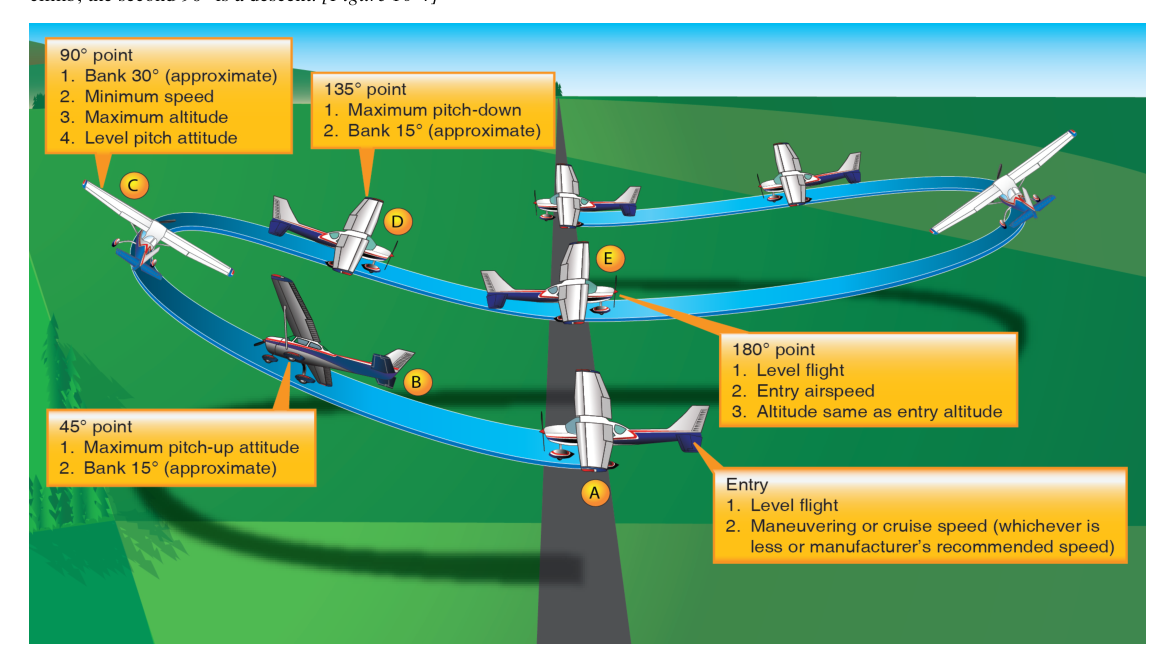
The lazy eight is one of the most elegant maneuvers in the commercial pilot syllabus, and it is also one of the most revealing. Unlike a chandelle or steep turn, the lazy eight has no level intermediate segment—it flows continuously through climbing and descending arcs across two 180° turns in opposite directions, tracing a figure-eight pattern on the horizon. Because the maneuver is never static, every control input must be coordinated and timed precisely. For flight instructors, the 90° and 270° points (the pitch peaks of each half) are the most informative windows into a student's coordination and planning skills.
To understand errors at those points, you first need to understand what should happen there. At the 90° point, the aircraft should be at its highest pitch attitude and approximately 45° of bank—neither at maximum bank nor back to wings level. Bank angle is still increasing while pitch begins to transition from climbing to descending. The airspeed should be near its lowest value for that half of the maneuver. At the 270° point (the equivalent moment in the second half), the same conditions should be mirrored symmetrically. If anything is out of place at those two moments, the rest of the maneuver will cascade into errors.
Why It Matters
The lazy eight tests a pilot's ability to divide attention, plan ahead, and coordinate all three primary controls simultaneously—skills that transfer directly to real-world maneuvering flight and upset recovery. As an instructor, being able to pinpoint exactly where a student's coordination breaks down is the difference between vague critique and targeted correction. The 90° and 270° points serve as natural checkpoints because any deficiency in rudder coordination, pitch timing, or bank planning becomes obvious there.
Common Coordination and Symmetry Errors at 90° and 270°
- Insufficient rudder coordination (skidding or slipping): As pitch increases in the first quarter of each half, the left-turning tendencies—especially torque and P-factor—demand right rudder. Students who are passive on the rudder arrive at 90° in a skid. Conversely, over-application of rudder in the descending phase approaching 270° can produce a slip. The ball should remain centered throughout; if it is displaced at either checkpoint, rudder coordination is the first thing to examine.
- Reaching maximum pitch before 90°: Some students apply back pressure too aggressively early in the climbing arc. The pitch peaks early, airspeed decays faster than planned, and by the time the aircraft reaches the 90° reference point the nose is already falling and bank is excessive. The aircraft loses the graceful, timed progression the maneuver requires. Instructors should watch for a nose that "pops" up quickly rather than rising smoothly.
- Asymmetry between the two halves: A well-executed lazy eight is symmetrical—the altitude gained in the first half should equal the altitude lost, and the airspeed at each 90° and 270° point should match. If the student is heavier-handed in one direction, or if rudder coordination is better in one direction (very common), the two halves will look visually different and the aircraft will not return to the entry altitude and airspeed at the 180° and 360° reference points. Instructors should note which direction produces the sloppier 90° or 270° point—it almost always points to a coordination deficit that shows up elsewhere in the student's flying.
- Fixating on the reference point rather than the horizon: Students who stare at their 90° visual reference on the horizon tend to neglect the feel of the controls and let the ball drift. Encourage outside-in scanning: check the ball periodically rather than relying entirely on feel, especially while building coordination habits.
- Bank angle not at 45° at 90°: Either too shallow (student hesitated to roll in) or too steep (student rolled too fast). Either error disrupts the energy management for the rest of that half-maneuver. At 270°, a mirrored bank-angle error is a clear sign the student is repeating the same timing mistake.
Memory Aid
A useful instructor reminder: "Peak pitch, half bank, centered ball"—at both the 90° and 270° points, maximum pitch and approximately 45° bank should arrive together with the ball in the center. If any one of the three is missing, you have found the error.
Common Test Traps
- Many applicants confuse maximum pitch with maximum bank—they do not occur at the same point. Maximum bank (approximately 30°) is reached at the 135° and 315° points, not at 90° and 270°.
- The lazy eight is evaluated as a commercial pilot maneuver; instructors should know the ACS tolerances (±100 ft at completion, ±10 kt entry airspeed restored) and be able to explain them to applicants.
- Symmetry is an explicit standard—the two halves must be visually and aerodynamically equal. An asymmetric maneuver is a grading deficiency even if each individual half looks acceptable in isolation.
- Left-turning tendencies are strongest during the climbing portion heading toward 90°; this is where most students are caught under-footing the right rudder.