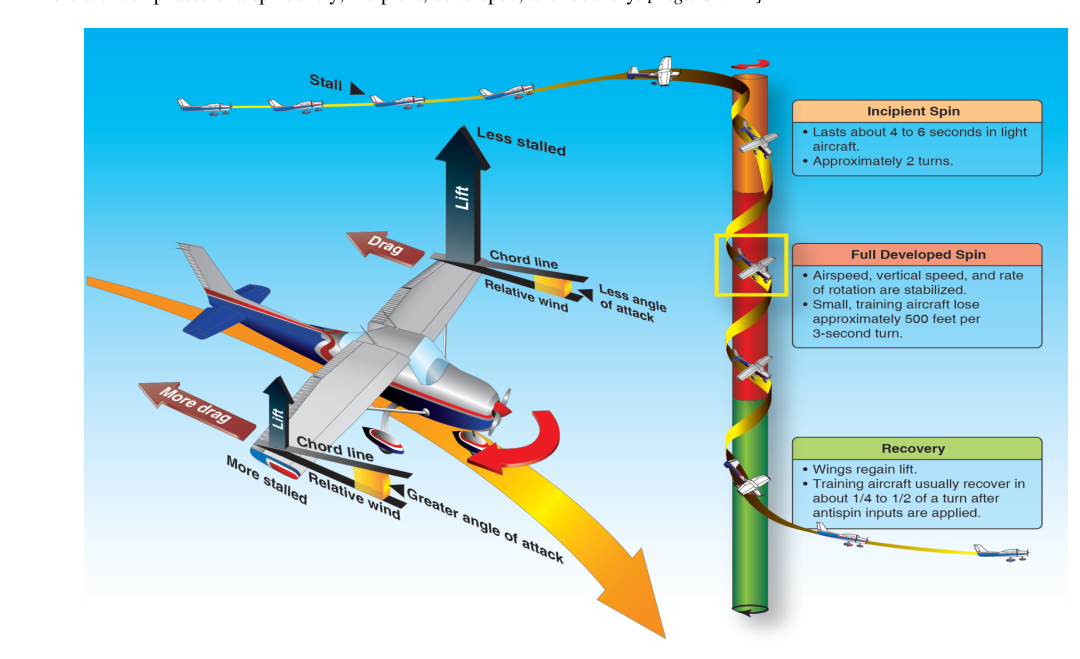
A spin is one of the most misunderstood and potentially lethal maneuvers in general aviation. It is not a steep spiral, an aggravated slip, or simply a fast descent — it is a sustained autorotation that follows an aggravated stall in which one wing is more deeply stalled than the other. The FAA defines a spin as a combination of roll, yaw, and pitch that produces a helical, nose-low flight path. Because the aircraft is fully stalled throughout, conventional control responses are degraded or even reversed. Understanding exactly which phase of the spin you occupy — and why each phase demands a specific response — is the foundation of both spin awareness and spin recovery training.
The Airplane Flying Handbook (FAA-H-8083-3) describes three operationally distinct phases: the incipient phase, the developed phase, and the recovery phase. For instructors and students preparing for certificate practical tests under the ACS, the critical skill is being able to identify each phase by its aerodynamic characteristics, understand why recovery becomes progressively harder as the spin matures, and execute the correct recovery procedure without hesitation.
The Aerodynamics Behind a Spin
A spin cannot occur without two simultaneous conditions: a stall and a yawing moment. When an aircraft stalls while one wing is moving faster than the other — because of uncoordinated rudder input, an asymmetric power application, or crossed controls — the faster wing generates relatively more lift and less drag, while the slower, more deeply stalled wing generates less lift and more drag. This differential creates a rolling and yawing moment that places the aircraft into autorotation. Once autorotation is established, it becomes self-sustaining: the descending inner wing remains at a higher angle of attack (AOA) than the rising outer wing, perpetuating the lift and drag asymmetry without any additional pilot input. This is the essence of what makes a spin different from any other upset — the aircraft is actively driving itself deeper into the condition.
Airspeed during a spin is paradoxically low — typically below the normal 1-g stall speed — because the very high AOA maintained by autorotation keeps both wings stalled. In contrast, a spiral dive features rapidly increasing airspeed and high load factors, which is why the recovery techniques for the two conditions are completely different and must never be confused.
The Incipient Phase
The incipient phase begins at the instant of the stall-and-yaw combination and continues for approximately the first one to three turns of rotation, though the exact duration varies by aircraft type and loading. During this phase, the spin is not yet in equilibrium — rotation rate is increasing, pitch attitude is still changing, and the descent rate is building. The aerodynamic and inertial forces have not yet reached a steady balance.
From a recovery standpoint, the incipient phase is the most forgiving window. Because autorotation is not fully established, the controls — particularly the rudder — retain meaningful authority. Altitude loss during the incipient phase is relatively small compared to later phases. A pilot who recognizes and acts during the first half-turn to full turn can often stop the spin before it transitions to a developed state, potentially recovering with only a few hundred feet of altitude loss. This is precisely why the FAA requires stall and spin awareness as a knowledge item for the private pilot certificate (14 CFR 61.105(b)(9)) and actual spin entry, spin, and spin recovery flight training for the flight instructor certificate (14 CFR Part 61.183) — early recognition during the incipient phase is the most reliable safety margin available.
The scenario most likely to produce an unintentional incipient spin is the base-to-final turn in the traffic pattern. A pilot who overshoots final, applies bottom (inside) rudder to tighten the turn, and allows the nose to drop will experience exactly the crossed-control, low-airspeed, high-AOA conditions that trigger a spin. At traffic pattern altitude — typically 800 to 1,000 feet AGL — an unrecognized incipient spin offers virtually no recovery margin.
The Developed Phase
After approximately one to three turns, the aerodynamic and inertial forces reach an equilibrium and the spin transitions to the developed phase. In this phase, the pitch attitude, rotation rate, airspeed, and vertical descent rate all stabilize at near-constant values. The aircraft is in full, steady-state autorotation. For most light training aircraft, the developed-phase descent rate can exceed 5,000 to 6,000 feet per minute, and the rotation rate may reach one to two seconds per turn, though these values are aircraft-specific.
Recovery from the developed phase is harder and requires significantly more altitude than recovery from the incipient phase. The controls — especially the elevator — are less effective because the high AOA blankets the horizontal tail in disturbed airflow. Inertia also plays a larger role: in heavier or longer aircraft, rotational inertia can delay the response to rudder input even after the correct technique is applied. This inertial lag means that several additional degrees of rotation may occur after full opposite rudder is applied before the spin actually stops. Pilots who are unaware of this may prematurely apply back pressure, re-stalling the aircraft and re-entering autorotation.
Standard Recovery Procedure: PARE
The FAA-accepted spin recovery procedure, documented in the Airplane Flying Handbook, is captured by the mnemonic PARE. It provides a logical, sequenced checklist that addresses each element of the spin in the correct order.
- P — Power to idle. Closing the throttle eliminates propeller torque and gyroscopic precession effects that can bias the rotation or complicate rudder effectiveness. In some single-engine aircraft, power-on spins rotate faster and recover more slowly than power-off spins.
- A — Ailerons neutral. The instinctive reaction to raise the low (inside) wing with aileron is actively harmful. Aileron deflection into the spin increases the AOA on the inside wing and can deepen the stall; aileron against the spin can accelerate rotation on some aircraft. Neutralizing the ailerons removes this variable.
- R — Rudder full opposite to rotation. This is the primary and first active recovery input. Full rudder deflection opposite the direction of spin yaw directly counters the autorotation. The pilot must correctly identify the direction of rotation — typically by observing which direction the nose is sweeping — before applying rudder.
- E — Elevator briskly forward (after rudder is applied). Once opposite rudder is established, a positive forward push on the elevator reduces the AOA on the stalled wing below the critical angle, breaking the stall and terminating autorotation. The sequence matters: rudder first to stop yaw, then elevator to break the stall.
After rotation stops and the stall is broken, the aircraft will be in a steep nose-low attitude with airspeed building rapidly. Neutralize the rudder immediately — prolonged opposite rudder after the spin stops can induce a spin in the opposite direction. Then apply smooth back pressure to recover from the dive, being careful not to pull so aggressively that you exceed the aircraft's load limit or trigger an accelerated stall. Always consult and follow the specific POH spin recovery procedure for the aircraft being flown, as some designs deviate from the standard PARE sequence.
Memory Aid
PARE — Power idle, Ailerons neutral, Rudder opposite, Elevator forward — is a genuine FAA-endorsed mnemonic that appears in the Airplane Flying Handbook and is the standard teaching tool for spin recovery across general aviation training.
Why Instructors Must Understand Both Phases
Under 14 CFR Part 61.183, applicants for a flight instructor certificate must receive and log flight training in stall awareness, spin entry, spins, and spin recovery procedures. This requirement reflects the FAA's recognition that instructors are uniquely positioned to prevent inadvertent spin accidents by teaching students to recognize the early warning signs — uncoordinated flight, airspeed decay, and control buffet — before the incipient phase even begins. An instructor who can articulate the aerodynamic difference between the incipient and developed phases, explain the rationale behind each step of PARE, and demonstrate the maneuver competently provides a level of safety education that no ground lesson alone can replicate.
Key Numbers and Rules
- Incipient phase duration: approximately one to three turns before transition to developed phase.
- Recovery altitude: always follow the POH; many training aircraft require at least 1,500 feet AGL above the recovery altitude to perform intentional spins safely.
- A spiral dive features increasing airspeed and high G; a spin features low airspeed and near-constant rotation — never pull back first in a spin.
- Stall and spin awareness is required aeronautical knowledge for the private pilot certificate (14 CFR 61.105(b)(9)); actual spin entry, spin, and spin recovery flight training is required for the flight instructor certificate (14 CFR Part 61.183).
- Aircraft not approved for spins in their POH/AFM must never be intentionally spun — structural limits may be exceeded in a developed spin.
Common Test Traps
- Ailerons into the spin: Applying aileron toward the high wing is instinctive but wrong — it deepens the stall on the inside wing. Ailerons must be neutralized.
- Elevator before rudder: Pulling back before applying opposite rudder can lock the aircraft deeper into autorotation. The correct sequence is rudder first, then elevator.
- Incipient vs. developed recovery difficulty: Test items frequently ask which phase is easier to recover from — the answer is always the incipient phase, because autorotation is not yet stabilized and control authority is greater.
- Spin vs. spiral confusion: A spiral dive recovery begins with rolling wings level, then pulling out of the dive. A spin recovery begins with PARE — pulling back in a spin without stopping rotation first will not work and may worsen the situation.
- Opposite rudder direction: Misidentifying the direction of rotation and applying rudder with the spin rather than against it will accelerate autorotation. Always confirm rotation direction before applying rudder.