A power-off stall replicates the aerodynamic conditions a pilot is most likely to face during a final approach, landing flare, or go-around entry when airspeed bleeds away and the angle of attack (AOA) climbs past the critical angle with the engine at idle. Unlike power-on stalls, which simulate a departure or climb-out scenario, the power-off variant keeps the throttle at idle throughout the entry, faithfully mirroring the low-energy, high-drag state of a normal approach to land. For flight and ground instructors, teaching this maneuver means going far beyond the mechanical sequence—it means building a student's ability to feel an approaching stall, identify the aerodynamic break, and respond with disciplined, coordinated control inputs every single time, under pressure, close to the ground.
The Aerodynamics Behind the Maneuver
Every stall, regardless of configuration or power setting, is purely an AOA event. The Pilot's Handbook of Aeronautical Knowledge (FAA-H-8083-25) is unambiguous: a wing stalls when it exceeds its critical angle of attack, typically near 15–20 degrees for most general aviation airfoils, regardless of airspeed, altitude, or attitude. During a power-off stall entry, the pilot deliberately increases AOA by applying progressive back pressure while drag from flaps and idle power causes airspeed to erode. The decreasing dynamic pressure (lower indicated airspeed) means the wing must fly at a higher AOA to produce the same lift required to maintain level flight—and eventually that AOA crosses the critical threshold.
At that threshold, the boundary layer of air over the upper wing surface separates, lift collapses, and induced drag spikes. The nose drops (or a wing drops asymmetrically if the ball is not centered), signaling the stall. The pre-stall buffet students feel through the airframe and controls is actually the separated, turbulent airflow off the stalled wing impacting the horizontal stabilizer—a tactile warning the pilot must learn to recognize before the full break occurs.
Entry Procedure and Configuration
According to the Airplane Flying Handbook (FAA-H-8083-3), the standard power-off stall entry begins at or above the manufacturer's recommended altitude for maneuver practice—typically at least 1,500 feet AGL to allow for safe recovery. The pilot clears the area with clearing turns, then reduces power to idle while simultaneously establishing a landing configuration appropriate to the aircraft: carb heat on if applicable, landing gear down (retractable aircraft), and flaps extended in stages to the approach or landing setting specified in the Pilot's Operating Handbook (POH).
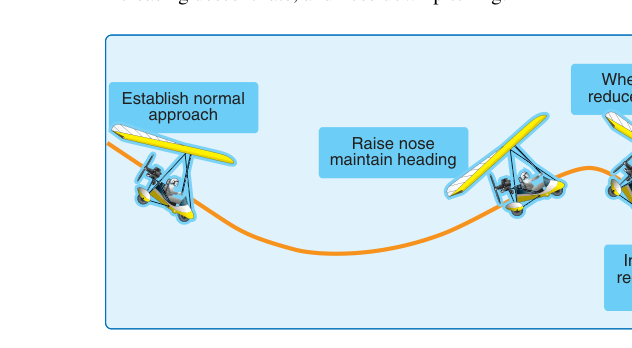
Once stabilized in a descent or level-flight attitude at approach airspeed, the pilot applies steady, deliberate back pressure, holding altitude as long as possible while airspeed continues to decay. Rudder must remain coordinated throughout—the incipient yaw that precedes an asymmetric break is exacerbated by even a small ball displacement. The stall is signaled by some combination of: activation of the stall warning device (horn, light, or vibrator, which typically triggers 5–10 knots above the actual stall), airframe buffet, and the unmistakable nose drop or wing drop at the full aerodynamic break.
Recovery Technique: Sequence and Priorities
The recovery from a power-off stall follows a prioritized sequence described in the AFH. First, the pilot reduces back pressure simultaneously with the break—this is the critical input because it lowers AOA below the critical angle and allows the wing to fly again. Second, smooth, full throttle is applied to arrest the altitude loss and restore energy. Third, rudder is used to level or maintain wings while coordinated aileron supplements directional control once the wing is producing lift again. Fourth, flaps are retracted incrementally as airspeed and performance confirm the aircraft is safely flying, not in one abrupt motion that could strip the remaining lift.
The AFH is clear that minimizing altitude loss is a goal, not the primary objective—the priority is restoring controlled flight first. Students frequently invert this, fixating on the altimeter during recovery and inadvertently reapplying back pressure before the wing is flying, causing a secondary stall. Instructors must address this tendency explicitly during the debrief.
Memory Aid
Many instructors sequence recovery inputs with the phrase Pitch–Power–Rudder–Flaps: reduce back pressure (pitch for AOA), apply power, ensure coordinated rudder to counter yaw/roll, then raise flaps incrementally. This is not an official FAA acronym but a sequenced priority list entirely consistent with AFH guidance and useful for preventing students from applying inputs in the wrong order.
Why This Maneuver Is Safety-Critical
Stall-spin accidents during the approach and landing phase remain among the leading causes of fatal general aviation accidents in the United States. The FAA's Risk Management Handbook (FAA-H-8083-2) identifies loss of control in flight (LOC-I) as a persistent and disproportionately lethal threat, and the base-to-final turn stall is a textbook LOC-I scenario. When a pilot overshoots the centerline on final, tightens the bank, applies back pressure to tighten the turn, and simultaneously allows airspeed to decay, the conditions for a crossed-control or accelerated stall at low altitude are set. There is often insufficient altitude to recover. A student who can recognize and recover from a power-off stall instinctively—without prompting—has a genuine, measurable safety margin on every single approach.
Instructor Demonstration Techniques
The Aviation Instructor's Handbook (FAA-H-8083-9) identifies the demonstration-performance method as one of the most effective techniques for teaching a psychomotor skill: the instructor demonstrates the complete, correct maneuver while narrating each phase, then the student performs it under guidance. For power-off stalls, effective narration means calling out the first stall warning cue as it appears, identifying the buffet sensation, announcing each recovery input and the reason for its sequence, and pointing out the airspeed trend and control feel at every stage.
A best-practice demonstration sequence includes three iterations. First, demonstrate a textbook recovery—minimum altitude loss, smooth power application, incremental flap retraction—so the student has a clear target behavior. Second, intentionally demonstrate a secondary stall by applying back pressure too aggressively after power addition, so the student sees exactly what it feels and looks like and understands the cause. Third, demonstrate an asymmetric wing-drop recovery emphasizing the correct rudder-first response, because many students instinctively reach for aileron on the low wing, which increases AOA on that wing and moves toward spin entry. Showing the wrong input's consequence—in a controlled setting with altitude to spare—is far more effective than simply describing it.
Key Numbers and Configuration Rules
- Stall AOA is constant for a given airfoil, typically 15–20 degrees. Stall speed varies with weight, load factor, and configuration.
- Load factor in a 60-degree banked coordinated turn is 2.0 Gs, which increases stall speed by approximately 41 percent over wings-level stall speed. At 45 degrees of bank the load factor is approximately 1.41 Gs.
- Stall warning devices are typically calibrated to activate 5–10 knots above the actual stall speed—they warn of an impending stall, not the stall itself.
- Flap extension increases lift and drag. Full flaps lower stall speed but also shift the pitch response; students must understand that full-flap stall recovery requires incremental flap retraction to avoid a sudden lift loss.
- Minimum entry altitude for stall practice is typically 1,500 feet AGL or higher per ACS standards, providing margin for recovery and student errors.
Common Test Traps and Misconceptions
- Using aileron to correct a wing drop at the stall. The AFH explicitly states that the correct initial response to an asymmetric wing drop is opposite rudder, not aileron. Deflecting aileron toward the dropped wing increases AOA on that semi-span and can deepen the stall, potentially initiating a spin.
- Believing recovery is complete at the stall warning. The stall warning activates before the full aerodynamic stall. Students who relax back pressure only at the horn and consider the maneuver finished may still be at or near the critical AOA with insufficient lift.
- Retracting flaps in one motion during recovery. Rapid full retraction of flaps during recovery removes a significant portion of lift before the wing is fully re-established and can cause the aircraft to sink or re-stall. The AFH recommends incremental retraction at confirmed positive climb airspeed.
- Assuming stall speed is a fixed number. Knowledge-test questions on stall speed frequently exploit the relationship between load factor and stall speed. Any condition that increases load factor—banked turns, turbulence, abrupt pull-ups—raises the indicated speed at which the stall occurs, even though the stall AOA remains constant.
- Neglecting coordination during entry. Skidding or slipping into the stall changes the relative airflow across each wing semi-span unevenly, making an asymmetric break more likely. Instructors must monitor and correct uncoordinated entries before the student develops a habit of sloppy rudder work on approach.