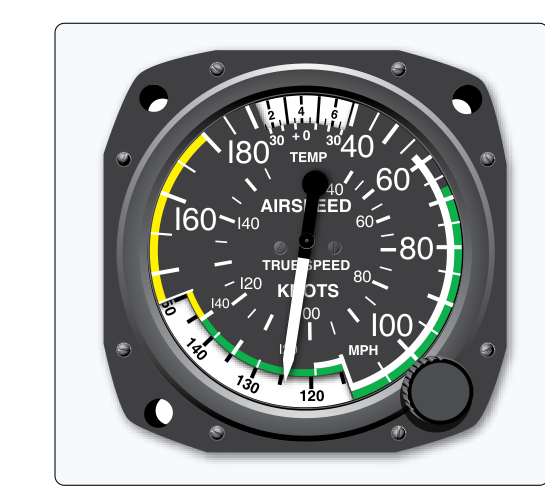
When you glance at your airspeed indicator during cruise flight, the needle is telling you something important — but not the whole story. The instrument measures indicated airspeed (IAS), which is directly tied to the pressure the air exerts on the pitot-static system. What it cannot tell you is how fast you are actually moving through the air mass — your true airspeed (TAS). The gap between these two values grows dramatically as density altitude increases, and understanding that gap is essential for accurate flight planning, performance calculations, and safe operations at high-elevation airports or on hot summer days.
This article walks through exactly why IAS and TAS diverge, how to calculate the difference, and why pilots who ignore it sometimes run out of runway, bust altitude assignments, or misjudge fuel burn. These are not abstract concerns — density altitude accidents appear in NTSB reports every summer.
What the Airspeed Indicator Actually Measures
The airspeed indicator is a differential pressure gauge. It compares the ram (impact) pressure captured by the pitot tube with the static pressure from the static port. The difference between the two is called dynamic pressure, and the instrument's internal capsule expands or contracts with that pressure difference to move the needle. The scale is calibrated assuming the air has the density of the standard atmosphere at sea level — approximately 0.002377 slugs per cubic foot (or 1.225 kg/m³ in SI units).
Here is the key insight: the airspeed indicator does not actually measure density. It only measures a pressure difference. When air density is lower than the sea-level standard — which happens whenever you climb higher, fly in hot air, fly in humid air, or any combination of the three — the same pressure difference corresponds to a higher actual velocity. The airplane has to move faster through the thin air to generate the same ram pressure it would produce in dense sea-level air. The instrument, however, still reports the old calibrated value as if the air were standard density.
How Density Altitude Creates the TAS–IAS Split
Density altitude is pressure altitude corrected for non-standard temperature. It is the altitude at which the current air density would be found in the standard atmosphere. At standard sea-level conditions, density altitude equals field elevation and TAS equals IAS (ignoring small instrument and position error corrections). As density altitude rises — whether from actual altitude gain, rising temperature, or both — TAS increasingly exceeds IAS.
The relationship follows directly from the physics of dynamic pressure. Dynamic pressure (q) equals one-half times air density (ρ) times velocity squared: q = ½ρV². Because the airspeed indicator is calibrated for standard sea-level density, it always solves for V using that fixed standard ρ. But in the real atmosphere at higher density altitudes, the actual ρ is lower. To produce the same q that the instrument sees, the actual velocity V must be higher. Mathematically, if density drops by a factor, velocity must increase by the square root of that factor to keep q constant.
A practical rule of thumb found in FAA materials such as the Pilot's Handbook of Aeronautical Knowledge: TAS increases approximately 2 percent above IAS for every 1,000 feet of pressure altitude in a standard atmosphere. This is an approximation, but it is remarkably useful for mental math. At 10,000 feet density altitude, TAS will be roughly 20 percent higher than IAS. At 5,000 feet, roughly 10 percent. A pilot cruising at 120 knots IAS at a density altitude of 8,000 feet is actually moving through the air mass (TAS, not groundspeed) at approximately 139 knots — nearly 19 knots faster than the instrument shows.
Calibrated Airspeed and True Airspeed — The Full Chain
It is worth noting the full chain of airspeed corrections so you understand where density altitude fits in:
- Indicated airspeed (IAS) — the raw reading off the instrument, including any instrument error inherent to that specific unit.
- Calibrated airspeed (CAS) — IAS corrected for instrument error and position error (errors caused by where the pitot and static ports are located on the airframe). At normal cruise speeds, IAS and CAS are close, but they can diverge at low speeds or high angles of attack. The Pilot's Operating Handbook (POH) provides an airspeed calibration table for each aircraft.
- Equivalent airspeed (EAS) — CAS corrected for compressibility of air, which becomes significant at higher speeds and altitudes — generally cited as a factor above roughly 200 KTAS at altitudes above 10,000 feet, rather than a flat threshold at any altitude. For most light general aviation aircraft, EAS and CAS are treated as equal.
- True airspeed (TAS) — EAS (or CAS for light GA aircraft) corrected for the actual air density at flight conditions. This is the speed at which you are actually moving through the air mass.
For practical GA purposes, the two most important values are IAS (which governs aircraft performance — stall speeds, Vx, Vy, Va, Vfe, and Vno are all published as IAS) and TAS (which governs navigation, fuel planning, and wind calculations).
Why It Matters: Performance and Safety Implications
The TAS–IAS split has cascading effects on almost every aspect of flight performance:
Takeoff and landing distances: An aircraft lifts off when it reaches a certain IAS — say, 55 knots. But at a high-density altitude airport, reaching 55 knots IAS requires the airplane to roll much faster along the ground (higher TAS), which means it needs more runway to accelerate. The aircraft also climbs more steeply by the airspeed indicator numbers, but its actual climb rate in feet per minute is reduced because the engine produces less power and the propeller bites less air. The combination can be lethal at short, high-elevation airstrips on hot afternoons.
Cruise fuel planning: Flight plans are calculated using TAS plus or minus wind. If a pilot mistakenly uses IAS as TAS, they will significantly underestimate time en route and fuel burn, potentially leading to fuel exhaustion. At 8,000 feet density altitude, a ~16–20% error in groundspeed estimation is possible on a no-wind day.
Navigation and wind correction: The E6B flight computer and electronic equivalents all compute TAS from CAS/IAS by accounting for pressure altitude and temperature. Students must input both variables correctly. A common error on FAA knowledge tests is confusing pressure altitude with density altitude in the TAS calculation process. Remember: you calculate TAS using pressure altitude and outside air temperature, which together determine actual density — the computer does the density correction internally.
Key Numbers and Rules
- 2% TAS increase per 1,000 ft of pressure altitude in a standard atmosphere — the FAA-endorsed rule of thumb for estimating TAS from IAS.
- Standard sea level conditions: 29.92 in Hg, 15°C (59°F); at these conditions, TAS = IAS (ignoring instrument and position errors).
- Every published V-speed (Vx, Vy, Vs, Va, Vfe, etc.) is in IAS — fly these numbers regardless of density altitude; the wing and engine respond to IAS, not TAS.
- Groundspeed ≠ TAS — TAS is movement through the air mass; groundspeed is TAS corrected for wind. Both are higher than IAS at altitude.
- E6B inputs: Calibrated airspeed (or IAS corrected per POH), pressure altitude, and outside air temperature — not density altitude as a direct input.
- High, hot, humid = high density altitude — humidity has a smaller effect than temperature or altitude, but it still reduces density and raises TAS above IAS.