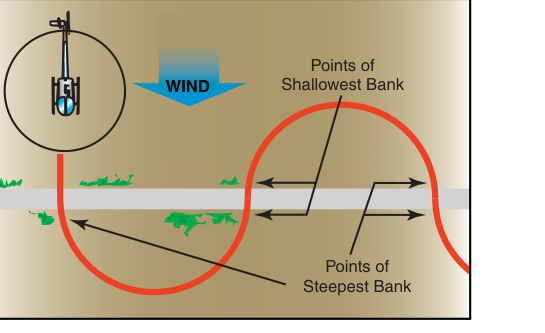
What Are S-Turns Across a Road?
S-turns across a road is a ground reference maneuver in which the pilot makes a series of equal-diameter, semicircular turns on alternating sides of a straight ground reference line — typically a road, fence line, or section line running perpendicular to the wind. The goal is a constant-radius ground track that forms the letter "S" when viewed from above. As described in the Airplane Flying Handbook (FAA-H-8083-3), ground reference maneuvers develop the pilot's ability to divide attention between controlling the airplane and maintaining a desired ground track while correcting for wind drift — a foundational skill that transfers directly to traffic-pattern flying and cross-country navigation.
Why Wind Makes Bank Angle Variable
The central challenge of S-turns is that the airplane's groundspeed — and therefore the rate at which it sweeps around a circle — changes constantly as its heading rotates relative to the wind. When the airplane is flying downwind (wind pushing from behind), groundspeed is highest and the airplane tends to drift outward from the intended circle. To compensate, the pilot must use the steepest bank of the entire maneuver at that point. Conversely, when flying directly into the wind, groundspeed is lowest, the airplane tends to cut inside the circle, and the shallowest bank is appropriate.
Think of it this way: bank angle controls the rate of turn, and rate of turn must match groundspeed so that the radius stays constant. Faster groundspeed requires a faster turn rate to keep the radius from ballooning outward — and a steeper bank produces that faster turn rate. Slower groundspeed requires a slower turn rate to prevent tightening inside the intended path — and a shallower bank produces that slower turn rate. The pilot is essentially solving a continuous geometry problem, adjusting bank in real time as the wind component changes from tailwind to crosswind to headwind and back again throughout each semicircle.
The Correct Entry and Bank Sequencing
The Airplane Flying Handbook recommends entering the maneuver perpendicular to the reference line, flying directly downwind (or as close to it as practical), at the pilot's selected altitude — typically 600 to 1,000 feet AGL — and at a predetermined airspeed appropriate for the aircraft. Entry is made with the steepest bank angle the maneuver will use, because the airplane is at its highest groundspeed at the moment it crosses the road going downwind. The sequence for each semicircle is as follows:
- Crossing the road downwind: Enter with the steepest bank (generally not to exceed 45°). This high bank produces the fastest rate of turn needed to track the constant radius against the fast-moving ground.
- Reaching the 90° point (crosswind heading): Bank has been progressively shallowing as groundspeed decreased from the tailwind component. At the 90° point the bank should be at a medium angle — roughly half-way between the steepest and shallowest banks of the semicircle.
- Approaching the road heading into the wind: Bank continues to shallow. As the airplane arrives back at the road heading directly upwind, the bank should be at its shallowest, reflecting the airplane's lowest groundspeed.
- Crossing the road upwind: The moment the airplane crosses the road, the pilot rolls to the opposite direction of turn and establishes the shallowest bank of the new semicircle, because the airplane is momentarily heading directly into the wind at that point; the bank is then progressively steepened as the airplane turns from upwind toward the crosswind and downwind points of the new arc.
Notice that the bank transition at the road is the most complex moment in the maneuver: the pilot must smoothly roll from the steepest bank in one direction to the shallowest bank in the opposite direction as the airplane crosses the reference line. There is no pause or flat segment — the "S" is continuous.
Altitude, Airspeed, and Configuration
The Airplane Flying Handbook specifies that ground reference maneuvers should be performed at a consistent altitude, typically 600 to 1,000 feet AGL. This altitude keeps the ground reference clearly visible and provides an adequate safety margin. The pilot should select an airspeed that is comfortable for coordinated maneuvering — often cruise or a slightly reduced speed, consistent with the manufacturer's recommendations. Maintaining altitude throughout the S-turn requires back-pressure coordination; during steep banks, induced drag increases, and the nose may want to drop. The throttle and pitch must be managed to hold altitude as bank angle varies around the semicircle.
Wind Correction and Crab Angle Within the Arc
Some students mistakenly believe that because bank angle is varied, no further wind correction is needed. In fact, the varied bank angle is the wind correction — it adjusts the radius. There is no need to apply an additional crab angle within the turn. The radius remains constant automatically when the bank is proportional to groundspeed at every point on the circle. If the student crabs while also banking incorrectly, they compound errors. The key insight: bank angle variation is the entire correction method for wind in a turn.
Why the Maneuver Is Required — Regulatory and Practical Context
Under 14 CFR Part 61, S-turns are listed as a required maneuver in the private pilot practical test standards (now the Airman Certification Standards, or ACS). They appear in the ACS under the Ground Reference Maneuvers task area. The ACS requires the applicant to maintain the selected altitude within ±100 feet, maintain airspeed within ±10 knots, and roll out on the reference line heading within ±10° while demonstrating coordinated flight throughout. For the CFI candidate, the deeper requirement is the ability to recognize and verbally explain every error a student is making, explain why it happens, and demonstrate the correct technique.
Common Student Errors in S-Turns
The Airplane Flying Handbook explicitly lists common errors for this maneuver. CFI candidates must be able to articulate every one of these:
- Failure to adequately clear the area before beginning: Students dive straight into the maneuver without a 360° clearing turn or at least a thorough scan. Safety first — always.
- Poor timing of the bank angle changes: The most common error. Students tend to delay steepening the bank after crossing the road downwind, allowing the radius to balloon outward. Conversely, they may steepen too aggressively going upwind, tightening the circle.
- Applying a constant (non-varying) bank angle: Some students treat S-turns like two coordinated 180° turns at the same bank angle. This works only in calm air; in any wind, the upwind semicircle will be too tight and the downwind semicircle will be too wide.
- Rolling out too early or too late at the road: If the student rolls out before reaching the road, the airplane crosses with a heading that is not perpendicular to the line, making subsequent geometry difficult. Rolling out too late means the airplane has already begun drifting into the new semicircle at the wrong angle.
- Gaining or losing altitude: Preoccupation with the ground track causes students to neglect pitch and throttle management. Altitude deviations beyond the ACS tolerance indicate divided-attention deficiency — a training priority.
- Uncoordinated flight (skidding or slipping): In haste to correct for a widening radius, students may apply top or bottom rudder instead of adjusting bank. Uncoordinated flight during ground reference maneuvers is a significant error that the CFI must immediately address.
- Not rolling into the new bank immediately upon crossing the road: Students sometimes linger wings-level at the road crossing, creating a flat section in the "S" and distorting the geometry of the following semicircle.
Memory Aid
To remember when to use the steepest versus shallowest bank, use the phrase "Fast = Steep, Slow = Shallow." When groundspeed is fast (downwind crossing), bank steep. When groundspeed is slow (upwind crossing), bank shallow. This ties the physical cause (wind effect on groundspeed) directly to the cockpit action (bank adjustment), making it intuitive rather than a memorized rule.
The CFI's Teaching Approach
When introducing S-turns to a student, the CFI should first demonstrate the maneuver while narrating the bank adjustments aloud in real time — something like: "I'm crossing the road downwind now, so I'm steepening to about 40°… now I'm turning through the crosswind point and you can feel me relaxing to maybe 20°… coming back to the road headwind, I'm nearly wings-level." This running commentary builds a mental model before the student attempts the maneuver. On subsequent attempts, the CFI should prompt the student with questions rather than directives: "Where is the wind coming from relative to your heading right now? What should that mean for your bank?" This Socratic method encourages the student to internalize the reasoning, not just mimic the control inputs.
CFI candidates should also be prepared to demonstrate what happens when the bank is held constant: the semicircles will be visibly asymmetric, with the downwind half bulging outward. Deliberately showing this error — and then correcting it — is a powerful teaching tool that makes the concept concrete.
Common Test Traps
- "Steepest bank is used on the upwind semicircle" — FALSE. Steepest bank is used on the downwind crossing and throughout the downwind arc. Upwind = shallowest bank.
- "The bank angle should be constant throughout each semicircle" — FALSE. Bank must be continuously varied throughout every arc to maintain constant radius in a wind.
- "S-turns should be entered on the upwind side of the road" — FALSE per the AFH. Entry is made heading downwind, crossing the road perpendicularly, so the steepest bank can be established immediately at the point of highest groundspeed.
- "Altitude tolerance for the ACS is ±200 feet" — FALSE. It is ±100 feet for the private pilot ACS ground reference maneuvers.
- "A crab angle must be added during the turn to correct for wind" — FALSE. Varying the bank angle is the correct and complete wind correction method in turning ground reference maneuvers; no additional crab angle is applied within the arc.