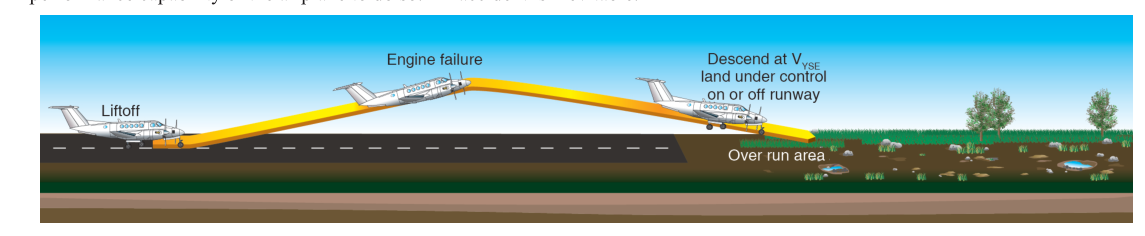
Engine failure in a high-performance single-engine aircraft is among the most demanding emergencies a commercial pilot candidate must master. Unlike a multi-engine platform, there is no backup powerplant to carry you to the nearest airport. Your survival margin comes from three things: instant priority management, disciplined adherence to the Pilot's Operating Handbook (POH) emergency checklist, and an understanding of why each step works. The FAA's Airplane Flying Handbook (FAA-H-8083-3) defines the overarching framework as Aviate → Navigate → Communicate, and that hierarchy must be second nature before you sit for the Commercial Pilot Airplane Knowledge Test.
Defining the Aircraft and the Stakes
For regulatory and training purposes, a high-performance aircraft is one with an engine of more than 200 horsepower, as defined in 14 CFR 61.31(f). Many aircraft in this category also qualify as complex — meaning they have a constant-speed propeller, retractable landing gear, and wing flaps — though the two designations are independent. High-performance singles typically cruise at higher true airspeeds, carry larger fuel loads, and are often turbocharged or turbo-normalized. Each of those features introduces unique failure modes: a turbocharger deck-pressure fault, an engine-driven fuel pump failure, vapor lock in a hot fuel-injected engine, or wastegate malfunction can all rob you of power in subtly different ways. Knowing the system architecture of the specific aircraft you fly is not optional — it is what lets you diagnose and respond correctly rather than just executing memorized steps blindly.
The Immediate Action: Best-Glide Speed
The moment power is lost — or even significantly reduced — the first and most time-critical action is to pitch for best-glide speed (VG). This is the airspeed that produces the maximum glide ratio (lift-to-drag ratio), giving you the greatest horizontal distance per foot of altitude lost. Every tenth of a knot matters less than getting reasonably close, but the FAA-H-8083-3 notes that flying even 10 knots above or below VG measurably shortens your glide range. VG is published in Section 3 (Emergency Procedures) and Section 5 (Performance) of the POH and is often depicted on the airspeed indicator as a small triangle or marked with a placard.
After establishing VG, retrim the aircraft so the glide can be maintained with minimal control input — this frees mental bandwidth for the checklist and for scanning the terrain below. Simultaneously, begin a mental map of the landing environment: runways, roads aligned with the wind, large flat fields, and areas free of wires and obstacles. Pick a primary landing target and keep it in your scan. You are flying toward something, not just away from a problem.
The Emergency Checklist: Step by Step
Once the glide is stabilized and a target area identified, work the POH emergency checklist. The following sequence is representative of most high-performance fuel-injected singles; always defer to your specific POH because fuel-system architecture varies considerably.
- Fuel selector — fullest tank or BOTH. Many high-performance singles have left/right wing tanks and an engine-driven pump that draws from one at a time. Switching tanks eliminates fuel starvation as a cause.
- Fuel boost pump — ON. The electric boost pump is installed specifically to back up the engine-driven pump. If the engine-driven pump has failed, the boost pump alone may restore fuel flow and allow a restart. It also pressurizes the fuel lines, which can clear vapor lock in hot conditions.
- Mixture — rich (or as appropriate for altitude). A lean mixture set for cruise may not support combustion during a restart. At high density altitude, full rich can cause roughness, so apply good judgment — the POH will specify.
- Magnetos — check BOTH. A single magneto failure will cause roughness and power reduction but rarely a complete stoppage. Cycling from LEFT to RIGHT and back to BOTH can identify a failed mag and may restore partial power sufficient to reach an airport.
- Throttle — vary the position. Try a slight advance. A momentarily stuck throttle linkage or an unusual mixture condition may respond to small throttle movements.
- Primer — IN and locked. An unlocked primer on fuel-injected engines bypasses normal metering, producing a rich condition that can prevent restart. Verify it is fully seated and locked.
- Carburetor heat — ON (if carbureted). Carburetor icing can cause complete power loss even in moderate temperatures. Carb heat introduces warm air to melt ice; expect a momentary RPM drop if ice is present, followed by power restoration.
- Restart attempt — per POH. Follow the specific restart procedure. Fuel-injected engines that have experienced vapor lock may require a different priming sequence than a cold or flooded start.
- Declare emergency — squawk 7700, transmit MAYDAY. Once the aircraft is stabilized and a landing area is committed to, contact ATC or use 121.5 MHz. Do not let radio work distract from flying. The Aeronautical Information Manual (AIM) Chapter 6 covers emergency communications procedures.
Constant-Speed Propeller Considerations
High-performance singles almost universally use a constant-speed propeller controlled by a governor. During normal flight the governor automatically adjusts blade pitch to maintain a selected RPM. After engine failure, the governor may lose oil pressure and drive the blades toward coarse (high) pitch — a position that produces significant aerodynamic drag even at zero thrust. For this reason, most POHs direct you to move the propeller control to the high-RPM (low-pitch) position during a restart attempt. Low pitch reduces blade angle of attack and allows the engine to turn over more readily, which is why it is the recommended setting while actively attempting a restart. However, if the engine does not restart and continues windmilling, low pitch actually increases drag compared to a coarse (high) pitch setting — a fully feathered or coarse-pitch blade presents less frontal area to the airflow and produces less windmilling drag. Know your specific aircraft's guidance — some designs do not have a feathering option, and the drag implications differ.
Turbocharged and Turbo-Normalized Engine Nuances
Turbocharged high-performance singles add another layer of diagnosis. A turbocharger failure typically manifests as a sudden loss of manifold pressure above the aircraft's critical altitude, accompanied by a drop to naturally aspirated power rather than complete engine stoppage. A wastegate stuck open produces a similar symptom. A wastegate stuck closed can cause overboost on takeoff, potentially causing internal engine damage before the pilot can reduce throttle. Turbo-normalized engines, which maintain sea-level manifold pressure up to their critical altitude without exceeding it, are less susceptible to overboost but still subject to exhaust-driven component failures. The POH emergency section for turbo aircraft includes specific guidance on these scenarios; commercial candidates should be prepared to discuss them.
Securing the Engine and Forced Landing Preparation
If the restart is unsuccessful, commit fully to the forced landing. Secure the engine by moving the mixture to idle cutoff, turning the fuel selector OFF, and switching ignition OFF. This eliminates fire risk and ensures the engine does not suddenly catch at an inopportune moment during final approach. Configure flaps per the POH for the planned landing surface — firm, dry runways allow a different flap setting than a soft or uneven field. Retractable-gear aircraft present a judgment call: on a prepared surface, gear down is standard; on soft or rough terrain, gear up may reduce the risk of the aircraft flipping. The FAA-H-8083-3 discusses this tradeoff explicitly — a gear-up landing on a runway carries survivable consequences, while a noseover in a field with gear extended can be fatal.
Crack the door or window slightly before touchdown to prevent airframe warping from impact forces jamming the door shut. Brief passengers in plain language: brace position, harnesses tight, no smoking. A controlled, wings-level touchdown at the slowest possible airspeed — even off-airport — is vastly more survivable than an accelerated stall or uncontrolled contact.
Key Numbers and Rules
- High-performance definition: more than 200 HP per 14 CFR 61.31(f); endorsement required.
- Best-glide speed (VG): aircraft-specific; published in POH Section 3 and Section 5. Deviating 10+ knots materially reduces glide distance.
- Emergency squawk: 7700; emergency frequency 121.5 MHz (AIM Chapter 6).
- Prop lever position on restart: high RPM (low pitch) in most POHs to ease engine turnover; if the engine will not restart, coarse (high) pitch produces less windmilling drag.
- Carburetor icing range: can occur from roughly 20°F to 70°F with visible moisture or high relative humidity (Aviation Weather FAA-H-8083-28).
- Vapor lock risk: highest with fuel-injected engines on hot, high-density-altitude days shortly after shutdown.
Common Test Traps
- First action after power loss: The correct answer on the Commercial Pilot Airplane Knowledge Test is establish best-glide speed — not declare an emergency, not immediately attempt a restart. Aviate first.
- Boost pump vs. engine-driven pump: The electric boost pump is a backup, not a substitute. Turning it on is a legitimate emergency restart step, not merely a pre-takeoff ritual.
- Prop control direction on restart: Move toward high RPM (low pitch, forward on the quadrant) to ease engine acceleration during an active restart attempt — but remember that if the engine will not restart and is windmilling, coarse (high) pitch minimizes drag, the opposite of the restart-attempt setting.
- Restart vs. flying the approach: Checklist work is conducted simultaneously with flying toward the landing target. The emergency checklist never takes priority over maintaining aircraft control.
- Gear-up vs. gear-down forced landing: Gear down on a prepared surface; the POH and crew judgment govern off-airport decisions — there is no single universal answer, which is itself a test trap.
- Turbo failure vs. complete engine failure: A turbocharger failure above critical altitude does not necessarily mean total engine loss; a power reduction to naturally aspirated levels may still allow flight to a nearby airport at lower altitude.