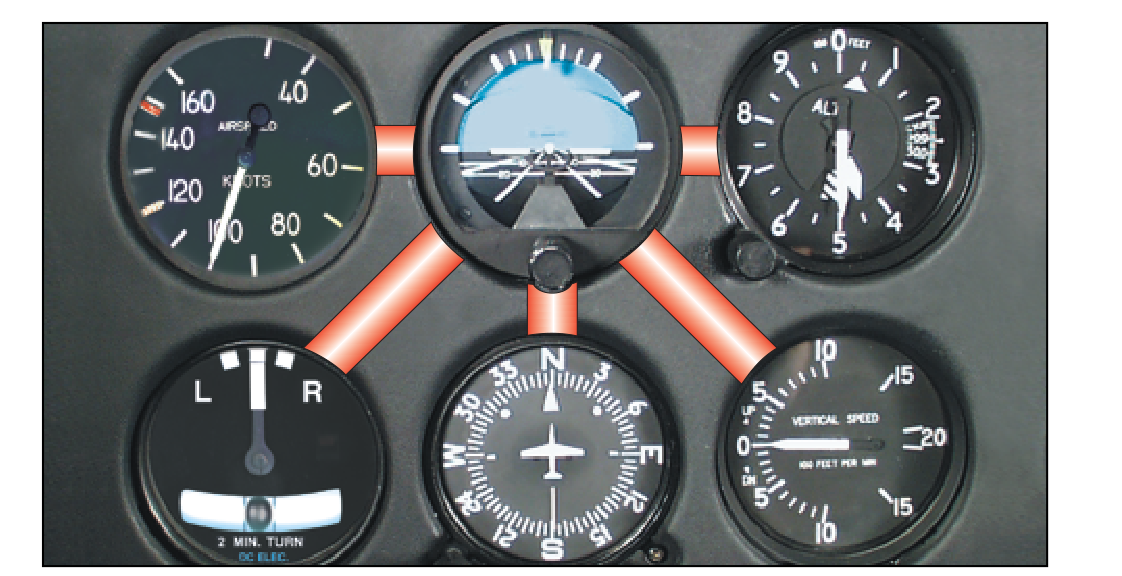
When a pilot transitions from visual flight to instrument flight, the eyes can no longer glance outside to confirm wings-level or verify a climb. Every piece of information about the aircraft's attitude, altitude, airspeed, and navigation must now come from a panel of gauges — and reading those gauges correctly, continuously, and in the right sequence is the single most important basic skill in instrument flying. That discipline is called the instrument cross-check, sometimes called the instrument scan. It is a structured habit of moving the eyes from instrument to instrument so that no single reading goes unchallenged and no developing deviation goes unnoticed long enough to become a crisis.
Instrument cross-check sounds simple — just look at all the gauges — but human visual and cognitive tendencies conspire against it in subtle and dangerous ways. Chief among those tendencies is fixation: the unconscious locking of attention onto one instrument while the others are ignored. The FAA Instrument Flying Handbook (FAA-H-8083-15) identifies fixation as one of the three primary errors in instrument cross-check, alongside omission (failing to include an instrument in the scan) and emphasis (overweighting one instrument's information relative to others). Understanding why these errors happen and how to correct them is fundamental to earning an instrument rating and, more importantly, to surviving flight in the clouds.
How the Cross-Check Works
Attitude instrument flying rests on a two-step process: first, you control the aircraft by setting a pitch-and-bank attitude on the attitude indicator; second, you cross-check the performance instruments — altimeter, airspeed indicator, vertical speed indicator, heading indicator, and turn coordinator — to verify that the attitude you have set is actually producing the desired flight path. Neither step is useful without the other.
The attitude indicator (AI) sits at the center of the scan because it provides the most immediate, direct picture of pitch and bank. Instrument instructors sometimes describe it as the "hub" of a wheel, with the other instruments as spokes. Every cross-check sequence begins and ends with a quick glance at the AI to confirm attitude before moving on to a performance instrument, and then back to the AI again before moving to the next spoke. This hub-and-spoke pattern is the selective radial scan recommended in FAA-H-8083-15 for most phases of flight.
During different phases of flight, you naturally emphasize different instruments. In straight-and-level cruise, you spend more time on the altimeter and heading indicator. In a climbing turn, you pay extra attention to the AI, airspeed, and turn coordinator. The key is that no instrument is ever dropped from the rotation entirely. Each instrument in the panel has a job, and each tells you something the others cannot.
What Each Instrument Tells You
- Attitude Indicator (AI): Immediate pitch and bank — the primary control reference. Errors here lead directly to unintended climbs, dives, or turns.
- Altimeter: Actual altitude. A slow drift on the altimeter is usually the first sign that pitch control is slightly off.
- Airspeed Indicator (ASI): Trend information. Airspeed rising means the nose is pitching down or power is increasing; airspeed falling warns of a pitch-up or decelerating condition.
- Vertical Speed Indicator (VSI): Rate of climb or descent. It lags by a few seconds before stabilizing, so it is used to confirm a trend, not to make immediate corrections.
- Heading Indicator (DI/HSI): Magnetic heading. Slow drift here reveals an unnoticed bank or a precessing gyro.
- Turn Coordinator: Rate of turn and quality of coordination (via the inclinometer/ball). Useful when the AI is unreliable as a partial-panel backup.
Fixation: What It Is and Why It Happens
Fixation is the involuntary fixation of attention on one instrument — usually one that is showing a problem — while the pilot subconsciously suppresses awareness of all others. It is not laziness or carelessness; it is a predictable cognitive response to stress or novelty. When the altimeter shows an unexpected 200-foot deviation, the brain locks onto it the same way a driver stares at an obstacle instead of steering around it. The eyes may still make brief excursions to other instruments, but the mind does not process those readings because cognitive resources are already consumed.
Classic fixation scenarios include: staring at the altimeter while trying to recapture altitude, staring at the heading indicator during an ATC course correction, or staring at the CDI needle during an ILS approach. In each case, the fixated instrument may actually improve — or the pilot may over-control it — while heading, airspeed, or bank wanders into dangerous territory.
The most dangerous consequence of fixation is the graveyard spiral. A pilot fixated on an altimeter showing a rapid descent may add back-pressure to stop the descent — but if the AI or turn coordinator (ignored during fixation) shows a 45-degree bank, back-pressure only tightens the spiral, increasing the rate of descent and the load factor simultaneously. The altimeter continues to unwind, the airspeed climbs past redline, and structural failure or ground impact can follow within seconds. This scenario is not hypothetical; it is a documented accident pattern associated with spatial disorientation compounded by fixation.
Omission and Emphasis: The Other Two Cross-Check Errors
Omission occurs when an instrument is simply left out of the scan, either habitually or situationally. A common example is ignoring the VSI during a cruise segment because the altimeter appears steady — and then being surprised when the altimeter begins to move, having missed the VSI's early trend indication. Another is leaving the turn coordinator out of the scan when autopilot monitoring is the primary task, only to discover too late that the autopilot has disconnected.
Emphasis is the opposite of fixation in degree but similar in effect: a pilot may scan all the instruments but mentally weight one so heavily that corrections are always made based on that single instrument while others are treated as minor background data. Novice instrument pilots often over-emphasize the VSI, making pitch corrections every time the VSI needle twitches — not realizing that the VSI's inherent lag means they are chasing old information and actually destabilizing the aircraft with repeated corrections.
Recognizing Fixation in Flight
Self-awareness is the first corrective tool. Ask yourself periodically: When did I last look at the heading indicator? When did I last cross-check the airspeed? If you cannot answer within a few seconds, you are likely fixating. Some instructors recommend a quiet verbal cue — saying the names of instruments as the eyes move: "AI — altimeter — AI — airspeed — AI — heading." The act of naming forces deliberate eye movement and engages a second cognitive channel that breaks the fixation loop.
Physical cues can also indicate that fixation has allowed a deviation to develop: an unexpected increase in control pressure, a change in background engine sound, or a subtle G-force shift may all signal that the aircraft's energy state has changed while attention was elsewhere.
Correcting Fixation: Practical Techniques
The fundamental correction for fixation is returning to the AI immediately, re-establishing the correct pitch-and-bank attitude, and then — with discipline — resuming the full radial scan rather than jumping to the instrument that was previously fixated. This sequence — attitude, then performance — prevents the common mistake of chasing one instrument while allowing others to drift.
For students who habitually fixate on the altimeter during altitude captures, a useful exercise is the "timed scan": use the second hand of the clock or the digital timer in the avionics to force a complete scan cycle every five to seven seconds. Over time, the timed discipline becomes automatic habit. During training under the hood, an instructor's role is partly to catch fixation early by asking "What's your heading?" or "What's your airspeed?" mid-maneuver — questions the student cannot answer if fixation has occurred.
Partial-panel flying — covering the attitude indicator to simulate a gyro failure — is another training technique that fundamentally retrains the scan. Without the AI, the pilot must distribute attention deliberately among the altimeter, ASI, VSI, and turn coordinator, which breaks any over-reliance on a single hub instrument.
Key Numbers and Rules
- The VSI typically lags a few seconds behind actual vertical speed changes — use it to confirm trends, not for immediate corrections.
- The attitude indicator is the primary control reference during instrument flight; all other instruments are performance references that validate the AI.
- During a normal instrument cross-check, return to the AI after every performance instrument check — it is never appropriate to chain multiple performance readings without an AI reference in between.
- The inclinometer (ball) in the turn coordinator indicates coordination; a centered ball confirms that yaw and bank are matched, while a skid or slip reveals rudder-aileron imbalance even when pitch appears correct.
- ATC standard instrument approaches and holding patterns require precise altitude and heading control — fixation errors compound fastest during high-workload, low-altitude, or low-visibility phases of flight.
Memory Aid
"Control, Performance, Navigation" is the FAA's framework for attitude instrument flying, drawn from FAA-H-8083-15. Each word anchors one category of instruments in the scan:
- Control instruments (AI, power instruments): Set the desired attitude.
- Performance instruments (altimeter, ASI, VSI, heading indicator): Confirm the attitude is producing the desired result.
- Navigation instruments (VOR, GPS, ILS): Confirm position and course relative to the planned route.
Remembering this hierarchy reminds you that the scan is not random — it flows from setting attitude, to checking performance, to confirming navigation, and back again.
Common Test Traps
- Fixation is not always obvious in the moment. Test questions may describe a scenario where a pilot is "closely monitoring" a deviation — which sounds careful, but is actually the definition of fixation if other instruments are being ignored.
- VSI lag confusion. The FAA knowledge test sometimes asks which instrument provides the most immediate indication of a pitch change. The answer is the attitude indicator (or in some questions, the airspeed indicator as an early trend indicator) — not the VSI, which lags.
- Omission vs. fixation. Omission means never including an instrument; fixation means including it but mentally locking onto one. These are tested as separate concepts with different corrective strategies.
- "Emphasis" error is easy to confuse with good airmanship. Paying extra attention to one instrument during a critical phase is appropriate; allowing that attention to degrade the rest of the scan is the error. The distinction is whether the full scan is still completed.
- Partial-panel priorities. On the knowledge test, questions about gyro failure ask which instruments take over. Remember: if the AI fails, the turn coordinator becomes the primary bank reference, and the altimeter and VSI together replace the AI for pitch trend information.