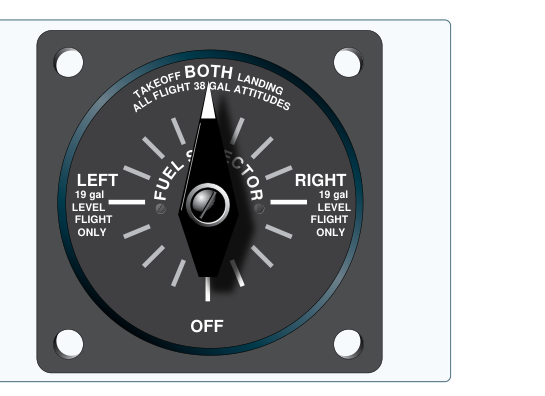
The fuel selector valve is one of the most mechanically straightforward yet operationally critical components in an aircraft fuel system. It serves as the pilot's primary means of managing fuel flow from multiple tanks, selecting the appropriate fuel source, or shutting off fuel entirely in an emergency. For the airframe technician, a thorough understanding of how selector valves are designed, how they function under normal and abnormal conditions, and how to properly inspect and maintain them is essential — both for passing the FAA knowledge and oral exams and for performing safe, airworthy maintenance in the field.
Fuel selector valves appear in virtually every certificated aircraft with more than one fuel tank, and even in single-tank designs where a simple shutoff valve is required. The valve sits in the fuel line between the tank or tanks and the engine-driven fuel pump, making it a gatekeeping device for everything downstream — the primer, the carburetor or fuel-injection system, and ultimately the engine itself. A valve that sticks, leaks, or selects the wrong position can cause engine starvation or fuel contamination, so the airframe technician must treat every inspection with the same diligence applied to primary flight controls.
How Fuel Selector Valves Work
At its core, a fuel selector valve is a flow-control device that uses a rotating or sliding internal element to align or block internal passages that correspond to different fuel tanks or to an off position. When the pilot moves the handle, the internal element rotates (or translates) to open a specific passage, allowing fuel from the selected tank to flow toward the engine while physically blocking flow from unselected tanks. The valve body is typically made from aluminum alloy or brass, and the internal rotary plug or ball is machined to close tolerances to prevent cross-contamination or leakage between ports.
Rotary Plug Valves
The most common type found in light general aviation aircraft is the rotary plug valve, sometimes called a cone valve. Inside the valve body, a tapered or cylindrical plug with machined channels rotates within a matching bore. Each rotational position aligns one set of channels with inlet and outlet ports, completing a flow path. These valves are simple, durable, and easy to safety-wire or lock into position. However, because the plug and bore are in direct contact, they are susceptible to fuel residue buildup, swelling of rubber seals, and corrosion — all of which can cause the valve to become stiff or impossible to move.
Ball Valves
Some modern aircraft use ball valves, in which a spherical element with a hole through its center rotates within the valve body. Turning the ball 90 degrees moves the hole from aligned (open) to perpendicular (closed). As with any selector valve design, ball valves must be inspected for seat wear, seal condition, and positive shutoff to ensure reliable operation.
Sliding (Gate) Valves
Less common in light aircraft but found in some older designs and military surplus airframes are sliding or gate valves, which use a plate or gate that moves linearly across the flow ports. These valves can be prone to sticking when fuel varnish accumulates on the sliding surfaces and are generally more complex to service.
Detent Positions and Placarding
Regardless of type, fuel selector valves are engineered to have positive detent positions — mechanical stops or spring-loaded notches that hold the valve firmly in each selectable position (e.g., LEFT, RIGHT, BOTH, OFF). This is a critical safety feature; a valve that can rest between detents may partially block flow from both tanks or create an ambiguous flow path. Fuel selector placards must be clearly visible to the pilot and accurately describe each position, consistent with placarding and markings requirements under 14 CFR 23.1555 and the operating-limitations provisions of 14 CFR 91.9. The positions must correspond exactly to the internal porting of the valve — a mismatch between the placard and the actual flow path is an airworthiness discrepancy that must be corrected before flight.
Types by Function: Simple Shutoff vs. Multi-Position Selectors
Not every aircraft uses a complex multi-position selector. A simple on/off shutoff valve is acceptable when the aircraft has a single fuel tank feeding a single engine. This valve has only two positions and is often incorporated directly into the fuel strainer bowl assembly. In contrast, high-wing aircraft like the Cessna 172 (in some configurations) use a BOTH position that draws simultaneously from both wing tanks through a common line, while other designs require the pilot to select LEFT or RIGHT individually and periodically switch tanks to maintain lateral balance. Aircraft with BOTH positions use a valve body configured so both tank inlet ports are simultaneously connected to the outlet port when BOTH is selected.
Some larger single-engine and twin-engine aircraft add a crossfeed position that allows one engine to draw from the opposite wing's tank, providing fuel management flexibility during abnormal operations. Crossfeed valves are more complex, with additional ports and internal passages, and require careful inspection to confirm that crossfeed does not occur inadvertently when the valve is in the normal feeding positions.
Why Fuel Selector Valve Condition Matters
Engine fuel starvation is a leading cause of power loss in piston aircraft, and a significant number of starvation accidents result not from empty tanks but from fuel selector mismanagement — either the pilot fails to switch tanks, or the valve is not fully in the selected position. From the maintenance standpoint, a valve that is stiff, has a loose handle, or does not seat firmly in its detents actively contributes to this accident chain. Similarly, internal leakage past the valve plug can allow fuel to siphon from one tank to another on the ground (cross-tank migration), causing the aircraft to depart with an unexpected lateral fuel imbalance.
A leaking valve in the OFF position is particularly hazardous. If the valve does not fully shut off when selected to OFF, the pilot cannot stop fuel flow to a fire-affected engine or in a fuel system emergency. This is why every scheduled inspection must verify positive shutoff, not just visible freedom of movement.
Inspection Procedures
Fuel selector valve inspection is addressed in the Aircraft Maintenance Manual (AMM) for each specific aircraft and is guided by the principles in the Aviation Maintenance Technician Handbook — Airframe (FAA-H-8083-31). The following steps represent the core inspection process applicable to most general aviation designs.
- Visual inspection: Examine the valve body, fittings, and fuel lines for cracks, corrosion, chafing, and fuel staining. Staining around the valve body indicates weeping past the plug seals — a condition requiring immediate attention.
- Handle and linkage check: Verify that the handle moves smoothly and positively into every detent position. A handle that requires excessive force, skips detents, or feels gritty may indicate internal corrosion, worn seals, or varnish buildup. Confirm that the external position indicator (placard or index mark) accurately corresponds to the internal valve position.
- Detent integrity: Confirm that the valve stays in each selected position without drifting. Apply a light lateral force to the handle to simulate cockpit vibration and confirm no movement.
- Flow check: With tanks filled to a known level, confirm fuel flows freely from each selectable tank position and is fully blocked in the OFF position. This may require a bench flow test after removal or a careful in-aircraft test per the AMM.
- Leakage check: With the valve in OFF, confirm no fuel drips or flows past the valve into the outlet line. Any leakage past a closed valve is cause for replacement or overhaul.
- Screen or strainer inspection: Many fuel selector valves incorporate a fine mesh screen at the inlet ports. This screen should be removed, cleaned with an approved solvent, inspected for damage, and reinstalled with new gaskets or O-rings as required.
- Seal and O-ring condition: During any disassembly, inspect all seals for swelling, cracking, hardening, or deterioration. Use only seals approved for fuel service and compatible with the aircraft's fuel type (100LL or jet fuel as applicable).
Key Numbers and Rules
- Fuel selector valves must be accessible and operable by the pilot from the seated position — a requirement rooted in 14 CFR Part 23 design standards.
- Each selectable position must be clearly and unambiguously placarded; the placard must match actual valve function.
- Valves must incorporate positive detents so the handle cannot rest between positions under normal vibration.
- Under 14 CFR 23.995, fuel systems must incorporate a means to shut off fuel to each engine, though the specific configuration and exceptions depend on tank arrangement and system design — technicians should consult the applicable type certificate data and AMM rather than assume a blanket requirement for every individual tank.
- Any repair or replacement of a fuel selector valve is a return-to-airworthy-condition task that requires a logbook entry, a runup or leak check, and sign-off by a certificated airframe mechanic (or IA if the task falls within an annual inspection).
- Replacement seals must be fuel-compatible; petroleum-based O-rings should never be substituted for Buna-N or Viton seals rated for aviation gasoline service.
Common Test Traps
- Confusing starvation with exhaustion: Engine failure from a valve left in OFF or pointing to an empty tank is fuel starvation (fuel available but not reaching the engine), not fuel exhaustion (all fuel consumed). The distinction appears on FAA knowledge tests.
- Assuming BOTH is always best: In high-wing aircraft where BOTH draws from both tanks simultaneously, this position may be appropriate for takeoff and landing per the POH, but it can cause cross-flow problems in some aircraft. Maintenance students should understand that the BOTH position does not always mean equal draw — tank venting and head pressure differences can cause one tank to drain preferentially.
- Overlooking internal leakage: A valve that visually appears fine and moves smoothly can still leak internally in the OFF position. Physical flow testing, not just visual inspection, is required to confirm shutoff integrity.
- Mixing seal materials: Using the wrong O-ring compound can cause rapid seal swelling and valve seizure or, conversely, seal shrinkage and leakage. Always verify material compatibility with the specific fuel type before installation.
- Placard vs. actual position mismatch: After any valve removal and reinstallation, confirm that handle positions and placard markings agree with actual internal flow paths. Reinstalling a valve rotated out of its correct orientation is a serious maintenance error that can lead to fuel mismanagement or engine stoppage in flight.