Introduction
Every reciprocating aircraft engine relies on its magneto-based ignition system to fire the spark plugs at precisely the right moment. But the magneto is a self-contained electrical generator — once the engine is turning fast enough, the magneto produces high-voltage spark on its own, independent of the aircraft's battery or bus. That independence is a safety advantage in flight, but it creates a critical ground-safety concern: how do you stop a magneto from firing? The answer lies in the P-lead circuit and the ignition switch, two deceptively simple components that every aviation maintenance technician (AMT) must understand thoroughly.
This article covers how the ignition switch and P-lead work together, what happens electrically when you rotate the key through each position, how to test the system correctly, and what failures look like — including the dangerous scenario of a magneto that is electrically "off" but mechanically ready to fire.
How the Magneto Ignition System Works
A magneto is a permanent-magnet AC generator combined with a breaker-point assembly (or electronic triggering), a capacitor, a high-voltage coil, and a distributor. As the engine rotates the magneto's rotor magnet past the primary coil, it induces a rising current. At the precise firing angle, the breaker points open (or the electronic trigger fires), the primary circuit collapses, and the collapsing magnetic field induces a very high voltage in the secondary winding — typically 15,000 to 20,000 volts. That pulse travels through the distributor to the correct spark plug.
The key insight is that the magneto generates its own electricity internally. The aircraft's master switch and battery have no role in making a magneto fire during normal engine operation. This is why a magneto ignition system continues to work even with a complete electrical system failure in flight — an important airworthiness feature.
The Role of the P-Lead
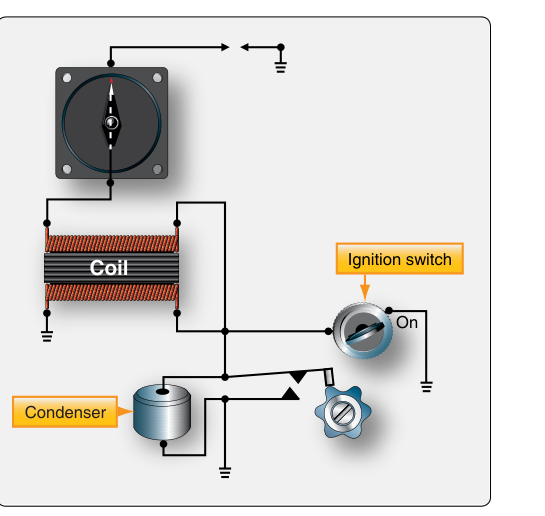
Because the magneto is electrically self-sufficient, the ignition switch cannot simply "cut power" to it the way a light switch cuts power to a lamp. Instead, the ignition system uses a primary lead, universally called the P-lead, to control the magneto. The P-lead is a shielded wire that connects the magneto's primary circuit (the low-voltage side, between the breaker points and the primary coil) directly to the ignition switch.
When the ignition switch is in the ON position, the P-lead circuit is open. The primary circuit inside the magneto functions normally — current builds and collapses in the primary winding with each breaker-point opening, and the magneto fires the plugs.
When the ignition switch is moved to the OFF position, the switch closes the P-lead circuit, creating a path to ground for the magneto's primary circuit. With the primary continuously grounded, the breaker points can no longer induce a primary current collapse — there is no voltage build-up, no collapsing field, and no high-voltage pulse in the secondary. The magneto is effectively disabled.
This inverted logic — switch closed means magneto OFF, switch open means magneto ON — surprises many students but is fundamental to understanding P-lead failures.
Ignition Switch Positions
A standard four-position ignition switch is labeled OFF – R – L – BOTH (sometimes with a spring-loaded START position as well). Here is what happens at each position:
- OFF: Both the Left and Right magneto P-leads are grounded. Neither magneto can fire. The engine will not run.
- R (Right): The Right magneto P-lead is open (right mag fires). The Left magneto P-lead is grounded (left mag is disabled). Only the right magneto powers the plugs.
- L (Left): The Left magneto P-lead is open (left mag fires). The Right magneto P-lead is grounded (right mag is disabled). Only the left magneto powers the plugs.
- BOTH: Both P-leads are open. Both magnetos fire simultaneously. Each cylinder receives two sparks per firing event, from two independent ignition sources. This is the normal in-flight position.
- START (if equipped): Energizes the starter motor while typically keeping both magnetos active (BOTH position maintained). Some designs include an impulse coupling engagement at this position.
The Magneto Check — Testing the P-Lead in Practice
The pre-takeoff magneto check (run-up) is not just a test of the magnetos themselves — it is also a P-lead continuity check. During the run-up, the pilot rotates the switch from BOTH to R, then back to BOTH, then to L, and back to BOTH. At each single-magneto position, a small, acceptable RPM drop (typically no more than 125 RPM drop on either mag, and no more than 50 RPM differential between the two, though always check the specific aircraft POH) confirms the magneto is operating but with only half the ignition firing. This verifies plug and magneto health.
Equally important: when the switch passes through or is placed at OFF, the RPM should drop to zero (engine stops). If the engine continues to run with the switch at OFF, that is a clear sign of a broken or disconnected P-lead. Without a ground path, the magneto behaves as if the switch is in the ON position — it cannot be shut down electrically. This condition is extremely dangerous and must be corrected before further flight.
P-Lead Failure Modes and Safety Implications
Understanding P-lead failure modes is critical for both technicians and pilots.
Open P-Lead (Broken or Disconnected)
If a P-lead breaks, corrodes open, or becomes disconnected at either the magneto or the switch end, the affected magneto cannot be grounded. The ignition switch will appear to work normally because the other magneto is still controlled by its intact P-lead. However, turning the switch to the OFF position will not disable the affected magneto. The engine may appear to shut down (because the other, functioning magneto is properly grounded), but the magneto with the broken P-lead remains hot — electrically live and ready to fire if the propeller moves even slightly. This is the classic "hot mag" hazard.
A hot mag is a serious danger during propeller hand-turning for inspection, servicing, or prop-pull starts. Any rotation of the propeller can cause the hot magneto to fire a plug and kick the propeller violently. Mechanics must always treat a propeller as if the engine could start, and verifying P-lead continuity before hand-turning is essential.
Shorted P-Lead (Grounded When It Shouldn't Be)
If a P-lead shorts to ground inside its shielding or elsewhere, the affected magneto is permanently grounded — the switch effectively reads as OFF for that magneto regardless of position. The magneto will not fire under any switch position. This is less dangerous from a ground-safety perspective but will cause an in-flight single-magneto failure. During the magneto check, the RPM drop when switching to the affected magneto will be very large (essentially engine stoppage or severe roughness), alerting the pilot to the problem before flight.
Shielding and Electromagnetic Interference
P-leads are shielded cables — a grounded outer braid surrounds the insulated inner conductor. This shielding prevents the high-frequency electrical pulses present in the magneto primary circuit from radiating as electromagnetic interference (EMI), which could disrupt onboard avionics. The outer shield itself must be properly grounded at both the magneto and switch ends; a shielding ground failure can cause radio interference without affecting ignition function.
Key Numbers and Rules
- P-lead logic: Switch OPEN = Magneto ON. Switch CLOSED (grounded) = Magneto OFF. Remember this is reverse of normal switch logic.
- Hot mag test: After engine shutdown, briefly turn the switch to OFF, then momentarily to BOTH — if the engine tries to fire, a mag is hot (P-lead fault on the grounded mag is working, but the hot mag is not being controlled).
- Typical max RPM drop during mag check: 125 RPM per mag, with no more than 50 RPM differential between left and right (verify in applicable POH/engine manufacturer data).
- Engine runs with switch at OFF: Indicates an open P-lead — a grounding defect. Aircraft is grounded until repaired.
- Engine won't run on one mag position: May indicate a shorted P-lead (permanently grounded magneto) or a failed magneto — requires maintenance inspection.
- 14 CFR Part 43: P-lead replacement and magneto inspection are maintenance tasks requiring a certificated technician with an appropriate rating.
Common Test Traps
- Thinking OFF means "no power to the mag": The magneto makes its own power. OFF means the P-lead grounds the primary circuit — do not confuse this with cutting battery power to an ignition coil.
- Confusing a broken P-lead symptom: A broken P-lead causes the engine to continue running when the switch is placed at OFF (or to not lose RPM when switching to that magneto's single position during run-up). Students often expect the opposite.
- Assuming the magneto is safe when the switch is off: A broken P-lead means the magneto is fully active regardless of switch position. The propeller is never safe to hand-turn without verifying P-lead integrity first.
- Mistaking a shorted P-lead for a failed magneto: A shorted P-lead produces the same cockpit symptom as a dead magneto during the mag check — extremely high RPM drop on that position. Proper diagnosis requires removing the P-lead and testing magneto output directly.
- Ignoring EMI shielding in avionics troubleshooting: A P-lead with degraded outer shielding can cause radio static or compass interference without any ignition malfunction. The fix is replacing the shielded P-lead, not the radio or magneto.
Practical Maintenance Notes
When replacing or inspecting a P-lead, technicians must ensure the connection at the magneto is secure and corrosion-free, the outer shield is properly grounded, and the insulation of the inner conductor is intact. A simple continuity test with the switch in the OFF position should show a grounded primary circuit at the magneto. With the switch in the ON position, the primary circuit should be open (no continuity to ground through the P-lead path). Always consult the engine manufacturer's maintenance manual and 14 CFR Part 43 for approved maintenance procedures before performing ignition system work.
Understanding the P-lead circuit is not merely academic — it is directly connected to ground safety around propellers, in-flight reliability, and the correct interpretation of magneto check results. Mastery of this topic is essential for any AMT working on reciprocating aircraft engines.