Of all the tasks an aviation powerplant technician performs, few are more consequential than setting magneto-to-engine timing. Get it right and the engine develops full rated power with smooth, reliable operation. Get it wrong and the consequences range from hard starting and power loss all the way to catastrophic engine damage or an uncontrolled start on the ground. This article walks through the complete theory, the hardware involved, the step-by-step logic of the timing process, and the practical pitfalls that appear on FAA knowledge tests and in the hangar alike.
Magneto-to-engine timing — sometimes called external timing or ignition timing — defines the crankshaft angle at which the magneto's breaker points open (or, in impulse-coupled and electronic systems, at which the high-voltage discharge is triggered) relative to top dead center (TDC) of the piston on the compression stroke. Nearly all certified aircraft reciprocating engines require that the spark occur before TDC — a condition called spark advance — so that the expanding flame front reaches peak pressure just as the piston passes TDC and begins its power stroke.
Why Spark Must Occur Before TDC
Combustion is not instantaneous. From the moment the spark plug fires, the flame kernel must propagate outward through the fuel-air charge. This propagation time is relatively constant in absolute terms, though it is influenced to some degree by engine RPM, turbulence, and mixture conditions. Because the crankshaft is rotating rapidly, this roughly constant burn time translates into more degrees of crankshaft rotation as RPM increases — which is part of why some magneto and ignition systems use RPM-sensitive spark advance. If the spark fired exactly at TDC, the piston would already be well into the power stroke before pressure peaked, wasting much of the available energy. By advancing the spark so it fires before TDC, the flame front arrives at peak pressure right at the optimal crank position. The specific advance angle is determined by the engine manufacturer through extensive testing and is published in the Type Certificate Data Sheet (TCDS) and the engine maintenance manual.
Internal vs. External Timing
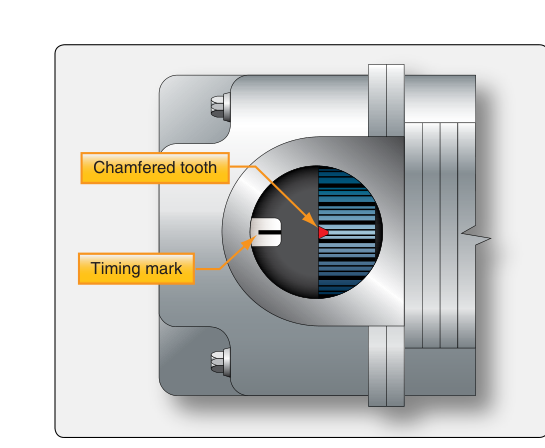
Internal timing refers to the relationship between components inside the magneto itself — specifically, the position of the rotating magnet relative to the breaker points (or electronic trigger). Internal timing sets the E-gap (efficiency gap), the precise rotor position at which the magnetic flux change through the coil is most rapid, producing the strongest possible primary current collapse and thus the highest secondary voltage spike. The E-gap position is established during magneto assembly or overhaul and is typically checked by aligning a timing mark on the distributor gear or rotor housing with a reference mark on the magneto body while the points are just opening. Internal timing is a prerequisite: if it is incorrect, external timing cannot compensate.
External timing is what the technician sets during installation — aligning the magneto's firing event to the correct crankshaft position. The two tasks are complementary, and both must be correct for the ignition system to function properly.
Timing Marks on the Engine
Aircraft engine timing marks are physical reference points that allow the technician to know exactly where the crankshaft is in its rotation. Their location varies by engine family but the principle is universal.
Opposed (Lycoming and Continental) Engines
On horizontally opposed engines, timing marks are most often found on the propeller flange or on a starter ring gear visible through a small inspection hole in the engine case. A fixed pointer or witness mark on the case serves as the reference. Common markings include a line or notch labeled with the advance angle (for example, 25° BTC, meaning 25 degrees before top center) and a separate mark for TDC. The technician rotates the propeller by hand — always in the direction of normal rotation — while watching the timing marks until the specified advance mark aligns with the fixed pointer, with the number-one cylinder on its compression stroke. Confirming the compression stroke (rather than the exhaust stroke, which also brings the piston near TDC) is critical; this is done by feeling for pressure at the spark plug hole or by watching the intake valve close as TDC approaches.
Radial Engines
Radial engines typically use a knuckle pin or crankshaft timing mark visible through a window in the nose case, or a graduated scale on the propeller shaft housing. Because radial engines have many cylinders arranged around a single throw crankshaft, the timing reference is always set relative to the number-one cylinder — the master rod cylinder — at the specified advance angle before its TDC on the compression stroke.
The Timing Procedure: Step by Step
- Remove the top spark plugs from all cylinders to eliminate compression resistance, making it easy to rotate the propeller by hand and to feel or see the compression stroke.
- Rotate the propeller in the direction of normal engine rotation until the number-one cylinder is approaching TDC on its compression stroke. Confirm by placing a finger over the plug hole — you will feel air being pushed out as the piston rises.
- Continue rotating until the specified timing mark (for example, 25° BTC) aligns with the fixed pointer on the engine case.
- Connect a timing light or magneto timing device (a simple battery-powered continuity light or a dedicated ignition timing tester) across the breaker points of the magneto. The light will be ON when the points are closed and will go OFF — or the tester will signal — at the moment the points open.
- Install the magneto loosely on the engine so it can be rotated for adjustment. With the engine at the timing mark, slowly rotate the magneto body until the timing light indicates the points are just opening (the light just goes out). At this instant, both the engine and the magneto are at their correct relative positions.
- Tighten the magneto hold-down hardware to the torque value specified in the maintenance manual without allowing the magneto to shift. Recheck the timing light indication after torquing, because tightening can move the magneto slightly.
- Verify with a final check: rotate the propeller backward a small amount (to eliminate backlash), then slowly advance it forward again through the timing mark while watching the light. Confirm the points open precisely at the specified mark.
Impulse Couplings and Their Effect on Timing
Most small aircraft engines use an impulse coupling on the left magneto (sometimes both). The impulse coupling temporarily holds the magneto rotor slightly behind its driven position during starting, then releases it with a snap — increasing rotational velocity for a brief moment to generate a strong spark at low cranking RPM. It also automatically retards the spark during starting to prevent kickback. When timing an impulse-coupled magneto, the technician must distinguish between the advanced position (normal running timing) and the retarded firing position used at start. Manufacturers' manuals specify which position to use for the timing check; commonly, the static timing check is performed at the retarded (impulse) firing position, since the impulse coupling engages and holds the rotor in this retarded position during cranking, and the technician must follow the specific manufacturer's procedure to hold or trigger the coupling correctly for an accurate reading.
Key Numbers and Rules
- Timing specification: Always from the engine manufacturer's manual and TCDS — typical values range from roughly 20° to 30° BTC for many certified opposed engines, but the exact figure varies by model and must never be assumed.
- Direction of rotation: Always rotate the propeller in the direction of normal engine rotation when approaching the timing mark; approaching from the wrong direction introduces backlash error.
- E-gap: The internal timing angle at which the magneto's points should open; the exact angle of magnet rotation past the neutral position is magneto-model specific and must be obtained from the applicable magneto manufacturer's overhaul manual rather than assumed.
- After timing, safety the propeller: With spark plugs removed and ignition leads connected, the engine is live; treat the propeller as if the engine could start at any time.
- Dual magneto check: After reinstallation, an engine run-up magneto check (typically comparing single-magneto RPM drop against limits in the POH/AFM) confirms proper timing in operation.
Common Test Traps
- Confusing BTC with ATC: Timing marks labeled BTC (before top center) advance the spark; ATC (after top center) would retard it. Nearly all certificated reciprocating engines require spark advance (BTC). A question that asks what happens if timing is set too far advanced (detonation, overheating) versus too far retarded (power loss, high CHT at high power) tests this understanding directly.
- Ignoring the compression stroke: Setting timing on the exhaust stroke instead of the compression stroke places the spark 180° off. Always confirm which stroke the number-one piston is on before finalizing timing.
- Not accounting for the impulse coupling: Failing to follow the manufacturer's specified procedure for the impulse coupling during static timing will produce a timing reading that appears correct on the tester but is actually wrong for normal operation.
- Forgetting to recheck after torquing: The magneto can shift as the hold-down bolts are tightened, advancing or retarding timing from the set position. A recheck after torquing is not optional — it is required practice.
- Mixing up internal and external timing: A question may describe symptoms (weak spark despite correct external timing) that point to an internal E-gap problem. Recognizing that internal timing must be verified independently of external timing is a key exam and practical skill.
Magneto-to-engine timing is a discipline that rewards methodical attention to detail. Every step — confirming the correct stroke, approaching the timing mark in the right direction, accounting for impulse coupling behavior, and rechecking after torque — exists because small errors produce real consequences in a running engine. Mastering the logic and the hardware behind timing marks is foundational knowledge for any powerplant technician seeking FAA certification.