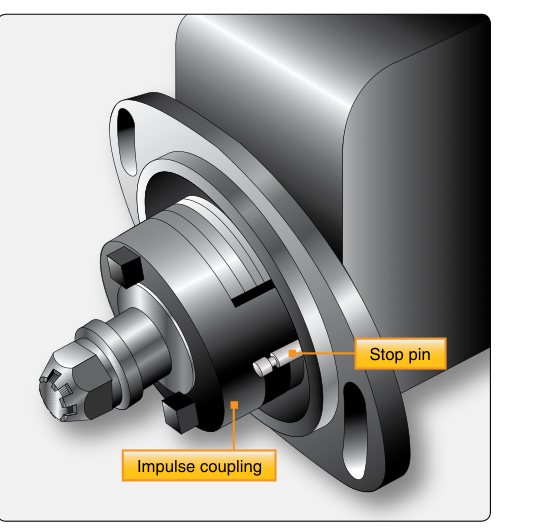
Starting a piston aircraft engine presents a unique ignition challenge: at cranking speeds, the magneto rotor spins far too slowly to generate the high-voltage surge needed to fire a spark plug against the compression pressure in the cylinder. The solution engineers developed decades ago is a clever mechanical device called an impulse coupling. Fitted between the engine accessory drive and the magneto rotor shaft, an impulse coupling stores rotational energy like a tiny spring-loaded trap, then releases it in a sudden snap that briefly spins the magneto rotor at a speed high enough to produce a strong ignition spark — even while the engine itself is barely turning. Understanding exactly how this device works, why it matters for safe engine starting, and how to inspect and maintain it is essential knowledge for every Aviation Maintenance Technician (AMT) working on powerplants.
Impulse couplings are most commonly found on one magneto — typically the left — of horizontally opposed aircraft engines, though the exact arrangement and which magneto fires which set of spark plugs varies by engine model and manufacturer, so the AMT should always consult the specific engine and magneto manufacturer's maintenance data rather than assume a universal configuration. Some older designs and certain radial engine installations use impulse couplings on both magnetos. When the engine starts and reaches self-sustaining rpm, the impulse coupling automatically stops engaging and the magneto operates in its normal, direct-drive mode for the rest of the flight.
How the Impulse Coupling Works
An impulse coupling is essentially a spring-loaded flyweight mechanism housed in a small shell that mounts between the magneto drive gear and the magneto rotor shaft. Its operation involves three coordinated events: latching, energy storage, and release.
As the engine is hand-propped or starter-cranked through its compression stroke, the coupling shell begins to rotate with the accessory drive. Inside, a set of flyweights (also called stop pins or dogs, depending on design) engage a fixed stop on the magneto body. This causes the inner rotor shaft to momentarily hold back while the outer shell continues to rotate. During this brief lag, a coiled mainspring inside the coupling winds up, storing energy.
At a precise point — corresponding to the correct retarded spark timing position for starting, which varies by engine design and is specified in the manufacturer's maintenance data — the flyweights snap off the stop. The stored spring energy is instantly released, driving the magneto rotor through a rapid angular acceleration. This momentary high-speed spin produces the strong, snappy magnetic flux change the magneto needs to generate a high-voltage output capable of jumping the spark plug gap under compression.
The retarded timing effect is critical to safety. If a magneto fired at full advance timing during hand-starting, the resulting early spark could cause the engine to kick back violently against the starter or the hand of someone hand-propping — a potentially fatal hazard. The impulse coupling retards the timing for starting to a value specified by the manufacturer, then stops engaging at normal operating rpm so the magneto resumes full advance firing timing for efficient cruise performance.
Types of Impulse Couplings
Most general aviation engines use one of two basic impulse coupling designs. The single-flyweight type uses one weighted arm that catches a single stop pin. The more common dual-flyweight type uses two opposing flyweights and provides a smoother, more balanced action. In both cases, the fundamental spring-latch-snap principle is identical. Some manufacturers also build impulse couplings integral with the magneto drive flange, while others use a separate coupling assembly bolted to the magneto inlet shaft. The AMT must know the specific design used on the engine being serviced because disassembly and spring-loading procedures differ.
Why Impulse Couplings Matter
Without a functioning impulse coupling, starting a magneto-equipped piston engine becomes difficult at best and dangerous at worst. A weak or failed coupling produces a feeble spark that may not ignite the fuel-air mixture reliably, leading to hard starting, backfiring, or no start at all. More seriously, a coupling that is sticking, broken, or improperly timed can cause the magneto to fire with full advance timing at cranking speed — creating the kickback hazard mentioned above.
Beyond starting, a malfunctioning impulse coupling that fails to stop engaging at run-up speed can cause the magneto to produce retarded spark timing during normal flight operations, resulting in rough running, loss of power, high fuel consumption, and elevated exhaust gas temperatures. Pilots and mechanics sometimes misdiagnose this condition as a fouled plug or a failing magneto, when the true cause is a worn or broken impulse coupling that no longer releases cleanly.
Because the coupling operates under repeated impact loading (the snap-release action creates a shock load on the spring and flyweights every start cycle), its components wear over time. Springs can weaken, crack, or fracture; flyweights can wear at their pivot points; stop pins can become rounded or broken. These failures can be insidious because the coupling may still produce some spark during a pre-flight magneto check, yet be unable to fire reliably under the higher compression pressures of a cold start.
Inspection Procedures
Inspection of the impulse coupling is typically performed during each annual inspection and anytime ignition system discrepancies are investigated. The process follows the engine and magneto manufacturer's maintenance manual instructions precisely. The general steps and checks described here reflect guidance found in FAA powerplant maintenance references.
Visual and Physical Check
With the magneto removed from the engine per the manufacturer's procedure, the mechanic examines the coupling externally for cracks, corrosion, and security of all retaining components. The coupling shell should be free of dents or deformation. The flyweights (where visible without disassembly) should pivot freely but without excessive slop. Any sign of oil or fuel contamination on the coupling warrants further investigation, as lubrication in the wrong location can alter flyweight release characteristics.
Spring and Flyweight Inspection
When the manufacturer's instructions require coupling disassembly, the mainspring is removed and inspected for cracks, set (permanent deformation), or corrosion. A cracked or weakened spring must be replaced — never bent back into shape or reused. Flyweights are checked for wear at pivot pins and contact surfaces. The stop-pin surfaces on the flyweights and the fixed stop should show minimal rounding; if wear exceeds manufacturer limits, replacement is required.
Operational (Functional) Check
After reassembly, the coupling is checked for correct operation. When rotated slowly by hand in the direction of normal rotation, the flyweights should latch against the stop smoothly and the spring should wind with increasing resistance. At the correct release point, the rotor should snap forward with an audible click and a distinct kick felt through the hand. If the release is sluggish, occurs too early or too late, or produces only a weak snap, the coupling must be serviced or replaced. The AMT can also perform a rough timing check to verify that the spark occurs at the retarded position appropriate for starting.
Reinstallation and Timing
After inspection or replacement, the magneto must be retimed to the engine per the manufacturer's specifications. This involves aligning the engine to the correct number of degrees before top dead center on the compression stroke of the cylinder specified by the manufacturer, then setting the magneto's internal timing (E-gap position) and installing the unit so that the points break — or the sensor triggers — at that precise moment. An improperly timed magneto with an impulse coupling can negate all the safety benefits the coupling is designed to provide.
Key Numbers and Rules
- Timing retard at start: The impulse coupling retards spark timing for starting to a value near top dead center relative to the engine's normal full-advance timing setting; the exact retard angle and normal advance timing figures vary by engine model and are specified in the manufacturer's maintenance data, reducing kickback risk.
- Disengagement behavior: Impulse couplings are designed so the flyweight/spring mechanism stops engaging the stop pins once the engine accelerates past cranking speed and reaches self-sustaining rpm, ensuring the retard feature is only active during starting; specific rpm thresholds are not standardized and depend on the individual coupling design per the manufacturer's data.
- Spring replacement: Impulse coupling springs must be replaced at overhaul intervals or whenever signs of fatigue, cracking, or weak snap action are found — springs are never repaired or re-formed.
- Single vs. dual magneto systems: In many dual-magneto systems, only one magneto (commonly the left) has an impulse coupling; the configuration of the other magneto varies by installation and is specified in the manufacturer's maintenance data.
- Magneto removal required: Full coupling inspection and disassembly must be done with the magneto removed; attempting coupling inspection on the engine without removal is not acceptable for any but the most cursory visual check.
Common Test Traps
- Confusing impulse coupling function with ignition switch grounding: The ignition switch grounds the primary circuit to stop the magneto; the impulse coupling is purely a mechanical timing and voltage-boosting device. They are completely separate functions.
- Assuming both magnetos have impulse couplings: On most light aircraft engines, only one magneto (commonly the left) has an impulse coupling. The configuration of the other magneto for starting assistance varies by installation and should be verified against the manufacturer's data.
- Misidentifying the cause of hard starting as spark plug fouling: A worn or broken impulse coupling spring can cause hard starting or no-start conditions that mimic fouled plugs. Always consider the coupling during ignition troubleshooting.
- Overlooking the retiming requirement after coupling replacement: Simply swapping a new impulse coupling without re-checking and resetting magneto-to-engine timing is an incomplete job and a potential airworthiness violation.
- Failing to check snap action during inspection: A coupling that does not produce a crisp, audible snap when manually rotated through its release point is defective, even if no visible damage is present. Functional testing is mandatory — visual inspection alone is insufficient.