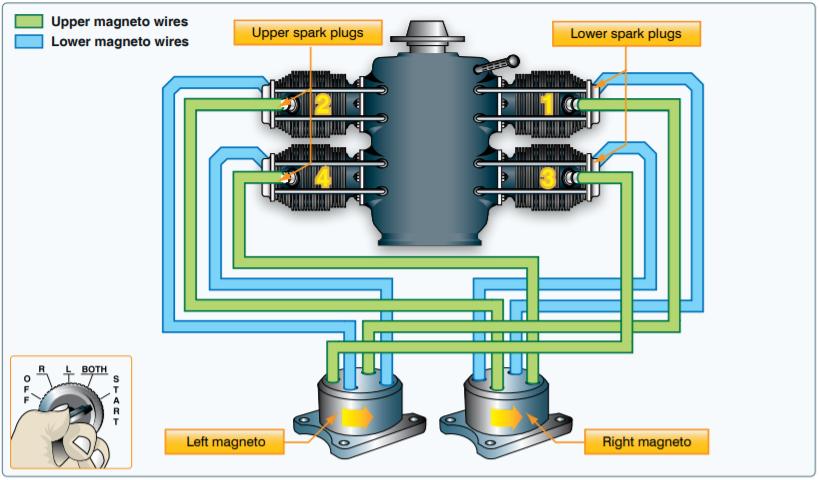
Every piston-powered aircraft engine relies on a precisely timed spark to ignite the fuel-air mixture inside its cylinders. Unlike an automobile, which depends on the car's battery and alternator to power its ignition system, a certificated aircraft uses magnetos — self-contained, engine-driven generators that produce their own high-voltage electricity. Understanding how magnetos work, why aircraft have two of them, and what the cockpit checks reveal is fundamental knowledge for every private pilot candidate.
The magneto ignition system is one of the most elegantly simple and safety-critical systems on a piston aircraft. It requires no external electrical power to operate, meaning the engine will continue running even if the battery dies and the alternator fails completely. That single characteristic makes the magneto system a cornerstone of aircraft engine reliability.
How the Magneto System Works
A magneto is essentially a small permanent-magnet generator built directly into the engine and driven by the engine's accessory drive. As the engine rotates, it spins a set of permanent magnets past a coil of wire (the primary coil). This spinning magnetic field induces a low-voltage current in the primary coil. At precisely the right moment — determined by the position of a rotating contact breaker, or points — the primary circuit is suddenly opened. This rapid collapse of the magnetic field induces a very high voltage (commonly cited as around 20,000 volts or more, depending on plug gap and conditions) in a secondary coil wound around the same core. That high-voltage pulse travels through shielded ignition leads to the spark plug, where it jumps the gap and ignites the fuel-air mixture.
The timing of this spark relative to the position of the piston is critical. The spark is fired slightly before the piston reaches top dead center (TDC) on the compression stroke — a setting called ignition advance. This gives the fuel-air mixture just enough time to begin burning and reach peak pressure right as the piston passes TDC and starts its power stroke, extracting maximum work from each combustion event. Ignition timing is set by the mechanic during maintenance and is not adjustable by the pilot in flight.
The Dual-Magneto System: Redundancy by Design
Nearly all certificated piston aircraft engines are equipped with two completely independent magnetos — commonly referred to as the left magneto and the right magneto, though the exact designation can vary by engine and POH. Each magneto has its own set of points, its own coil, and its own set of ignition leads. Each cylinder has two spark plugs: one fired by the left magneto and one fired by the right magneto.
This dual arrangement provides two layers of benefit. First, it is a true redundancy: if one magneto fails completely in flight, the engine continues to run on the other magneto with only a modest reduction in power. Second, having two spark plugs per cylinder ignites the fuel-air mixture at two points simultaneously. This twin-flame propagation burns the charge more completely and more quickly, improving combustion efficiency, reducing the chance of detonation, and producing slightly more power than a single plug alone.
The ignition switch in the cockpit controls both magnetos. Its positions are typically labeled OFF, R (right), L (left), BOTH, and sometimes START. In normal flight, the switch is always in the BOTH position, using both magnetos simultaneously. The R and L positions allow the pilot to isolate one magneto at a time — which is exactly what the pre-takeoff magneto check accomplishes.
The Pre-Takeoff Magneto Check (Run-Up)
Before every takeoff, pilots perform an engine run-up that includes a magneto check to verify that each magneto is functioning properly and that the ignition system is grounded correctly. The procedure is straightforward: with the engine at a manufacturer-specified RPM (commonly around 1,800 RPM for many trainer aircraft, though always verify in the Pilot's Operating Handbook), the pilot rotates the ignition switch from BOTH to one magneto position, notes the RPM drop, then returns to BOTH and switches to the other magneto, again noting the drop.
When you operate on a single magneto, you lose one spark plug per cylinder. This slightly less efficient combustion causes a measurable drop in engine RPM. The key numbers to understand are:
- Maximum allowable RPM drop on a single magneto: commonly cited around 150 RPM in many POHs (figures vary by aircraft — always check the specific POH).
- Maximum allowable difference between the two magneto drops: commonly cited as no more than 50 RPM difference between left and right drops, though this figure varies by aircraft type and must be verified against the specific POH.
- No drop at all: This is also a problem — it may indicate that the magneto being tested is not actually being isolated, potentially meaning the ground wire (P-lead) is broken.
A drop greater than the limit suggests fouled spark plugs, improper timing, or internal magneto problems — all of which must be addressed before flight. A rough running engine during a single-magneto check, even if the RPM drop is within limits, should also be investigated.
The P-Lead: Grounding the Magneto
One detail that surprises many students is how the ignition switch actually turns the magnetos off. Because a magneto generates its own electricity, you cannot simply cut power to it — there is no power going in. Instead, the ignition switch is connected to each magneto by a wire called the P-lead (primary lead). When the switch is moved to OFF, the P-lead grounds the primary coil of each magneto, preventing the voltage spike that would otherwise fire the spark plugs.
This design has a critical safety implication: a broken or disconnected P-lead means the magneto cannot be grounded. If the P-lead for one magneto is broken, moving the ignition switch to OFF will not actually shut that magneto off — meaning the engine could fire if the propeller is hand-turned, even with the switch in the OFF position. This is why aircraft propellers must always be treated as if they are live, and why a careful magneto check will reveal an improperly grounded magneto as a zero RPM drop when switching to that position.
Why It Matters for Safety
The magneto system's independence from the aircraft's electrical bus is not a quirk — it is an intentional, certificated safety feature. An aircraft can suffer a complete electrical failure (dead battery, failed alternator) and the engine will continue running without interruption. This separates aviation ignition from almost every other vehicle application and is a key reason why piston aircraft engines are extraordinarily reliable.
Understanding this system also informs proper shutdown procedure. After landing, the pilot should never leave the ignition switch in the OFF position with the engine still running while taxiing, as this provides no actual protection — the engine is not running in that scenario anyway. The correct procedure is to move the switch to OFF after the engine has been shut down by mixture cut-off, confirming the P-leads are properly grounding the magnetos. Some pilots briefly switch to OFF during shutdown to confirm the engine dies, verifying the P-leads are intact.
Key Numbers and Rules
- Aircraft piston engines use two independent magnetos — left and right — each firing one spark plug per cylinder.
- Magnetos are self-powered; they generate their own electricity and do not require the aircraft battery.
- The ignition switch grounds (does not cut power to) magnetos via P-leads.
- Typical maximum RPM drop on a single magneto: often cited around 150 RPM (always verify in the specific aircraft POH).
- Typical maximum difference between left and right drops: 50 RPM (verify against the specific POH).
- A zero RPM drop on a magneto check is a red flag — the magneto may not be grounding, possibly due to a broken P-lead.
- Normal flight operations always use the BOTH position to maximize redundancy and combustion efficiency.
Common Test Traps
- Confusing OFF with no power: The ignition switch does not cut power to the magneto — it grounds it. The magneto is always capable of producing electricity while it is spinning. This is why the propeller is always treated as live.
- Assuming a zero RPM drop is good: Students sometimes think no drop means the magneto is perfect. In reality, zero drop likely means the magneto is NOT being grounded and isolated — a potentially dangerous condition indicating a broken P-lead.
- Ignoring a rough-running magneto check: Even if the RPM drop is within limits, an engine that runs rough on a single magneto indicates a problem (often a fouled plug) that warrants investigation before flight.
- Forgetting why two magnetos matter: The FAA expects you to know that the dual system provides both redundancy (one can fail and the engine keeps running) and efficiency (two-point ignition burns fuel more completely).
- Thinking electrical failure stops the engine: A battery or alternator failure has no effect on the magneto ignition system. The engine keeps running. Students often confuse the magneto system with battery-dependent ignition from automotive experience.