As a transport-category aircraft climbs and accelerates into the high-subsonic cruise regime, it enters a speed range where classical subsonic aerodynamics no longer fully apply. Near and beyond the aircraft's critical Mach number (Mcrit), pockets of locally supersonic airflow appear over the wing, shockwaves form, and the aircraft begins to exhibit a progressive, self-reinforcing nose-down pitching tendency called Mach tuck. For any pilot operating a high-speed jet — and for every ATP candidate — understanding the physics behind Mach tuck, the systems designed to counteract it, and the correct response when those systems are absent or fail is not optional knowledge. It is fundamental airmanship grounded directly in the principles taught in the FAA Pilot's Handbook of Aeronautical Knowledge (PHAK, FAA-H-8083-25), Chapter 5, and the Airplane Flying Handbook (FAA-H-8083-3), Chapter 2.
The Transonic Flow Environment
At purely subsonic cruise speeds, airflow accelerates smoothly over the wing's upper surface and then decelerates back to roughly freestream velocity before leaving the trailing edge. The pressure distribution that results places the center of pressure (CP) — the single point through which the net aerodynamic lift force acts — at approximately the quarter-chord location for a conventional aerofoil, in accordance with thin-airfoil theory described in the PHAK.
As the aircraft's Mach number increases, the local velocity of air accelerating over the thickest part of the upper surface reaches Mach 1.0 before the aircraft itself does. The Mach number at which this first occurs anywhere on the airframe is Mcrit. Beyond Mcrit the aircraft is operating in the transonic regime — a mixed-flow environment where subsonic and locally supersonic regions coexist. This regime is particularly challenging because the physics of subsonic flow (governed by incompressible or mildly compressible equations) and supersonic flow (governed by shock relationships) are both present simultaneously, and neither set of rules alone predicts the aircraft's behavior.
How Mach Tuck Develops: The Aerodynamic Chain
Shockwave formation and boundary-layer separation
Once local supersonic flow exists over the upper wing surface, it must decelerate back to subsonic conditions before the trailing edge. Nature accomplishes this through a normal shockwave — an extremely thin region of near-instantaneous pressure rise. Across this shock, static pressure increases sharply, velocity drops to subsonic, and a severe adverse pressure gradient is imposed on the boundary layer. That adverse gradient causes the boundary layer to separate from the surface immediately aft of the shock. The separated, turbulent wake destroys lift in the region behind the shockwave, and as Mach number continues to increase, the shockwave strengthens and migrates progressively rearward toward the trailing edge, enlarging the separated zone.
Rearward migration of the center of pressure
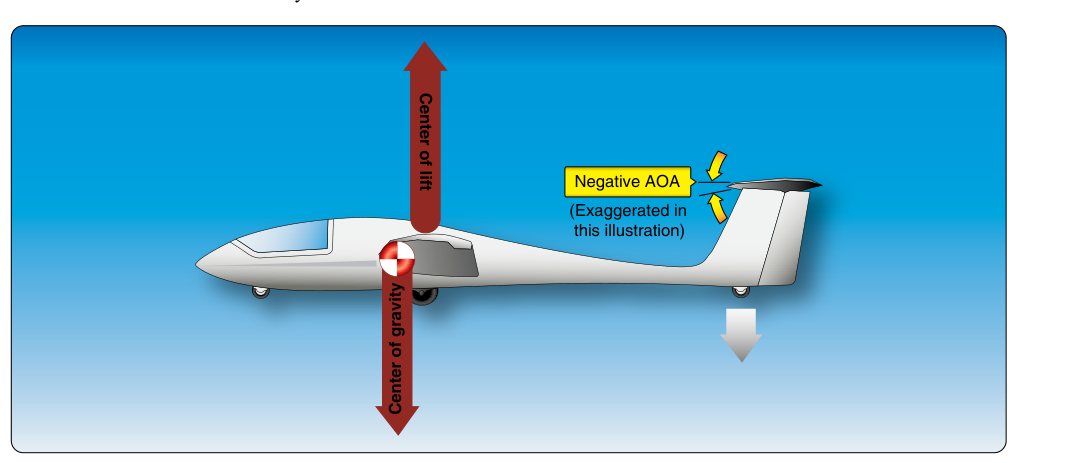
The destruction of lift aft of the shockwave shifts the effective CP rearward — sometimes dramatically so. Because the aircraft's center of gravity (CG) remains essentially fixed, a CP that has migrated behind the CG creates a nose-down pitching moment about the lateral axis. This is the defining characteristic of Mach tuck: an uncommanded, progressive pitch-down that grows stronger as speed increases. It is worth emphasizing the direction — the CP moves aft, not forward. Students who confuse this direction will choose the wrong answer on the ATP written knowledge test.
Reduced tail effectiveness and the feedback loop
Compounding the problem, shockwaves that form on the horizontal stabilizer and, at higher Mach numbers, on the elevator itself reduce the aerodynamic effectiveness of the pitch-control surfaces. The pilot's instinct — pull back to arrest the nose-down pitch — produces progressively less corrective moment precisely when the most correction is needed. Meanwhile, the nose-down attitude increases the rate of descent, which increases true airspeed and therefore Mach number, which intensifies the shockwaves, which worsens the tuck. This self-reinforcing cycle is historically called Mach tuck divergence, and before the era of Mach trim systems and robust speed-limiting protections, it caused fatal accidents in early jet and high-performance propeller-driven aircraft that inadvertently entered the transonic regime in dives.
Design Features That Address Mach Tuck
Swept wings
Wing sweep is the primary geometric tool used to delay Mcrit. Because the component of freestream velocity that acts perpendicular to the leading edge — the component that drives upper-surface acceleration — is reduced by the cosine of the sweep angle, a swept wing effectively experiences a lower local Mach number than a straight wing at the same flight speed. This pushes Mcrit to a higher indicated Mach number, giving the aircraft a wider usable high-speed envelope before tuck becomes significant. The PHAK discusses how sweep angle, thickness-to-chord ratio, and camber all influence Mcrit.
Mach trim systems
Modern transport-category jets are equipped with Mach trim compensators — automatic pitch-trim actuators (often electrically driven stabilizer trim motors) that apply a progressive nose-up trim input as the aircraft's Mach number increases beyond a threshold value. The Mach trim system acts transparently to the crew; it continuously offsets the aft CP migration so that the aircraft's stick-force gradient remains stable and slightly positive (requiring back-pressure to maintain a given pitch attitude). Without Mach trim, a properly certificated transport-category aircraft must still be demonstrated as controllable, but the pilot will notice a steadily increasing nose-down tendency requiring manual back-pressure that grows with speed.
Overspeed warning systems and Vmo/Mmo
Every transport-category aircraft has both a maximum operating indicated airspeed (Vmo) and a maximum operating Mach number (Mmo), whichever is more restrictive at a given altitude. These limits are certificated under 14 CFR Part 25 to provide adequate margin below speeds where Mach tuck could become unrecoverable. Exceeding Vmo/Mmo triggers an overspeed warning — the distinctive clacker or aural alert familiar to every airline pilot — giving the crew immediate, unambiguous notice to reduce thrust and, if necessary, extend speed brakes.
Why It Matters: Flight Safety and Airmanship
The practical in-cockpit significance of Mach tuck is that a high-speed upset at cruise altitude can develop very quickly. A distracted crew that allows the aircraft to accelerate through Mmo in a shallow descent — perhaps following an autopilot disconnect at high altitude or during an inattentive high-speed cruise descent — may experience the nose pitching progressively forward with diminishing elevator authority. The correct recovery, consistent with transport-category upset recovery training, is to reduce thrust to idle, deploy speed brakes as certified, and apply smooth, deliberate back-pressure. Abrupt, large elevator inputs at high dynamic pressure risk structural overload. The crew should not chase Mach number with aggressive pitch inputs but should instead allow speed to decrease as drag devices take effect, restoring normal elevator authority before attempting to re-establish level flight.
Key Numbers and Rules
- Mcrit is the Mach number at which local airflow first reaches Mach 1.0 anywhere on the airframe — onset of transonic effects and the beginning of the CP shift.
- Mmo is set by the manufacturer and certificated under 14 CFR Part 25; it provides structural and aerodynamic margins above which tuck could become divergent.
- CP moves rearward beyond Mcrit — this is the direct cause of the nose-down pitching moment.
- Mach trim engages automatically and is typically not pilot-selectable in normal operation; a Mach trim failure may require a reduced operating speed limit per the aircraft's specific AFM.
- Sweep angle reduces perpendicular velocity by the cosine of the sweep angle, raising Mcrit and delaying tuck onset.
- Control authority decreases as shockwaves form on tail surfaces — larger control inputs produce smaller corrective moments.
Common Test Traps
- Direction of CP movement. The CP shifts aft (rearward) beyond Mcrit, not forward. This aft shift places the CP behind the CG, producing a nose-DOWN pitching moment — the essence of Mach tuck.
- Mcrit versus Mmo. Mcrit marks the onset of local supersonic flow and the beginning of CP migration. Mmo is the certificated operating limit. Tuck worsens continuously between the two; Mmo is set to ensure the tuck remains controllable with available systems.
- Mach tuck is not a stability augmentation failure or a Dutch roll. The ATP written knowledge test distinguishes Mach tuck specifically as a transonic aerodynamic phenomenon driven by shockwave-induced CP migration.
- Mach trim failure does not make the aircraft immediately uncontrollable. It means the pilot must manually provide increasing back-pressure at high Mach numbers, and a reduced speed limit may apply per the AFM for that specific aircraft type.
- Recovery is gentle, not aggressive. High dynamic pressure at Mach tuck onset means abrupt pitch inputs risk exceeding structural limits — smooth inputs and drag-device deployment are the correct technique.
Memory aid
The phrase "Shocks Push CP Back, Nose Pitches Down" captures the essential cause-and-effect chain: shockwaves form → separation destroys aft-wing lift → CP migrates rearward behind the CG → the moment arm creates a nose-down pitch → Mach increases in the resulting dive → shockwaves intensify. Breaking this loop requires reducing speed, not fighting pitch with raw elevator force.