A turbofan engine generates thrust by accelerating a large mass of air rearward through the combined work of its fan and core. The magnitude of that thrust at any given moment is governed primarily by two interrelated variables: altitude and airspeed. The term thrust lapse rate describes the rate at which maximum available thrust diminishes as the aircraft climbs higher or as ambient conditions change. For ATP candidates operating under 14 CFR Part 121 or Part 135, a precise understanding of thrust lapse is not academic trivia—it is the physical foundation behind every takeoff weight limit, obstacle-clearance gradient, and single-engine climb requirement in the Aircraft Flight Manual (AFM).
How a Turbofan Produces Thrust
Before examining lapse rate, it helps to ground the concept in basic turbofan physics. A high-bypass turbofan directs the majority of its intake airflow through a large fan that bypasses the core combustion section entirely. The fan stream produces the bulk of the net thrust at typical transport-category cruise conditions, while the hot core stream contributes the remainder. Both streams depend on mass airflow—the actual mass of air molecules processed each second. Mass airflow is the product of air density, inlet area, and velocity. Because inlet area is fixed by the engine design, the key variable the pilot cannot control is air density. Anything that reduces density directly reduces mass airflow and, therefore, thrust.
Altitude and Density: The Primary Driver of Thrust Lapse
The International Standard Atmosphere (ISA) defines how air pressure and temperature decrease with altitude. In the troposphere, both temperature and pressure fall with increasing altitude, and density—proportional to pressure divided by absolute temperature—falls as well. At sea level on a standard day, air density is approximately 0.002377 slugs per cubic foot. By the time an aircraft reaches the tropopause (approximately 36,089 feet MSL in standard conditions), density has dropped to roughly 30 percent of the sea-level value. Because the engine can only accelerate the air molecules that actually enter the inlet, this density reduction translates almost directly into a reduction in available thrust.
Thrust lapse is not a constant percentage per thousand feet of altitude gain. In the lower troposphere, where both pressure and temperature are falling together, thrust falls at one rate. Near the tropopause, temperature ceases to drop (it stabilizes near −56.5°C in standard conditions), but pressure continues to fall. This changes the density gradient and alters the rate of thrust decrease. Above the tropopause in the lower stratosphere, temperature actually begins to rise slightly with altitude, further modifying the lapse character. As a practical rule of thumb used in transport operations, thrust may be approximated as decreasing roughly in proportion to the decrease in air density—sometimes characterized informally as losing several percent of sea-level thrust for each 5,000-foot increment of altitude gain—but pilots should always use AFM-tabulated data rather than rule-of-thumb estimates for actual performance planning.
Airspeed Effects: Ram Recovery and Its Limits
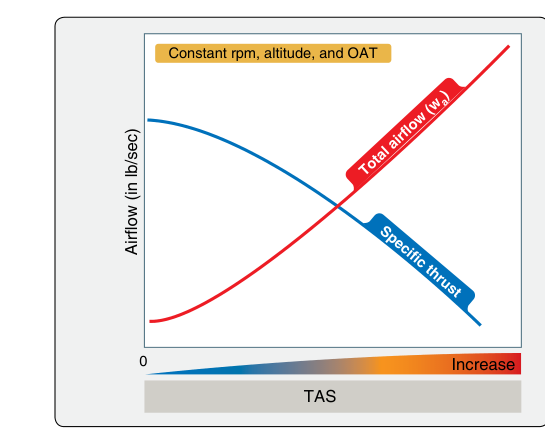
Airspeed introduces a compensating effect known as ram recovery, sometimes called ram compression or ram rise. As the aircraft accelerates forward, the relative wind impacting the engine inlet is slowed and compressed before it reaches the fan face. This ram compression raises the total pressure at the inlet above the ambient static pressure, effectively increasing the density of air entering the engine. At low airspeeds—immediately after brake release or shortly after liftoff—ram recovery is negligible and the engine operates essentially on ambient static conditions. As airspeed increases through the climb and into the cruise regime, ram recovery becomes more significant and partially offsets the density loss due to altitude.
The net result is that thrust does not decrease as rapidly during cruise as naive altitude-only thinking might suggest. In the normal operating Mach number range for transport-category jets (roughly Mach 0.75 to Mach 0.86), ram recovery meaningfully moderates the altitude-driven lapse. However, at very high Mach numbers—approaching or exceeding the design limits of the inlet—shock wave formation and inlet total-pressure recovery losses begin to impose new efficiency penalties, causing net thrust to fall again. This creates a thrust-versus-airspeed relationship that is neither linear nor monotonic over the full speed envelope.
Flat-Rated Thrust and the Corner-Point Temperature
Modern high-bypass turbofan engines certified for transport-category airplanes are typically flat-rated. Flat-rating means the engine's full-authority digital engine control (FADEC) or fuel-control system limits thrust to a certified maximum takeoff value (expressed in pounds-force or kilonewtons) up to a specific outside air temperature called the flat-rating temperature or corner-point temperature. This temperature is often ISA +15°C or ISA +20°C at sea level, though the precise value is engine-model specific.
Below the corner-point temperature, the engine could physically produce more thrust than the rated value, but the control system caps it. This deliberate limiting reduces thermal and mechanical stress on the hot section, extending engine life and improving dispatch reliability. Above the corner-point temperature, the engine can no longer maintain rated thrust; thrust decreases with any further temperature increase. At a high-elevation airport on a very hot day, both altitude-driven lapse (reduced density due to lower pressure) and temperature-driven lapse (density further reduced by high temperature, and the engine past its corner point) compound simultaneously. This compounding effect is precisely why high-elevation, high-temperature airports impose the most severe payload restrictions.
Assumed Temperature (Flex) Thrust and Its Interaction with Lapse Rate
Many operators use assumed temperature reduced thrust (called flex thrust or derate in various regulatory frameworks) for takeoff. The principle exploits flat-rating: if the actual ambient temperature is, say, 20°C and the flat-rating temperature is 40°C, the crew programs a higher assumed temperature into the FMS or thrust management computer. The engine then limits thrust to the level it would produce at that higher assumed temperature, resulting in a deliberate thrust reduction. This technique reduces takeoff thrust, lowers engine wear, and extends hot-section life. Critically, assumed temperature thrust is only permissible when performance analysis confirms that actual runway length, obstacle clearance, and climb gradient requirements are met at the reduced thrust level. The AFM and Operations Specifications govern the specific conditions and limits, and operators must comply with 14 CFR Part 121 performance requirements regardless of the thrust setting selected.
Why Thrust Lapse Matters for Transport-Category Operations
Every takeoff weight, V-speed, and climb gradient in the AFM is computed assuming a specific ambient pressure altitude and temperature, which together determine the thrust the engines will actually produce. Under 14 CFR Part 25, transport-category airplanes must meet certified one-engine-inoperative (OEI) climb gradients during each segment of the departure: first segment (gear down), second segment (gear up, flaps takeoff), and final segment (flaps up, cruise configuration). Per 14 CFR 25.121(b), the second-segment climb gradient requires a minimum of 2.4 percent for two-engine airplanes, 2.7 percent for three-engine airplanes, and 3.0 percent for four-engine airplanes. These gradients are guaranteed only at the certified conditions. If actual density altitude is higher than accounted for, the degraded thrust will reduce the climb gradient—possibly below regulatory minimums—at a weight that appeared legal on the ground.
- Second-segment OEI gradient: Minimum 2.4% for two-engine, 2.7% for three-engine, and 3.0% for four-engine transport-category airplanes (14 CFR 25.121(b)).
- Flat-rating corner point: Engine-specific; commonly ISA+15°C to ISA+20°C at sea level.
- Thrust variation with density: Thrust is approximately proportional to air density; a 30% density reduction at altitude implies roughly 30% less maximum thrust, before ram recovery adjustment.
- Ram recovery benefit: Meaningful at cruise Mach numbers; negligible at low airspeeds on the runway or immediately after liftoff.
Common Test Traps
- Flat-rating does not eliminate lapse: A flat-rated engine is still fully subject to thrust lapse above its corner-point temperature. Flat-rating only limits thrust below that temperature; it provides no protection against high-temperature or high-altitude lapse.
- Ram recovery is not unlimited: Some candidates assume increasing airspeed indefinitely compensates for altitude loss. In reality, high Mach shock effects and inlet losses eventually reverse the benefit.
- Lapse rate is not constant with altitude: The rate of thrust decrease per 1,000 feet changes near the tropopause and lower stratosphere due to shifting temperature gradients.
- Density altitude, not pressure altitude, drives thrust: Thrust depends on actual air density, which reflects both pressure and temperature. Using pressure altitude alone on a hot non-standard day will overestimate available thrust.
- Assumed temperature thrust has limits: Flex or assumed-temperature reduced thrust cannot be used when actual conditions already exceed the flat-rating temperature, when runway or obstacle margins are marginal, or when prohibited by Operations Specifications.
Memory Aid
The phrase "High, Hot, and Humid kills thrust" maps directly onto thrust lapse physics: high altitude reduces pressure density, high temperature reduces mass density beyond the corner point, and high humidity (water vapor displacing denser air molecules) further reduces the effective density of the intake air. Each factor degrades mass airflow, and reduced mass airflow is the mechanical root cause of every thrust lapse scenario tested on the ATP knowledge exam.