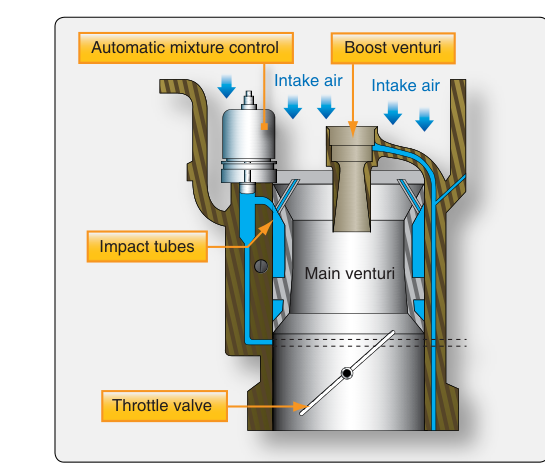
Every reciprocating aircraft engine depends on a precise balance between fuel and air to burn efficiently and safely. Too much fuel — a rich mixture — wastes fuel, cools the exhaust valves incompletely, and can foul spark plugs. Too little fuel — a lean mixture — can cause detonation, overheating, and in extreme cases, burned pistons or valves. The system that governs this critical ratio is the mixture control, and understanding how it works — in both manual and automatic forms — is fundamental knowledge for any Aviation Maintenance Technician (AMT) preparing for the FAA Powerplant knowledge test.
Air density decreases as altitude increases. A carburetor calibrated to deliver the ideal mixture at sea level will deliver an increasingly rich mixture as the aircraft climbs, because the same volume of air weighs less at altitude, and most fuel-metering systems (including many basic fuel injection systems) meter fuel based on airflow and will similarly enrich with altitude unless the mixture is leaned or the system is altitude-compensating. Without a mixture control, the engine would run progressively richer with altitude, burning excess fuel and losing power. The mixture control corrects for this by allowing the fuel flow to be reduced relative to the air mass actually entering the engine.
How Mixture Controls Work
At the core, a mixture control is a valve that adjusts the amount of fuel entering the fuel-metering system. In a float-type carburetor, the mixture control needle or valve sits in the main fuel passage and can restrict or cut off fuel flow. In a fuel injection system, the mixture control interacts with the fuel-air control unit to vary the fuel-to-air ratio. Regardless of design, the goal is always the same: maintain a stoichiometrically appropriate mixture across a range of altitudes, power settings, and ambient conditions.
The Ideal Mixture Ratio
The chemically correct (stoichiometric) air-to-fuel ratio for aviation gasoline is approximately 15:1 by weight — 15 pounds of air for every pound of fuel. In practice, aircraft engines operate slightly rich of stoichiometric for most cruise and climb conditions, to provide cooling and a margin against detonation. Maximum power is typically achieved at a mixture slightly rich of stoichiometric, while best economy cruise is achieved at or slightly lean of stoichiometric. These practical operating points make the mixture control one of the most frequently adjusted engine controls in the cockpit.
Manual Mixture Control
The manual mixture control (MMC) is the most common type found on light general aviation aircraft. It is a cockpit-operated control — usually a red-knobbed lever or vernier knob connected by a cable or rod to the mixture needle in the carburetor or the mixture valve in a fuel injection system. The pilot adjusts the control by feel and by monitoring engine instruments, primarily the exhaust gas temperature (EGT) gauge and, where available, a fuel flow indicator.
In a float-type carburetor, moving the mixture control toward lean raises the needle inside the idle mixture passage or restricts a needle valve in the main metering fuel passage, reducing fuel flow. Moving it toward rich lowers the restriction. The idle cutoff position, at the full lean end of travel, seats the needle fully and cuts off all fuel flow — this is the correct way to shut down a carbureted engine. Cutting off fuel at the source allows the engine to burn the fuel remaining in the induction system and cylinders until it stops on its own, rather than being shut down by cutting the ignition while fuel is still flowing, which helps prevent a hazardous afterfire or inadvertent restart.
In a continuous-flow fuel injection system (such as the Bendix/RSA or Continental fuel injection systems common on Lycoming and Continental engines), the mixture control adjusts a valve that alters the pressure differential controlling fuel flow to the injector nozzles. Fuel-injected engines generally respond more smoothly and precisely to mixture adjustments than carbureted engines, and EGT changes are often sharper and more distinct, making leaning easier for the pilot to verify.
The primary limitation of manual mixture control is pilot workload and technique dependence. Improper leaning — particularly leaning aggressively at high power settings — is a leading cause of detonation and engine damage. FAA guidance in the Pilot's Handbook of Aeronautical Knowledge and aircraft Pilot's Operating Handbooks (POH) consistently specify that leaning should be performed only at power settings at or below 75% rated power (with some aircraft exceptions) and that the pilot must monitor EGT carefully throughout the process.
Automatic Mixture Control
An automatic mixture control (AMC) system removes the need for pilot intervention by automatically compensating for changes in air density. It does this through a sealed bellows or aneroid device that senses ambient air pressure (altitude) and mechanically adjusts the fuel metering valve to maintain a relatively constant fuel-to-air ratio as the aircraft climbs or descends.
The bellows assembly is typically filled with a reference gas and sealed at a standard pressure. As ambient pressure decreases with altitude, the bellows expands. This mechanical expansion acts on the mixture needle or valve to progressively lean the mixture — exactly what the pilot would otherwise do manually. As the aircraft descends and pressure increases, the bellows contracts and the mixture enriches accordingly.
Automatic mixture control devices are most commonly associated with older carbureted radial engines and certain pressure-carburetor installations used on larger piston-powered aircraft. The Marvel-Schebler and Stromberg carburetors used on many older radial-engine aircraft incorporated AMC units as standard equipment. Some general aviation carburetors of the older pressure-injection type also incorporated AMC mechanisms.
Limitations of Automatic Mixture Control
While an AMC reduces pilot workload, it is not without limitations. The bellows is calibrated for standard atmospheric conditions. On non-standard days — particularly hot days where air density is lower than standard at a given altitude — the AMC may not lean the mixture sufficiently. Conversely, on cold days with denser-than-standard air, it may lean too aggressively. These deviations are generally small but should be understood by the AMT when troubleshooting mixture complaints.
Additionally, AMC units require careful maintenance. The bellows must remain sealed and must not develop leaks, which would cause erratic mixture behavior. Linkage wear or corrosion can cause the mechanism to stick, resulting in a fixed mixture position regardless of altitude — a condition that could be mistaken for a carburetor or fuel injection fault rather than an AMC fault. As with other engine accessory components, AMC units must be inspected and maintained in accordance with the applicable manufacturer's instructions for continued airworthiness and 14 CFR Part 43.
Why It Matters: Safety and Airworthiness
From an airworthiness standpoint, a malfunctioning mixture control system — whether manual or automatic — is a serious defect. A stuck-rich condition wastes fuel, reduces range, and can cause spark plug fouling severe enough to cause engine roughness or failure. A stuck-lean condition risks detonation, which produces shock waves inside the cylinder that can crack pistons, destroy rings, and cause catastrophic in-flight engine failure. The AMT must be able to identify, diagnose, and correct mixture control faults accurately.
Understanding mixture control systems also directly supports proper engine run-up procedures during maintenance. Verifying smooth mixture travel from full rich to idle cutoff, checking that EGT responds correctly when leaning, and confirming that the idle cutoff shuts the engine down promptly are all maintenance run-up checkpoints specified in applicable maintenance manuals.
Key Numbers and Rules
- Stoichiometric air-to-fuel ratio: approximately 15:1 by weight for aviation gasoline.
- Best power mixture: achieved slightly rich of stoichiometric; produces peak EGT plus slightly richer.
- Best economy mixture: at or slightly lean of peak EGT; approximately 15:1 to 16:1 by weight.
- Lean-of-peak (LOP) operation: allowed by some engine manufacturers; requires careful monitoring and is engine-specific — always verify POH and engine manufacturer authorization.
- General leaning rule: most naturally aspirated engines should be leaned only at 75% power or below; always follow the specific POH or engine manual.
- Idle cutoff: achieved at the full lean position of the mixture control; cuts fuel to zero and is the proper engine shutdown method for carbureted engines.
- AMC bellows calibration: set to standard day (ISA) conditions; deviations from standard atmosphere introduce mixture error.
Common Test Traps
- Rich vs. lean symptoms: Test questions often swap the symptoms. Remember — excessively lean causes overheating and detonation; excessively rich causes fouling, rough operation, and black smoke from the exhaust.
- Idle cutoff is not a malfunction: Some questions describe an engine that shuts down at full lean and ask for the cause. Full lean (idle cutoff) is the designed shutdown position, not a defect — unless it occurs before full travel is reached, which would indicate a misrigged or faulty mixture control.
- AMC is altitude-compensating, not throttle-compensating: The AMC responds to pressure (altitude), not power setting. It does not automatically lean the mixture when the throttle is retarded; that is still the pilot's or technician's responsibility.
- Fuel injection vs. carburetor response: Fuel-injected engines show sharper, more distinct EGT peaks when leaning than carbureted engines — the FAA tests this distinction in the context of leaning procedures and troubleshooting.
- Mixture rigging: Full rich must produce genuinely full rich fuel flow, and full lean must produce a clean idle cutoff. A cable that is too short or improperly rigged can prevent either endpoint from being reached — a common exam scenario tied to mixture control rigging and adjustment.