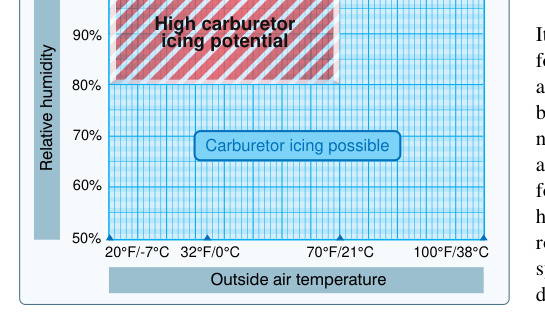
Carburetor icing is one of the most deceptive hazards in general aviation. Unlike fuel starvation or a broken ignition lead, carburetor ice gives no dramatic warning. Instead, power quietly bleeds away, the engine runs rough, and—if the condition is ignored—the engine stops. What makes this hazard especially treacherous is that it can occur on a clear afternoon when the outside air temperature is well above freezing. Understanding the physics behind carburetor icing, recognizing the three distinct types, and knowing exactly when and how to intervene is essential knowledge for both pilots and aviation maintenance technicians (AMTs) who inspect and service fuel systems.
The FAA's Pilot's Handbook of Aeronautical Knowledge (PHAK, FAA-H-8083-25) treats carburetor icing as a fundamental engine systems topic, and the Aviation Maintenance Handbook series reinforces the same principles from the mechanic's perspective. This article synthesizes both viewpoints so that technicians understand the operational context of the systems they maintain, and pilots understand the mechanical realities behind what they experience in the cockpit.
How the Float-Type Carburetor Works
Before examining icing, it helps to review the basics. A float-type carburetor mixes fuel and air by accelerating air through a venturi—a narrowing throat that increases air velocity and drops pressure. That low-pressure zone draws fuel from the float chamber through the main discharge nozzle. The resulting fuel-air mixture then flows through the throttle valve and into the intake manifold.
Two physical processes that are essential to carburetor operation also happen to promote ice formation. First, the venturi effect drops both the pressure and the temperature of the air passing through. Second, liquid fuel atomizes and evaporates as it mixes with that air. Evaporation is an endothermic process—it absorbs heat from the surrounding environment. Combined, these two effects can reduce the temperature inside the carburetor throat by as much as 60–70°F (approximately 33–39°C, or roughly a 20°C drop) compared to the ambient air temperature outside the engine. That dramatic temperature drop is the root cause of all three types of carburetor ice.
The Three Types of Carburetor Ice
1. Fuel Evaporation Ice
Fuel evaporation ice (sometimes called refrigeration ice) is the most common and most hazardous type. As fuel atomizes and evaporates in the venturi and throttle area, it absorbs latent heat, chilling that zone well below the freezing point even when outside air is warm. The moisture naturally present in ambient air then freezes on the carburetor's internal surfaces—particularly on the throttle valve (butterfly) and in the venturi throat. Because this ice forms from the inside out, it restricts the fuel-air mixture pathway and reduces the volume of charge reaching the cylinders.
The critical insight for AMTs and pilots alike is that fuel evaporation ice is most likely to form when ambient temperatures are between 20°F and 70°F (-7°C to 21°C) and relative humidity is above about 50%. It does not require visible moisture or clouds. A clear day with moderate humidity is enough. The PHAK specifically notes that this type of ice can occur on warm, sunny days—the scenario that catches pilots off guard.
2. Throttle Ice
Throttle ice is a subset of evaporation icing that forms specifically on and immediately around the throttle plate when the throttle is partially closed, such as during descent or cruise at reduced power. When the throttle is nearly closed, airflow velocity drops sharply just upstream of the valve, and pressure on the downstream side falls even further. This localized pressure drop amplifies the temperature drop in that region. Ice accumulates as a ring or irregular buildup on the throttle valve edges and the bore of the carburetor surrounding it.
Because a slightly open throttle is the position most likely to produce throttle ice, power-reduction phases of flight—cruise descents, traffic pattern approaches, and practice slow flight—are high-risk windows. An AMT inspecting a returned aircraft after complaints of rough idle or a sticky throttle during descent should consider throttle ice residue (or accumulated deposits exacerbated by repeated ice-melt cycles) as a possible contributor.
3. Impact Ice
Impact ice (also called induction system ice) differs fundamentally from the other two types. Rather than forming through a temperature-drop mechanism inside the carburetor, impact ice results when supercooled water droplets—liquid water that remains in the liquid state below 32°F due to the absence of freezing nuclei and surface tension effects that prevent ice crystal formation—strike the airframe or the carburetor air intake and instantly freeze on contact. It can also form when snow or wet ice crystals accumulate at the air intake screen or filter.
Impact ice tends to block the air inlet upstream of the carburetor rather than forming inside the venturi itself. It is most prevalent in visible moisture (clouds, freezing rain, freezing drizzle) at temperatures near or just below freezing. For mechanics, a partially clogged alternate air door that fails to open fully may leave a pilot with no defense against impact ice if the primary inlet becomes blocked. Regular inspection and rigging of the alternate air (or carburetor heat) system is therefore a direct safety-of-flight maintenance item.
Why Carburetor Ice Matters: Safety and Operational Consequences
Carburetor ice degrades engine performance in a manner that is insidious because it is gradual. On aircraft equipped with a fixed-pitch propeller, the first indication is often a slow decrease in RPM—the engine is receiving a leaner, restricted mixture so it produces less power and the prop slows. On a constant-speed propeller installation, RPM may remain steady while manifold pressure drops, making the power loss even less obvious to an inattentive pilot.
If ignored, the ice accumulation can completely block the fuel-air charge. A total engine stoppage from carburetor ice at a critical moment—short final approach, for instance—leaves little margin for recovery. The FAA has investigated numerous accidents attributable to carburetor icing, and the pattern is consistent: the condition was foreseeable, the environmental conditions were in the susceptible range, and carburetor heat was either not used or not used early enough.
From a maintenance standpoint, the carburetor heat system must deliver adequate heat reliably. The hot air source is typically a shroud around the exhaust pipe or muffler. AMTs must verify that the heat shroud is intact and free of cracks—a cracked exhaust heat muff can allow carbon monoxide to enter the carburetor heat air stream, creating a carbon monoxide poisoning risk in addition to the fire hazard of exhaust gases near the fuel system. This is one reason exhaust system integrity is treated as a priority inspection item.
Key Numbers, Rules, and Recognition
- Temperature range of maximum susceptibility: 20°F to 70°F (-7°C to 21°C) with relative humidity above ~50%.
- Temperature drop inside carburetor: up to 60–70°F below ambient—meaning ice can form inside the carburetor even on a mild, humid day well above freezing.
- Fixed-pitch propeller indication: unexplained, gradual RPM decrease.
- Constant-speed propeller indication: loss of manifold pressure with stable RPM.
- Carburetor heat application: full carburetor heat ON; initially expect a slight RPM drop (rich mixture as warm, less dense air enters), then a rise and rough running as ice melts, then smooth operation as ice clears.
- Precautionary use: many POH/AFM procedures call for carburetor heat use anytime the throttle is reduced below a specified power setting, especially during descents.
- Lean mixture caution: carburetor heat reduces air density, richening the mixture. At full heat, the mixture should be adjusted per the aircraft's POH to avoid excessive enrichment.
- Maintenance inspection items: carburetor heat door operation, alternate air door rigging, heat muff integrity, air filter condition, and carburetor bowl drain operation.
Memory Aid — CATS
A useful way to remember the three types and their primary locations is CATS:
- C — Cooling (evaporation) ice: forms from fuel cooling in the venturi and throttle area.
- A — Around the throttle plate: throttle ice concentrates at the butterfly valve.
- T — Temperature below ambient: the temperature drop is the underlying mechanism for C and A.
- S — Supercooled droplets: impact ice comes from outside supercooled water striking surfaces.
While CATS is not an officially standardized FAA mnemonic, the letter associations help technician students organize the three types for written exam recall and shop discussions.
Common Test Traps
- Trap 1 — Clear weather means no icing risk. Wrong. Fuel evaporation ice is most dangerous on clear, moderately humid days. Test questions frequently describe VFR conditions and ask whether carburetor ice is possible; the answer is yes.
- Trap 2 — Applying carburetor heat should immediately improve RPM. Wrong. The initial effect of carburetor heat is often a slight RPM decrease followed by rough running as ice melts and passes through. A rise and smooth-out follow. Students who expect an immediate RPM jump may prematurely conclude there was no ice present.
- Trap 3 — Impact ice forms inside the venturi. Wrong. Impact ice forms at the air intake or inlet screen upstream of the venturi, blocking incoming air rather than growing on internal surfaces.
- Trap 4 — Carburetor heat is safe to use at full power indefinitely. Caution is warranted. Unfiltered, hot air entering the engine increases detonation risk and can erode engine components over time. Most POH guidance restricts prolonged use of carburetor heat at high power settings. AMTs must ensure the alternate air source is reasonably filtered even when heat is applied.
- Trap 5 — A constant-speed propeller aircraft will show RPM drop as the first icing symptom. Wrong. Because the governor maintains RPM, the first cockpit indication on a constant-speed propeller installation is a drop in manifold pressure, not RPM loss.
For AMTs preparing for the FAA Powerplant Knowledge Test, mastery of carburetor icing types, the physical mechanisms behind each, the design of the carburetor heat system, and the inspection requirements for the heat muff and air induction components is essential. For pilots, the takeaway is equally direct: know your susceptibility window, apply heat early and decisively, and trust the process—even when the first sign of melting ice makes the engine sound worse before it sounds better.