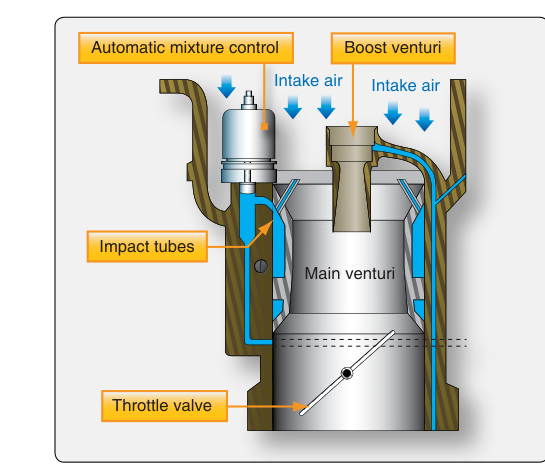
Every reciprocating aircraft engine faces a fundamental challenge: the carburetor or fuel injection system is calibrated to deliver a specific ratio of fuel to air by mass, yet air density decreases as altitude increases. A fixed metering system that delivers the correct mixture at sea level will progressively enrich the mixture as the aircraft climbs, because the same volume of air contains less oxygen at altitude than it did on the ground. Left uncorrected, this over-richening causes rough engine operation, high fuel consumption, excessive carbon deposits, and in severe cases, engine roughness or even stoppage. Altitude compensation and automatic mixture control (AMC) systems were engineered to solve this problem automatically, relieving the pilot or technician from the need to make constant manual adjustments and ensuring that mixture strength remains in the optimal range throughout the flight envelope.
Understanding how these systems work is essential knowledge for the Aviation Maintenance Technician (AMT) Powerplant certificate. FAA knowledge test questions frequently probe the principles of altitude compensation, the mechanical devices used to achieve it, and the maintenance considerations that keep these systems accurate. This article walks through the physics, the hardware, the regulatory context, and the practical maintenance implications in the depth needed to both pass the test and perform the work correctly.
The Physics Behind the Problem
Combustion depends on a chemically correct ratio of fuel mass to oxygen mass. For most aviation gasoline, the stoichiometric (chemically perfect) mixture is approximately 15:1 by mass — fifteen pounds of air for every pound of fuel. Practical power operation uses a slightly richer mixture, around 12:1 to 14:1, for cooling and detonation margin, while lean best-economy cruise is closer to 16:1 to 17:1. The critical point is that these ratios are by mass, not by volume.
A simple float-type carburetor meters fuel based on the pressure differential created by airflow through a venturi. At sea level on a standard day, air density is approximately 0.0765 lb/ft³. At 8,000 feet, density drops to roughly 0.0562 lb/ft³ — about 26% less. The venturi still creates a pressure drop proportional to airflow velocity, and the needle and jet still pass fuel at roughly the same rate per unit of pressure differential, so the fuel volume delivered stays nearly constant while the mass of air inducted drops significantly. The result: the mixture becomes progressively richer with altitude unless something intervenes.
How Altitude Compensation Works
Several mechanical and pneumatic strategies have been developed to correct for decreasing air density. The FAA Powerplant Handbook (FAA-H-8083-32) covers these approaches in the context of both float-type carburetors and fuel injection systems.
Back-Suction (Economizer) Mixture Control
In simple float-type carburetors, the most common method of manual mixture control is the back-suction system. A passage connects the float chamber (which is normally vented to atmospheric pressure) to a region of low pressure in the carburetor air inlet. When the mixture control is moved toward lean, a needle valve partially opens this passage, reducing the pressure in the float chamber. Because fuel is pushed up by atmospheric pressure acting on the float chamber, reducing that pressure reduces the pressure differential across the main jet, decreasing fuel flow. While this system requires pilot action, it establishes the architecture upon which automatic altitude compensation builds.
Automatic Mixture Control (AMC) Devices
Automatic mixture control eliminates the need for continuous pilot input by using a density-sensing element to continuously adjust mixture strength. The most common AMC device is the aneroid bellows (sometimes called a sealed sylphon bellows or density controller). This is a small, sealed, corrugated metal chamber that expands or contracts in response to changes in ambient air pressure — and therefore air density.
In a carburetor equipped with an AMC unit, the aneroid bellows is connected mechanically to the mixture metering valve or needle. As the aircraft climbs and ambient pressure drops, the bellows expands. This expansion is translated through a linkage into movement of the mixture valve, progressively reducing fuel flow to match the reduced air mass entering the engine. The result is that the fuel-air ratio by mass remains approximately constant across a wide altitude range without any cockpit input. The pilot may still have a manual mixture control for ground leaning or emergency use, but during normal operations the AMC handles altitude-induced changes automatically.
Pressure-Type Carburetors and Density Compensation
Pressure-type (injection) carburetors — such as the Bendix PS series — use a more sophisticated approach. These units contain multiple internal chambers referenced to different pressures: impact air pressure, venturi suction, and metered fuel pressure. A key component is the air density controller, which consists of an aneroid bellows and a vapor vent valve working together to compensate for both altitude and temperature variations in air density. As density decreases, the bellows repositions a regulating valve, reducing the effective pressure differential that drives fuel flow, thereby leaning the mixture automatically. The Powerplant Handbook explains that these carburetors are divided into a fuel control section and an air section, and that the automatic mixture control bridges the two by continuously sensing and correcting for density changes.
Continuous-Flow Fuel Injection
In continuous-flow fuel injection systems (such as the Lycoming/Precision RSA series), a servo regulator maintains a constant relationship between fuel pressure differential and airflow. The flow divider and injector nozzles distribute fuel to each cylinder. These systems achieve a degree of inherent altitude compensation through their design, since they meter fuel as a function of airflow differential rather than simple venturi depression. However, some installations also incorporate an automatic mixture control or a manual mixture control linked to a density-compensating mechanism. The pilot still typically leans manually during cruise, but the system is less sensitive to altitude than a simple float carburetor.
Maintenance of Altitude Compensation Systems
AMC systems require careful attention during overhaul and adjustment. Key maintenance points include:
- Bellows integrity: The aneroid bellows must be leak-free. A bellows that has developed a pinhole leak will fail to respond correctly to pressure changes, causing incorrect mixture at altitude. Inspection and replacement intervals are specified in the component manufacturer's overhaul manual and must be followed per 14 CFR Part 43.
- Calibration and rigging: After any repair or adjustment to the mixture control linkage, the system must be calibrated on a flow bench using manufacturer-approved equipment. Incorrect rigging can cause a full-rich condition that never leans, or a mixture that over-leans at high altitude.
- Vapor elimination: Pressure carburetors incorporate vapor vent passages that work in conjunction with the density controller. These passages must be clear; blockage can cause erratic mixture behavior that mimics AMC failure.
- Temperature effects: True air density depends on both pressure and temperature (as described by the ideal gas law). Most aneroid-based systems compensate primarily for pressure changes. Some advanced systems incorporate additional temperature-sensing elements, but simpler AMC units may still produce a slightly rich mixture in unusually cold air and a slightly lean mixture in unusually hot air relative to standard conditions.
- Return to service testing: After maintenance, idle mixture, idle speed, and full-power mixture should be verified per the airframe and engine manufacturer's instructions. Many installations specify an exhaust gas temperature (EGT) check at cruise altitude as part of the return-to-service procedure.
Why Altitude Compensation Matters for Safety and Performance
An over-rich mixture at altitude wastes fuel and produces excessive carbon monoxide in the exhaust, increasing contamination risk in aircraft with heater systems that use exhaust heat exchangers. More critically, an excessively rich mixture can foul spark plugs, leading to misfires and rough engine operation. In turbocharged engines, an over-rich mixture at high altitude can also cause turbine over-temperature events if mismanaged. Conversely, a compensating system that fails in the lean direction can allow the mixture to lean beyond the detonation boundary, particularly at high power settings, risking catastrophic engine damage.
For the AMT, understanding that altitude compensation is not just a pilot convenience but a fundamental safety system shapes the seriousness with which maintenance, inspection, and calibration are approached. A properly functioning AMC allows pilots to operate with confidence that the engine is receiving an appropriate mixture, reduces pilot workload in high-workload phases of flight, and extends engine life through proper combustion.
Key Numbers and Rules
- Stoichiometric fuel-air ratio for aviation gasoline: approximately 15:1 by mass.
- Standard atmosphere air density at sea level: approximately 0.0765 lb/ft³; decreases roughly 3–4% per 1,000 feet in the lower troposphere.
- Float carburetors without AMC must be leaned by the pilot; AMC-equipped units provide automatic compensation but do not eliminate the mixture control entirely.
- All maintenance on fuel metering systems, including AMC components, must be performed in accordance with 14 CFR Part 43 and the manufacturer's approved data.
- AMC bellows overhaul and replacement intervals are defined by the component manufacturer's Time Between Overhaul (TBO) data — not discretionary.
- After carburetor or fuel system maintenance, a ground run-up and an in-flight check (where specified) are required before return to normal service.
Common Test Traps
- Mixture vs. volume vs. mass: The FAA test often asks why mixture enriches with altitude. The answer is always that air mass decreases while fuel flow stays roughly constant — not that air volume changes. Volume of air inducted changes very little at constant RPM; it is the density that drops.
- AMC does not eliminate the mixture control: A common distractor suggests that AMC-equipped aircraft require no pilot mixture management ever. In fact, pilots still need to use the mixture control for idle lean on the ground (to prevent plug fouling) and for emergency situations.
- Aneroid bellows failure mode: Questions may ask what happens when the AMC bellows fails. A leaking bellows loses its pressure reference and typically causes the system to remain at a fixed (often rich) setting, resulting in an over-rich mixture at altitude.
- Pressure carburetors vs. float carburetors: These are fundamentally different architectures. A pressure carburetor uses fuel under pressure (not atmospheric pressure pushing fuel up) and has a more sophisticated density-compensation mechanism. Do not confuse the two on the exam.
- Calibration is required after any linkage adjustment: The test may offer answer choices suggesting a visual inspection alone is sufficient after rigging the mixture control. This is incorrect — flow bench calibration per manufacturer data is mandatory.