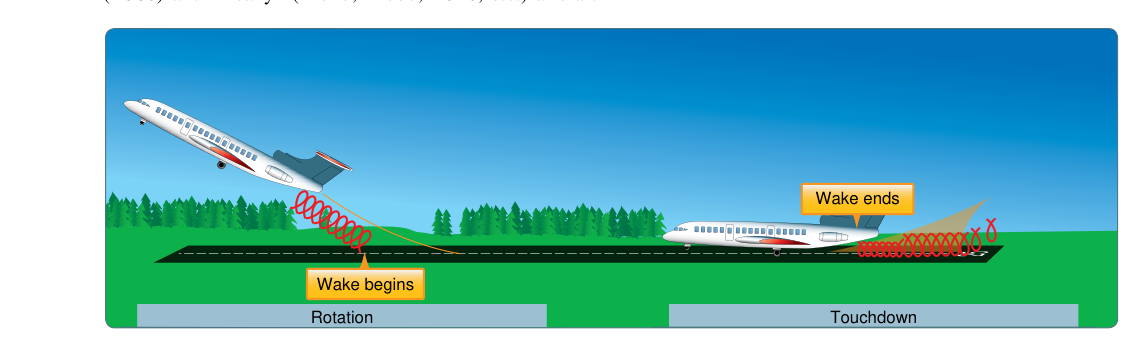
Every aircraft capable of generating lift is simultaneously capable of generating wake turbulence. The physics are inescapable: as a wing produces lift, it creates a pressure differential between its lower and upper surfaces. Air from the high-pressure region below the wing curls outward and upward around each wingtip toward the low-pressure region above, rolling off in a pair of counter-rotating, cylindrical vortices that trail behind the aircraft like invisible horizontal tornadoes. These vortices can produce rolling moments powerful enough to exceed the control authority of a following aircraft, and understanding their behavior is not merely an academic exercise — it is a survival skill for the commercial pilot.
FAA Wake Turbulence Weight Categories
The AIM and the Pilot's Handbook of Aeronautical Knowledge (PHAK, FAA-H-8083-25) describe the traditional FAA weight-based classification system used to establish ATC separation standards and to guide pilot decision-making. There are three primary categories, plus a special designation for the largest aircraft in service.
- Heavy: Aircraft with a maximum certificated takeoff weight (MCTOW) of 300,000 lb or more. Examples include the Boeing 747, Boeing 777, and Airbus A330. ATC appends the word "Heavy" to the call sign in radio communications whenever a Heavy aircraft is departing or arriving.
- Large: Aircraft with an MCTOW of more than 41,000 lb but less than 300,000 lb. This broad category encompasses most regional jets, narrow-body airliners, and turboprop transports.
- Small: Aircraft with an MCTOW of 41,000 lb or less. The vast majority of general aviation aircraft, including most piston singles and twins, fall here.
- Super: A designation applied by ATC to specific aircraft whose vortex characteristics are especially hazardous even relative to other Heavies. The Airbus A380 is the primary example currently in U.S. airspace. When ATC identifies a Super in the sequence, pilots will hear the word "Super" used in lieu of "Heavy" in position calls. Increased separation standards apply.
It is important to understand that these categories drive ATC separation minimums but do not fully capture every variable affecting vortex severity. A Boeing 757, for instance, is classified as Large yet is well-documented to produce vortices disproportionately powerful for its weight category. The FAA has historically required Heavy-style separation behind the 757 in many terminal environments for exactly this reason, and pilots should treat the 757 with the same respect they would give a Heavy aircraft.
What Makes a Vortex Strong or Weak
Vortex intensity is governed by four primary variables: the generating aircraft's weight, airspeed, wingspan, and configuration. The relationship can be summarized simply: the heavier, slower, and cleaner (less flap) the generating aircraft, the more powerful the vortices it produces. This is because a heavy aircraft must deflect a large mass of air downward per unit time to sustain flight, and at low speed it accomplishes this by producing a large pressure differential across the wing — exactly the condition that drives powerful tip vortices.
Configuration matters significantly. When the generating aircraft extends flaps, the resulting change in spanwise lift distribution causes some of the vorticity to be shed inboard rather than concentrated purely at the wingtips. The vortices become somewhat more diffuse. A clean-wing aircraft concentrates all of that energy at the tips, creating the strongest, tightest, most persistent vortices. This is why the most hazardous moment in any sequence is immediately after rotation, when a heavy aircraft is at high weight, low speed, and in a clean or minimally flapped configuration climbing away from the runway.
When Vortices Begin and End
Vortices are products of lift generation, which means they exist only when the wing is unloaded or generating lift while airborne. According to the AIM, vortices begin at the point of rotation on takeoff — the precise moment the wheels leave the runway surface — and cease at the point of touchdown on landing. During the ground roll itself, the weight of the aircraft is largely supported by the landing gear rather than the wings, so meaningful vortex generation does not occur. This timing has direct implications for separation strategy, discussed below.
Vortex Behavior Near the Ground
In open air, the two counter-rotating vortices tend to descend at approximately 400 to 500 feet per minute and drift laterally outward from the aircraft's flight path at roughly 5 knots each, ultimately stabilizing approximately 500 to 900 feet below the generating aircraft's altitude. Near the ground, however, the behavior changes in several important ways that make the terminal environment particularly hazardous.
Ground Effect on Vortex Sink Rate
When vortices approach the surface, the ground itself acts as a barrier to their continued descent. Rather than sinking further, each vortex begins moving outward, away from the aircraft's ground track. This means the vortices linger at low altitude near the runway much longer than they would at cruise altitude, remaining in exactly the zone where a following aircraft on approach or initial climb must fly. The combination of proximity to the ground and the relatively slow speeds involved in the takeoff and landing phase maximizes the time during which a following aircraft is exposed.
Wind Effects: The Critical Role of Crosswind
Wind dramatically alters where vortices migrate and how long they persist in the runway environment. Calm winds allow each vortex to drift symmetrically outboard, but they may linger in the touchdown or liftoff zone for an extended time — well over two minutes in some conditions. A light crosswind of approximately 3 to 7 knots represents a particularly insidious hazard: it counteracts the natural outward drift of the upwind vortex, effectively pinning it stationary over or near the runway centerline. A following aircraft executing a normal approach down the centerline can fly directly into this hovering vortex with little or no warning.
A stronger crosswind — generally above about 7 knots — tends to carry both vortices clear of the runway more rapidly, reducing but never eliminating the risk. A light quartering tailwind presents yet another scenario: it can transport a vortex generated near the threshold back along the final approach path, placing it in the flight path of an aircraft still on final approach who may believe they are safely outside the hazard zone. The AIM cautions pilots about this scenario explicitly.
Practical Separation Strategies in the Cockpit
Commercial pilots must apply category awareness actively. The governing rule is straightforward: stay above the generating aircraft's flight path and beyond its rotation or touchdown point.
- Departing behind a Heavy or Large aircraft: Note the preceding aircraft's rotation point. Plan to rotate before that point and immediately climb on a flight path that is above and upwind of the preceding aircraft's climbout path. Do not cut through its wake by turning directly into the departure course if the generator turned shortly after liftoff.
- Landing behind a Heavy or Large aircraft: Maintain a flight path that stays above the preceding aircraft's glide path on final, and aim to touch down beyond the preceding aircraft's touchdown point to avoid vortices drifting back from the threshold area.
- Intersecting runways: If a Heavy departs on an intersecting runway and its climbout path crosses your intended takeoff or departure route, the vortices it generates may drift into that airspace. AIM guidance addresses this scenario and recommends caution even when runways are not parallel.
- ATC separation is the floor, not the ceiling: Radar separation standards provided by ATC are minimums established for safety under average conditions. Wind, weight, and configuration can all make a given situation more hazardous than the standard accounts for. The pilot in command retains authority — and responsibility — to request additional spacing.
Common Test Traps for Commercial Pilot Applicants
- Vortices begin at rotation, not brake release. A classic distractor suggests wake generation starts during the takeoff roll — it does not. The wheels must leave the ground first.
- A light crosswind (3–7 knots) is more dangerous than no wind. Many applicants assume calm conditions are safest; in reality, light crosswinds can pin a vortex directly over the centerline for extended periods.
- High weight plus low speed plus clean configuration equals maximum vortex intensity. Do not confuse high speed with high hazard — speed reduces vortex intensity relative to weight.
- The Boeing 757 is classified Large, not Heavy, yet historically receives Heavy-equivalent separation treatment in many environments due to its disproportionately powerful vortices.
- "Super" is a distinct ATC designation above "Heavy," currently applied to aircraft such as the Airbus A380. Heavy and Super are not interchangeable terms.
- Vortices cease at touchdown, not at the runway exit. Once the generating aircraft's wheels are on the ground, new vortex generation stops — but previously generated vortices already in the air continue to exist and drift.
Memory Aid
A simple and widely taught reminder for timing: "Rotation to rotation, touchdown to touchdown." Vortices begin at the upwind aircraft's rotation point and end at its touchdown point. Use those two reference points on the runway surface to plan your own rotation and landing aim points accordingly, always targeting beyond the generator's marks to remain clear of the hazard zone.