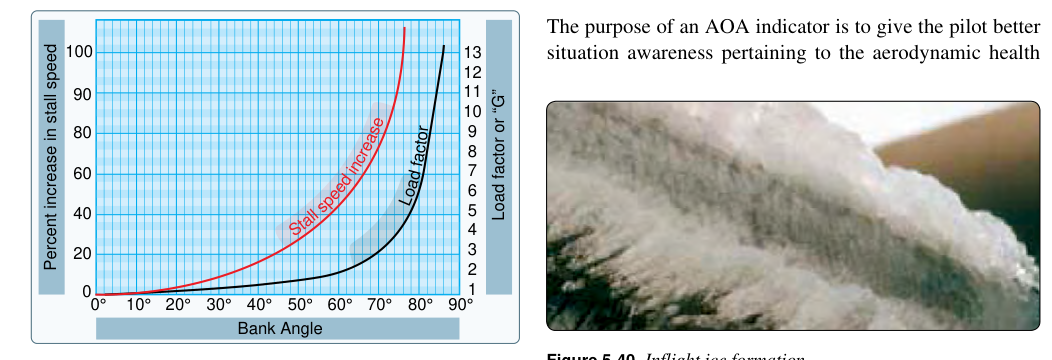
Most pilots learn to associate stalls with a single, reassuring number printed in the Pilot's Operating Handbook — the published stall speed. That number, however, is valid only under one specific condition: wings-level, unaccelerated, 1g flight. The moment a pilot increases back pressure to hold altitude in a steep turn, pulls up from a dive, or encounters a sharp vertical gust, the wing must generate additional lift to support a load greater than the aircraft's actual weight. That extra demand is measured in load factor, expressed as a multiple of gravitational acceleration (g). As load factor rises, the critical angle of attack — the aerodynamic threshold at which the wing can no longer sustain attached airflow — is reached at progressively higher airspeeds. The result is an accelerated stall: a stall that occurs at an airspeed that may be shockingly above the published 1g value.
The Aerodynamics of Load Factor
To understand accelerated stalls, you must first understand what the wing is actually doing. Lift is a function of air density, wing area, the square of velocity, and the lift coefficient — which itself depends directly on angle of attack. In level, unaccelerated flight, total lift equals total weight and load factor is 1g. When a pilot applies back pressure in a coordinated turn, the vertical component of lift must still equal total aircraft weight, but because the lift vector is now tilted, total lift must increase. That increase is the load factor.
The Pilot's Handbook of Aeronautical Knowledge (PHAK, FAA-H-8083-25) establishes a precise mathematical relationship: stall speed increases with the square root of the load factor. Expressed symbolically, the accelerated stall speed equals the 1g stall speed multiplied by the square root of the current load factor. This means the relationship is nonlinear — load factor must quadruple to double the stall speed, but even modest increases in bank produce significant increases in load factor above 45 degrees of bank.
Bank Angle, Load Factor, and the Numbers
The load factor in a level, coordinated turn is the reciprocal of the cosine of the bank angle. Some benchmark values every commercial pilot candidate should internalize:
- 30° bank: load factor ≈ 1.15g — stall speed increases by about 7%
- 45° bank: load factor ≈ 1.41g — stall speed increases by about 19%
- 60° bank: load factor = 2.0g — stall speed increases by approximately 41% (√2 ≈ 1.41)
- 75° bank: load factor ≈ 3.86g — stall speed nearly doubles (√3.86 ≈ 1.96)
- 80° bank: load factor ≈ 5.76g — stall speed increases by a factor of about 2.4
To make this concrete: an aircraft with a published 1g stall speed of 50 knots CAS will stall at approximately 70 knots CAS in a 60-degree banked level turn. At 75 degrees of bank, that same aircraft stalls near 98 knots. The wing does not read the airspeed indicator; it responds exclusively to angle of attack. Exceed the critical angle of attack at any speed, in any attitude, and the wing stalls.
The V-g Diagram and Maneuvering Speed
The velocity-load factor (V-g) diagram, also called the flight envelope, graphically captures these relationships. The curved left boundary of the envelope is the stall line — it climbs to the right, demonstrating that higher airspeeds allow higher load factors before the wing stalls. The top of that stall curve intersects the positive limit load factor, which for most normal-category aircraft is 3.8g. The airspeed at that intersection is maneuvering speed (VA).
VA represents the highest calibrated airspeed at which full deflection of a single flight control will cause the wing to reach its critical angle of attack — and stall — before the airframe experiences a load exceeding its structural limit. Below VA, the wing stalls protectively before structural damage occurs. Above VA, full abrupt control inputs can impose loads that exceed the aircraft's certified limit, risking structural failure. This is why turbulence penetration and abrupt maneuvering should be conducted at or below VA.
Critically, VA decreases as aircraft weight decreases. A lighter aircraft reaches its positive limit load factor at a lower airspeed, so VA must be reduced accordingly. The PHAK explains this clearly: at reduced weight, the same control input produces a greater load factor increase per unit of airspeed, so the protective stall occurs at a lower speed. Always consult the POH for weight-adjusted VA values if provided.
Why Accelerated Stalls Are Dangerous
Accelerated stalls are particularly hazardous because they occur during dynamic, attention-demanding phases of flight — phases where a pilot may be focused on traffic, terrain, or task completion rather than monitoring angle of attack. Three scenarios are especially well-documented in accident records and are emphasized in FAA training literature:
- The base-to-final skidding turn. A pilot overshoots the final approach course, applies rudder alone to tighten the turn, and simultaneously pulls back to maintain altitude. The skid increases effective angle of attack on the outer wing while load factor is elevated. The aircraft stalls and enters an incipient spin at an altitude too low for recovery. This is among the most lethal general aviation accident scenarios.
- Abrupt pull-up from low-altitude high-speed flight. A pilot flying fast and low pulls back sharply to clear an obstacle. The rapid increase in angle of attack combined with elevated load factor stalls the wing instantly, often with no warning buffet at higher speeds.
- Turbulence-induced gust loads. A sharp vertical gust effectively increases the wing's angle of attack instantaneously. At high cruise airspeeds, this can spike load factor well above 1g and approach or exceed the critical angle of attack, producing a brief but violent stall-like buffet — or in extreme cases, exceeding structural limits.
Recognition and Recovery
The commercial pilot must recognize accelerated stall onset before full stall entry. Warning signs include: control sluggishness or mushiness, reduced effectiveness of flight control inputs, airframe buffeting or shudder as flow begins separating from the wing, and activation of the stall warning device. Because stall warning systems — whether horn, light, or stick shaker — are driven by angle-of-attack sensors positioned near the wing's leading edge, they respond to the aerodynamic condition regardless of airspeed. A stall warning during a steep turn is just as valid as one during a slow-flight approach to stall.
The recovery sequence follows the same fundamental principle as any stall recovery: reduce angle of attack first. The pilot must release or relax back pressure to allow the wing to return below its critical angle of attack. Simultaneously or immediately after, add available power to minimize altitude loss, and reduce bank angle to decrease load factor — reducing the load factor helps reduce the stall speed and allows the aircraft to fly at its current airspeed. Roll wings level as flying speed is restored, and return to coordinated flight. The PHAK and the Airplane Flying Handbook (FAA-H-8083-3) both caution against the secondary stall: if the pilot pulls back aggressively during or immediately after the initial recovery, the angle of attack is again driven past the critical value and the wing re-stalls, often with less altitude available for a second recovery.
Key Numbers and Rules
- Stall speed scales with the square root of load factor, not load factor itself: at 4g, stall speed doubles; at 2g, it increases by 41%.
- Load factor in a level turn = 1 ÷ cosine(bank angle). Above 60°, load factor rises extremely rapidly.
- Normal-category aircraft positive limit load factor: 3.8g; utility category: 4.4g.
- VA protects structure only from single full control deflections — combined or sequential inputs can still overstress the airframe even below VA.
- VA is weight-dependent: always use the POH chart or note for actual flight weight.
- The critical angle of attack for a given wing is fixed by aerodynamics — typically around 15–20 degrees for most general aviation wings — and does not change with weight, bank, or airspeed.
Common Test Traps
- "Stalls occur only at low airspeed." False. A wing stalls at a critical angle of attack. Accelerated stalls routinely occur at airspeeds well above the published 1g stall speed.
- Confusing load factor with bank angle directly. Load factor grows slowly below 45° and then explosively above 60°. A 75° bank imposes nearly 4g — not 75% more than level flight.
- Applying VA as an absolute number regardless of weight. VA must be reduced at weights below the maximum listed in the POH.
- Believing full control deflection is always safe below VA. VA only accounts for single-axis full deflection. Simultaneous or rapid sequential full inputs can exceed limit load even below VA.
- Omitting bank angle reduction in the recovery. Reducing angle of attack alone may be insufficient if load factor remains high; reducing bank lowers the stall speed and allows recovery at the available airspeed.