Introduction: Why Ceilings and Climb Performance Matter
As a commercial pilot candidate, you must understand not just how high an airplane can fly, but how it gets there and what limits its climb. The concepts of service ceiling, absolute ceiling, and rate-of-climb gradient are central to advanced performance planning — and they are tested heavily on the FAA Commercial Pilot Knowledge Test. More importantly, they have direct safety implications every time you plan a flight near mountainous terrain or operate a heavily loaded aircraft on a hot day.
What Is Absolute Ceiling?
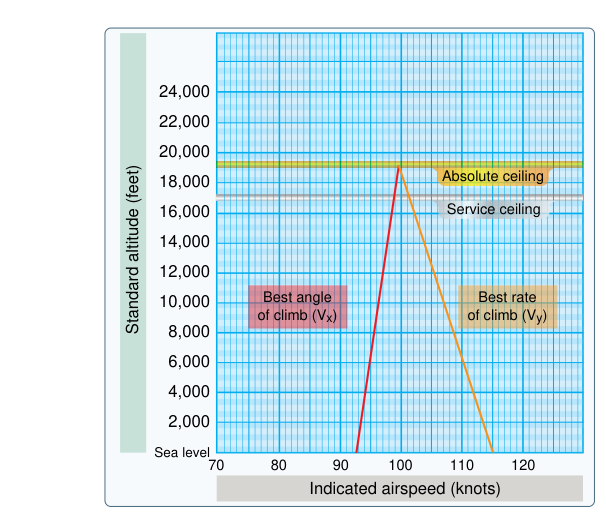
The absolute ceiling is the maximum altitude at which an aircraft can maintain level flight under standard atmospheric conditions. At this altitude, the excess thrust (or excess power, in piston-engine terms) available over that required for straight-and-level flight has dropped to exactly zero. The airplane cannot climb even one more foot; the maximum lift the wings can generate at any sustainable airspeed exactly equals the aircraft's weight, and every bit of available engine power is consumed just sustaining level flight.
In practice, approaching the absolute ceiling is a harrowing experience. The airspeed band between the stall speed (which rises as air density decreases) and the maximum speed (which falls as engine power decreases) narrows dramatically. Some texts describe this as the "coffin corner" phenomenon for high-altitude aircraft. For piston-engine training and commercial airplanes, the absolute ceiling is a theoretical limit — you will never comfortably operate near it — but understanding it anchors the concept of ceilings.
What Is Service Ceiling?
The service ceiling is defined by the FAA as the altitude at which the aircraft's maximum rate of climb drops to 100 feet per minute (fpm) under standard atmospheric conditions with maximum continuous power applied. This definition applies to single-engine airplanes. Some multi-engine certification contexts have historically referenced other single-engine climb benchmarks, but always check the specific aircraft's AFM for the applicable definition.
The service ceiling is the more operationally useful number of the two. While the absolute ceiling is theoretical, the service ceiling represents an altitude where the airplane is still controllably climbing — just barely. A 100 fpm climb rate means it might take 10 minutes to gain 1,000 feet, making normal en route operations impractical but not physically impossible. Manufacturers publish this number in the aircraft's Pilot's Operating Handbook (POH) or Approved Flight Manual (AFM) as part of the performance section.
Why 100 fpm?
The 100 fpm threshold was chosen because it represents a margin that a pilot can meaningfully control and measure. Below this climb rate, the aircraft is so close to its performance limit that any turbulence, increased weight, or slight temperature deviation above standard could push it to level flight — or worse, a descent. Operationally, planning flight altitudes near the service ceiling leaves virtually no safety margin.
How Ceilings Change With Density Altitude
Both the absolute ceiling and the service ceiling are defined under standard atmospheric conditions (ISA: 59°F / 15°C at sea level, lapse rate of approximately 3.5°F per 1,000 feet / 2°C per 1,000 feet). In real-world conditions, these ceilings shift dramatically.
- High temperature reduces air density, which decreases both engine power output and aerodynamic lift. This lowers both ceilings.
- High field elevation already places you partway up the performance curve before you even depart.
- High humidity further reduces air density (moist air is less dense than dry air at the same temperature and pressure), lowering engine performance.
- Heavy weight increases the lift required and therefore the power required to climb, eating into excess power faster and reducing the effective ceiling.
A practical rule: on a hot summer day at a high-elevation airport with a full load, your actual service ceiling may be thousands of feet lower than the number printed in the POH. Always compute density altitude before assuming published performance figures apply.
Rate of Climb vs. Angle of Climb: The Gradient
Rate of climb is measured in feet per minute (fpm) — a vertical speed. Climb gradient, sometimes called angle of climb, is a different but related concept measured in terms of altitude gained per unit of horizontal distance traveled. It is often expressed as a percentage (feet per 100 feet of horizontal distance, times 100) or in feet per nautical mile.
The distinction matters in the cockpit:
- Rate of climb (fpm) is maximized at Vy — the best rate-of-climb airspeed. Flying at Vy gets you to a target altitude in the shortest time. This is what saves engine TBO if you want to level off quickly and start cruise.
- Angle of climb (gradient) is maximized at Vx — the best angle-of-climb airspeed. Flying at Vx gets you the most altitude over the shortest distance. This is critical for obstacle clearance after takeoff.
The Physics Behind Vy and Vx
At Vy, the difference between power available and power required is at its greatest — this is called excess power. Since rate of climb equals excess power divided by aircraft weight (R/C = Excess HP × 33,000 ÷ Weight in lb), maximizing excess power maximizes fpm.
At Vx, the difference between thrust available and thrust required is at its greatest — this is excess thrust. Since climb angle is determined by excess thrust divided by weight, maximizing excess thrust maximizes the angle. Vx is always a lower airspeed than Vy for a given aircraft configuration.
How Ceilings Relate to Gradient
As altitude increases, both Vx and Vy change. Critically, Vx increases with altitude (indicated airspeed) and Vy decreases with altitude (indicated airspeed). At some altitude, Vx and Vy converge to a single speed. That convergence point is, by definition, the absolute ceiling — because there is no longer any airspeed at which the airplane can sustain a meaningful excess of either thrust or power. This is an important conceptual link: the merging of Vx and Vy signals that performance is fully exhausted.
Practical Application for Commercial Pilots
When planning a cross-country flight that requires crossing high terrain, the commercial pilot must confirm that the aircraft's service ceiling — adjusted for actual density altitude and gross weight — comfortably exceeds the required minimum en route altitude (MEA) or obstacle clearance altitude (OCA). The FAA recommends maintaining a safety margin well above the service ceiling when planning, because the 100 fpm climb rate at the service ceiling provides essentially no buffer for deviations.
For obstacle clearance immediately after takeoff, the climb gradient is the controlling factor. Departure procedures (DPs) published in instrument procedures may specify a required climb gradient in feet per nautical mile. The FAA's TERPS criteria (FAA Order 8260.3) establish 200 feet per nautical mile as the minimum standard climb gradient assumed in obstacle clearance procedure design, absent a charted higher requirement. If the aircraft cannot meet that gradient at the departure airport's density altitude and gross weight, the departure procedure cannot be safely flown, regardless of how high the aircraft's service ceiling may be.
A useful worked example: an aircraft with a published sea-level rate of climb of 800 fpm and a service ceiling of 14,000 feet MSL is departing from a high-elevation airport on a warm afternoon. If the computed density altitude at departure is already 9,000 feet, the aircraft is operating well up its performance curve. The actual rate of climb available is substantially reduced, and the effective service ceiling for that departure — considering the actual atmospheric conditions — may be only 12,000 feet or lower. Pilots who plan only from the published POH number without applying density altitude corrections risk an unpleasant surprise in the climb.
Memory Aid
To keep service ceiling and absolute ceiling straight, use this phrase: "Service has Something left (100 fpm); Absolute has Absolutely nothing (0 fpm)." The word "Absolute" means the absolute end — zero excess power, zero climb left. "Service" means you still have a sliver of useful performance — 100 feet per minute worth.
Common Test Traps
- Confusing 100 fpm with other values: The 100 fpm threshold defines service ceiling for single-engine airplanes under standard PHAK definitions. Always check the specific aircraft's AFM/POH for how the manufacturer defines the term for that airplane category.
- Assuming published ceilings are always achievable: POH ceilings are based on standard ISA conditions at published gross weight. On a hot, high, or heavy day, your actual ceiling is lower. Density altitude is the key correction.
- Mixing up Vx and Vy: Vx = best angle (obstacle clearance, shorter distance); Vy = best rate (shorter time). At altitude, Vx rises and Vy falls until they meet at the absolute ceiling.
- Thinking gradient equals rate of climb: A high rate of climb (fpm) does not guarantee a steep climb gradient if groundspeed is also high. Gradient (altitude per distance) depends on airspeed flown, not just vertical speed.
- Forgetting that absolute ceiling is a theoretical limit: The FAA defines it as zero rate of climb — a condition you would never safely plan to reach. Service ceiling is the operationally meaningful number for flight planning purposes.