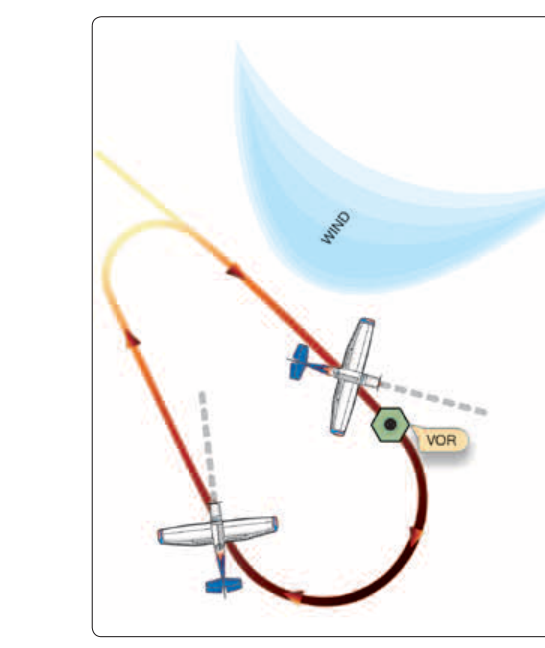
Holding patterns are one of the most intellectually demanding maneuvers in instrument flying. At first glance, a holding pattern looks simple — fly an oval racetrack in the sky and wait. In practice, flying a well-executed hold requires you to observe mandatory speed limits, calculate precise wind corrections on both the inbound and outbound legs, and make real-time adjustments every lap. The FAA designs protected airspace around a hold based on assumptions about aircraft speed and pilot technique; deviate from those assumptions and you risk flying outside protected airspace into obstacles or other traffic.
This article covers every element the Instrument Rating Aeronautical Knowledge Test expects you to know about holding pattern speed limits and wind correction, from the published numbers in the AIM and FAA-H-8083-15 to the mental math you'll use in actual IMC.
Holding Pattern Speed Limits
The AIM and the Instrument Flying Handbook (FAA-H-8083-15) both establish maximum airspeeds for holding patterns. These limits exist because the protected airspace — the area guaranteed to be clear of obstacles and conflicting IFR traffic — is sized based on worst-case aircraft speeds. Fly faster than the limit and your aircraft can overshoot the protected boundary before ATC expects you to turn, potentially placing you outside the safe zone.
Speed limits are published in terms of indicated airspeed (IAS) and are broken into altitude bands:
- At or below 6,000 feet MSL: Maximum 200 KIAS
- Above 6,000 feet MSL up to and including 14,000 feet MSL: Maximum 230 KIAS
- Above 14,000 feet MSL: Maximum 265 KIAS
These are maximums, not targets. You may fly slower, and in turbulence or during training you often should. Turbine aircraft routinely fly at published approach speeds or published charted holding speeds when these are lower. Note that some published holds have their own speed restriction printed directly on the chart — for example, a terminal hold might say 207 KIAS max. Always honor the more restrictive limit, whether it comes from the altitude-band table or the chart annotation.
When ATC expects you to slow down before entering a hold, they will typically give you advance notice — often at least one minute at jet speeds. If you are unable to comply with the speed limit, you must inform ATC immediately. Busting a holding speed limit is an ATC coordination and safety issue, not merely a procedural nicety.
Entering the Hold: Standard vs. Non-Standard
Before discussing wind correction, it is worth briefly grounding the wind discussion in the geometry of the hold. A standard holding pattern uses right-hand turns; a non-standard hold uses left-hand turns, which will always be annotated on the chart. The holding fix is where the inbound leg terminates. The outbound leg departs the fix on the reciprocal of the inbound course.
Standard timing calls for one-minute legs at or below 14,000 feet MSL and one-and-a-half-minute legs above 14,000 feet MSL. These are inbound leg times, started when wings roll level after the turn to the inbound course. The outbound leg time is adjusted — extended or shortened — to achieve the target inbound leg time. Wind is the primary reason the outbound time will almost never equal the inbound time.
How Wind Affects the Hold
Wind distorts the oval racetrack. A headwind on the inbound leg slows your ground speed and stretches the inbound leg time beyond the target one minute; conversely a tailwind shortens it. To compensate, you adjust the outbound leg timing and apply a wind correction angle (WCA) to keep the aircraft tracking the desired course on both legs.
Outbound Leg Time Adjustment
The standard technique taught in FAA-H-8083-15 is to correct outbound timing by the amount of error observed on the previous inbound leg. If your inbound leg took 1 minute 20 seconds (20 seconds too long because of a headwind on the inbound leg), shorten the outbound leg by 20 seconds to compensate. If the inbound leg took only 45 seconds (15 seconds too short, because of a tailwind on the inbound leg — which means a headwind on the outbound leg), lengthen the outbound by 15 seconds. Apply the correction to the outbound leg, not the inbound, because the inbound timing is what you are trying to control and measure.
On your first lap you cannot yet know the error, so fly the standard outbound time and use that inbound leg as your baseline measurement. By the second or third lap, most pilots can stabilize the pattern very close to the target inbound time.
Wind Correction Angle — Inbound Leg
On the inbound leg, track the holding course exactly as you would any other VOR or localizer course — crab into the wind to maintain the desired track. If you are holding on the 090° inbound course with a 20-knot crosswind from the north, you might crab 5–8° to the left (north) to hold the centerline.
Wind Correction Angle — Outbound Leg
The outbound leg is where most instrument students initially struggle. The FAA-H-8083-15 describes a commonly taught rule of thumb called triple the inbound correction: apply three times the inbound WCA on the outbound leg, in the same direction as the inbound correction. For example, if you are crabbing 6° into the wind on the inbound leg, crab 18° on the outbound leg. This triple correction counteracts the same wind that is pushing you off course on the outbound, and also pre-positions the aircraft for a crisper rollout onto the inbound course after the outbound turn.
Why triple? The geometry of the oval means you spend roughly the same time on each straight leg, but the turns introduce drift as well. The triple WCA is a practical approximation — a rule of thumb validated by decades of instrument training — that produces a well-shaped pattern in moderate wind. In very high winds (strong jet stream or gusty conditions), you may need to adjust further and accept some pattern distortion, informing ATC if you are unable to remain in protected airspace.
Putting the Techniques Together: A Worked Example
Imagine you are holding at a VOR on a 270° inbound course (outbound heading 090°), in a standard right-hand hold, at 8,000 feet MSL, with a wind from 360° at 25 knots (a direct crosswind from the north on both straight legs). Your maximum holding speed is 230 KIAS at this altitude.
- You enter the hold and fly outbound on 090° for 1 minute (standard at or below 14,000 feet MSL), crabbing 12° left (north) — triple the anticipated 4° inbound correction used as an initial estimate.
- You turn right 180° to the inbound heading, roll out on approximately 270°, and apply a 4° right crab to track the 270° course inbound. The inbound leg takes 1 minute 05 seconds — 5 seconds too long.
- On the next outbound leg, you shorten the outbound by 5 seconds (fly 55 seconds outbound) and refine the WCA based on what you observed inbound. After two or three laps, the pattern stabilizes.
Why It Matters
Holding pattern discipline is not academic. In real IMC, an imprecise hold can place your aircraft outside the protected airspace that ATC is using to sequence you behind other traffic. Terminal holding patterns near mountainous terrain have even tighter obstacle clearance assumptions. Speed busts are also an ATC compliance issue — if ATC expects you at the fix in 4 minutes based on your holding speed and you are actually flying 60 knots faster, your predicted position is wrong, and separation with other aircraft may be compromised.
From a practical standpoint, examinees regularly miss holding questions on the Instrument Rating knowledge test by confusing which leg timing is adjusted, misremembering the altitude speed tiers, or applying the WCA in the wrong direction outbound.
Key Numbers and Rules
- 200 KIAS max — at or below 6,000 feet MSL
- 230 KIAS max — above 6,000 up to and including 14,000 feet MSL
- 265 KIAS max — above 14,000 feet MSL
- 1-minute inbound leg — at or below 14,000 feet MSL
- 1.5-minute inbound leg — above 14,000 feet MSL
- Inbound timing starts when wings level after the turn to inbound — not when the turn begins
- Outbound time is adjusted by the amount of inbound timing error from the prior lap
- Triple the inbound WCA on the outbound leg, in the same wind correction direction
- A charted speed restriction overrides the altitude-band maximums if it is more restrictive
- Standard holds use right-hand turns; left-hand (non-standard) holds are always annotated
Memory Aid
For wind correction direction on the outbound leg, remember: "Same side, triple wide." You crab to the same side of the outbound heading as you crabbed on the inbound (both into the wind), and you make it triple the inbound correction angle. This two-word phrase has saved many students from the classic mistake of reversing the correction outbound.
Common Test Traps
- Confusing inbound and outbound timing adjustment: The outbound leg time is adjusted; the inbound leg time is what you are trying to achieve and measure. Never adjust the inbound time — that defeats the purpose of measuring it.
- Misapplying the altitude-band speed limits: The tiers are 6,000 and 14,000 feet MSL, not 10,000 or 18,000. Test writers deliberately use plausible-sounding altitudes to trip up students who learned the tiers imprecisely.
- Reversing the outbound WCA: Both the inbound and outbound corrections are into the wind (same side of the aircraft). Students often instinctively flip the correction on the outbound leg as if they have turned around — do not. The wind is still coming from the same direction.
- Forgetting that leg timing is based on IFR altitude bands, not aircraft type: The 1-minute vs. 1.5-minute rule is an altitude rule (14,000 feet), not a speed or category rule. A heavy jet and a light piston single both fly 1-minute inbound legs at 10,000 feet.
- Ignoring charted speed restrictions: Some students memorize only the altitude-band limits and miss the annotation on the chart for a specific terminal hold. Always read the chart; charted restrictions can be lower than the altitude-band default.