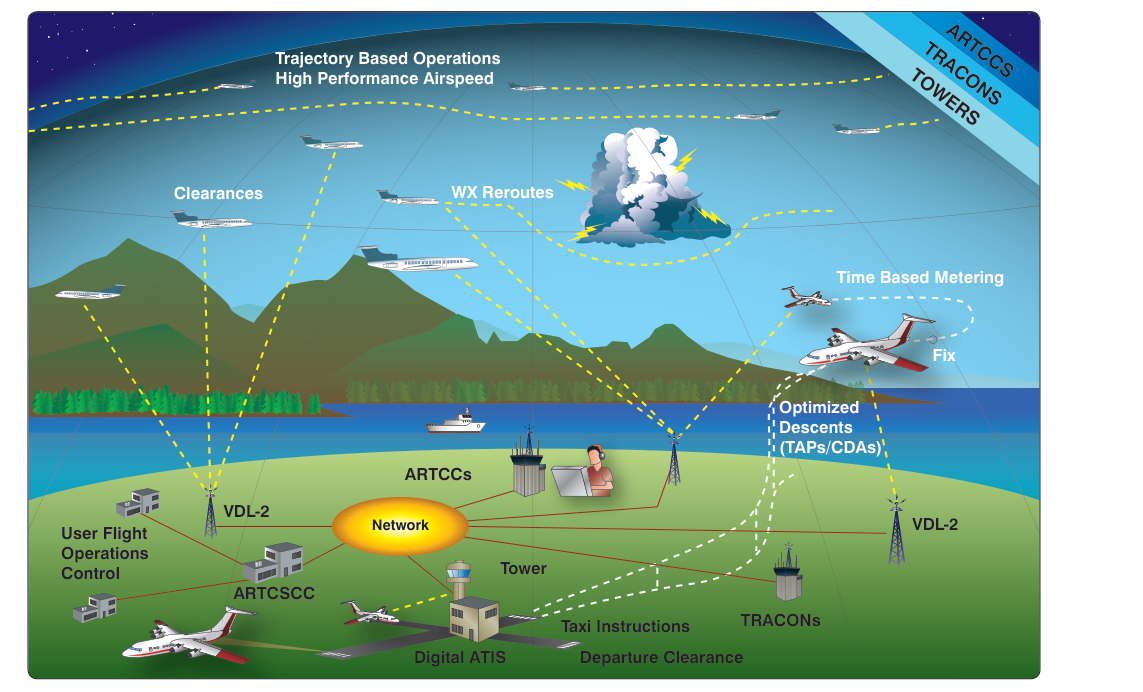
Once you depart under an IFR flight plan and enter the enroute environment, air traffic control (ATC) manages your flight through a series of clearances — formal authorizations that define exactly where you may fly, at what altitude, and under what conditions. For instrument-rated pilots, mastering the language of ATC clearances is not just a test requirement; it is a fundamental operational skill. A misunderstood clearance, an incomplete readback, or a failure to request an amendment can put your aircraft in conflict with terrain, traffic, or restricted airspace.
This article covers how ATC enroute clearances work, what their components mean, how amended clearances are issued and handled, and the practical habits that keep you safe and legal throughout a filed IFR flight.
Anatomy of an ATC Clearance
Every IFR clearance contains the same basic elements, often remembered by the acronym CRAFT. Even when delivered at cruise altitude rather than on the ground, the same structure applies. Each component tells you something specific:
- C — Clearance limit: The point to which you are cleared. In most enroute situations this is your destination airport, but ATC may clear you only to a fix if they need to sequence traffic or if the route beyond that fix is not yet coordinated.
- R — Route: The exact path you must fly — airways, direct segments, waypoints, or a combination. Any deviation from the issued route requires a new clearance.
- A — Altitude: The altitude (or altitudes at specific fixes) you are authorized to fly. Altitude clearances may include crossing restrictions such as "cross DUNNO intersection at or above 8,000 feet."
- F — Frequency: The departure or next-sector frequency, though enroute handoffs are typically issued verbally during the flight.
- T — Transponder: The squawk code ATC assigns. Squawk codes change with each new sector handoff.
Memory aid
CRAFT — Clearance limit, Route, Altitude, Frequency, Transponder. Use CRAFT every time you copy a clearance to ensure you have not missed a critical piece. Write each element in a column before you key the mic so nothing is omitted from your readback.
Receiving and Reading Back Clearances
The AIM is explicit: pilots must read back any clearance or instruction that could affect the safety of flight, including altitude assignments, heading assignments, runway assignments, and holds. Readbacks must be verbatim enough that a controller can catch any error. If you simply say "Roger" or "Wilco" without repeating the specific instruction, the controller cannot confirm you understood correctly.
During the enroute phase, clearances often arrive while you are busy with cockpit tasks — flying an approach into your alternation fix, copying weather, or troubleshooting an avionics issue. Good pilots develop a habit of announcing "standby" if they need a moment before copying, and controllers will typically accommodate a brief pause. Do not rush a readback and make an error; that is more dangerous than asking ATC to wait ten seconds.
When writing down a clearance, use standard contractions and abbreviations: V for Victor airways, J for Jet routes, Q for RNAV Q-routes, T for RNAV T-routes, and fix names spelled phonetically. Write altitude as a number with the word "thousand" spelled out to avoid confusion between, say, 6,000 and 16,000 feet.
Cruise Clearances
A special form of altitude authorization worth knowing is the cruise clearance. When ATC issues "cruise 9,000 feet," they are authorizing you to operate at any altitude from the minimum IFR altitude up to and including 9,000 feet. You may climb and descend within that block at your discretion. Importantly, once you report leaving an altitude during a descent on a cruise clearance, you may not return to that altitude without a new clearance. This is a frequently tested concept: the cruise clearance is a block altitude, but it is not a yo-yo pass — once you vacate a level during descent, it is gone.
How Amended Clearances Work
In the real world, ATC routinely amends clearances due to traffic conflicts, weather deviations, airspace restrictions, or more efficient routing. An amended clearance supersedes the previous one in its entirety for the elements that are changed. If ATC amends only your altitude, your route remains as cleared; if ATC amends the entire route, every segment of the original route is cancelled.
Common triggers for amended clearances include:
- Traffic conflicts: A faster aircraft is overtaking your position, requiring you to be stepped up or rerouted.
- Weather deviations: You request a deviation around convective activity, and ATC issues a new routing or temporary heading.
- SUA/TFR activation: Special use airspace or a temporary flight restriction becomes active along your filed route.
- EDCT (Enroute Delay Clearance Time): Traffic management initiatives may result in miles-in-trail restrictions that alter your clearance.
Requesting an Amended Clearance
As pilot in command, you are both entitled and obligated to request an amendment when the issued clearance would create a safety problem. The most common pilot-initiated amendment request is a deviation around weather. Under 14 CFR Part 91, a pilot facing an in-flight emergency may deviate from any rule to the extent necessary to meet that emergency, but this is a last resort — under routine conditions you must request and receive an amended clearance before deviating from your assigned route or altitude.
When requesting an amended clearance, be specific and concise. Tell ATC what you want and why: "Center, Archer 45 Tango, requesting direct SMITH VOR due to weather deviation, currently 20 miles southeast of the fix." The more information you give, the faster the controller can determine whether to approve, modify, or deny your request. If ATC cannot immediately accommodate your request, they will often issue a temporary heading while they coordinate — fly that heading and wait for the amended clearance before turning further.
Clearance Void Times and Pop-Up IFR
In areas without radar coverage — common at low altitudes and in remote regions — ATC may issue a clearance with a void time. This means your clearance is valid only if you depart by that specific time. If you do not depart before the void time, the clearance automatically cancels and you must call ATC for a new one before entering IFR conditions. The void time protects the separation standard for other IFR traffic on the same route.
Additionally, if you are flying VFR and encounter IMC unexpectedly, you may request a "pop-up" IFR clearance. ATC will attempt to accommodate you, but there is no guarantee that a clearance can be issued immediately, particularly in non-radar airspace. This is one reason the FAA strongly discourages launching VFR into marginal conditions — the IFR system cannot always rescue an unprepared pilot in time.
Key Numbers and Rules
- You must read back all hold instructions, altitude assignments, heading assignments, runway assignments, and any other safety-critical clearance elements (AIM 4-4-7).
- If you experience two-way radio failure in IFR conditions, squawk 7600, then fly the highest of: the last assigned altitude, the MEA for the route, or the altitude ATC told you to expect — continuing to the destination and flying the approach at the expected or filed ETA (14 CFR 91.185).
- Cruise clearances authorize any altitude from the MIA up to and including the cleared altitude; once vacated during descent, a level may not be re-occupied without a new clearance.
- A void-time clearance automatically cancels if you do not depart by the stated time — no phone call needed to cancel, but you must notify ATC if you did not depart so they can release the airspace (AIM 5-2-6).
- Unless otherwise specified, enroute altitude changes become effective when ATC issues them and you read back correctly — climb or descend promptly, not at your leisure.
Common Test Traps
- "Cruise" altitude is not a single level. The FAA often asks whether a pilot on a cruise clearance may descend below the cleared altitude. The answer is yes — the cruise clearance is a block. But once you report leaving a level during descent, you cannot return to it without a new clearance.
- Amended clearances do not cancel the whole route by default. Only the amended elements change. If ATC says "amended altitude, maintain 7,000," your route and other restrictions remain in effect exactly as before.
- Void times apply to the departure, not to the entire flight. The void time only means you must be airborne by that moment; it does not limit how long your flight can take.
- Readback "Roger" is not sufficient. The FAA tests whether pilots know that "Roger" merely means "received" — it does not confirm you have correctly understood a specific altitude, heading, or routing instruction.
- Weather deviations require a clearance first (when possible). Pilot exam questions sometimes imply that weather deviation is automatic. It is not — except in an emergency, you must request and receive an amended clearance from ATC before deviating from your route.