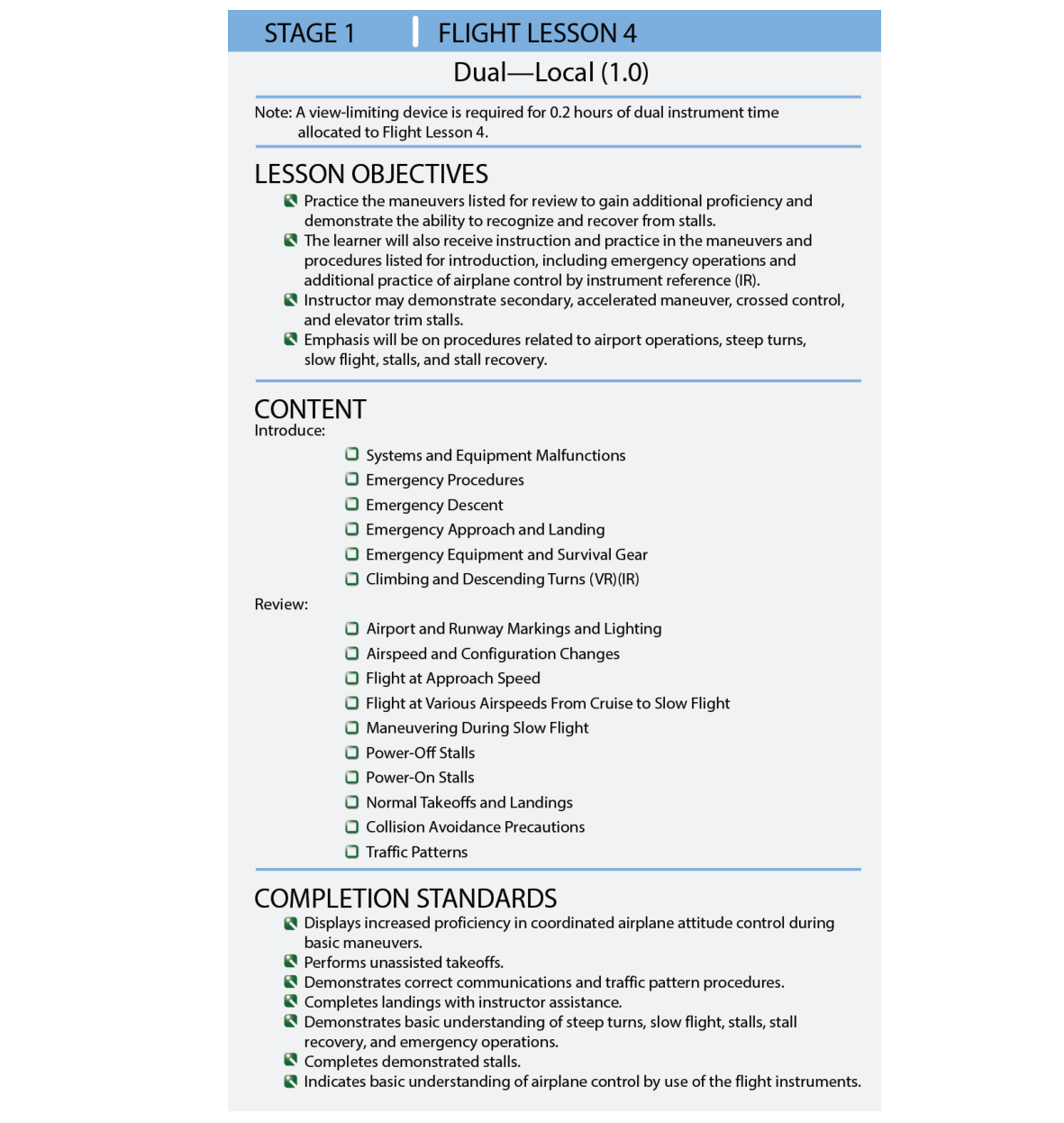
Every lesson a flight instructor delivers should end with a clear answer to one question: did the student actually learn what was intended? That answer is only possible when the lesson plan includes well-written completion standards—specific, observable criteria that define acceptable student performance. Without them, an instructor is left guessing whether a student is truly ready to move forward, and guessing in aviation training can have serious safety consequences.
The FAA's Aviation Instructor's Handbook (FAA-H-8083-9) describes a lesson plan as a detailed outline that guides both the instructor and the student through a single unit of instruction. A properly constructed lesson plan typically contains several key components—commonly including objective, content, schedule, equipment/materials, instructor/student activities, and completion standards—though the exact list can vary. The completion standard is the benchmark against which the student's performance is measured at the end of the lesson. It answers the question: How well must the student perform, and under what conditions, to be considered ready for the next phase of training?
Why It Matters
Completion standards protect the integrity of the entire training course. When standards are vague—such as "the student will understand stalls"—an instructor has no reliable way to evaluate readiness. One instructor might consider a wobbly recovery acceptable; another might not. This inconsistency puts students at risk and undermines standardization across a training program.
Measurable outcomes fix this problem by focusing on three elements drawn from sound instructional design:
- Condition: Under what circumstances will the student perform the task? For example, "in simulated instrument meteorological conditions" or "from the left seat with no assistance from the instructor."
- Behavior: What specific, observable action must the student demonstrate? "Perform a power-off stall" is observable; "understand stalls" is not.
- Standard: How well must the task be done? This often references the Airman Certification Standards (ACS) or Practical Test Standards (PTS), which provide FAA-approved tolerances that vary by task and certificate level—for example, private pilot tasks often allow ±100 feet altitude and ±10 degrees heading, while commercial and instrument tasks typically require tighter tolerances such as ±50 feet.
By anchoring completion standards directly to the ACS or PTS, instructors ensure that every lesson builds systematically toward checkride readiness. A student who consistently meets lesson-level completion standards will be far better prepared when the final practical test arrives.
The Aviation Instructor's Handbook also emphasizes that effective objectives—and by extension, effective completion standards—must be written so that student performance can be measured and evaluated, not merely observed in a general sense. The FAA emphasizes that vague or unmeasurable standards undermine effective lesson plan development.
Memory Aid
Remember the three elements of a measurable outcome with the phrase "CBS": Condition → Behavior → Standard. Before signing off any lesson, ask yourself: Did I define the condition, observe the behavior, and apply the standard?
Common Test Traps
- "Understand" is not measurable. The FAA knowledge test frequently presents completion standards written with words like "understand," "know," or "appreciate." These are cognitive states that cannot be directly observed or measured—always choose the answer that uses observable action words like "perform," "demonstrate," or "execute."
- Completion standards vs. lesson objectives. The objective states what the student should learn; the completion standard states how well the student must perform to prove they learned it. They work together but are not the same thing—don't confuse them on the test.
- ACS tolerances are the floor, not a suggestion. Some students think ACS standards are ideals. In fact, they represent the minimum acceptable performance for certification. Completion standards at the lesson level should meet or exceed them.
- A lesson with no completion standard is incomplete. If a question asks which element is missing from a described lesson plan, check for completion standards first—they are the most commonly omitted component in exam scenarios.