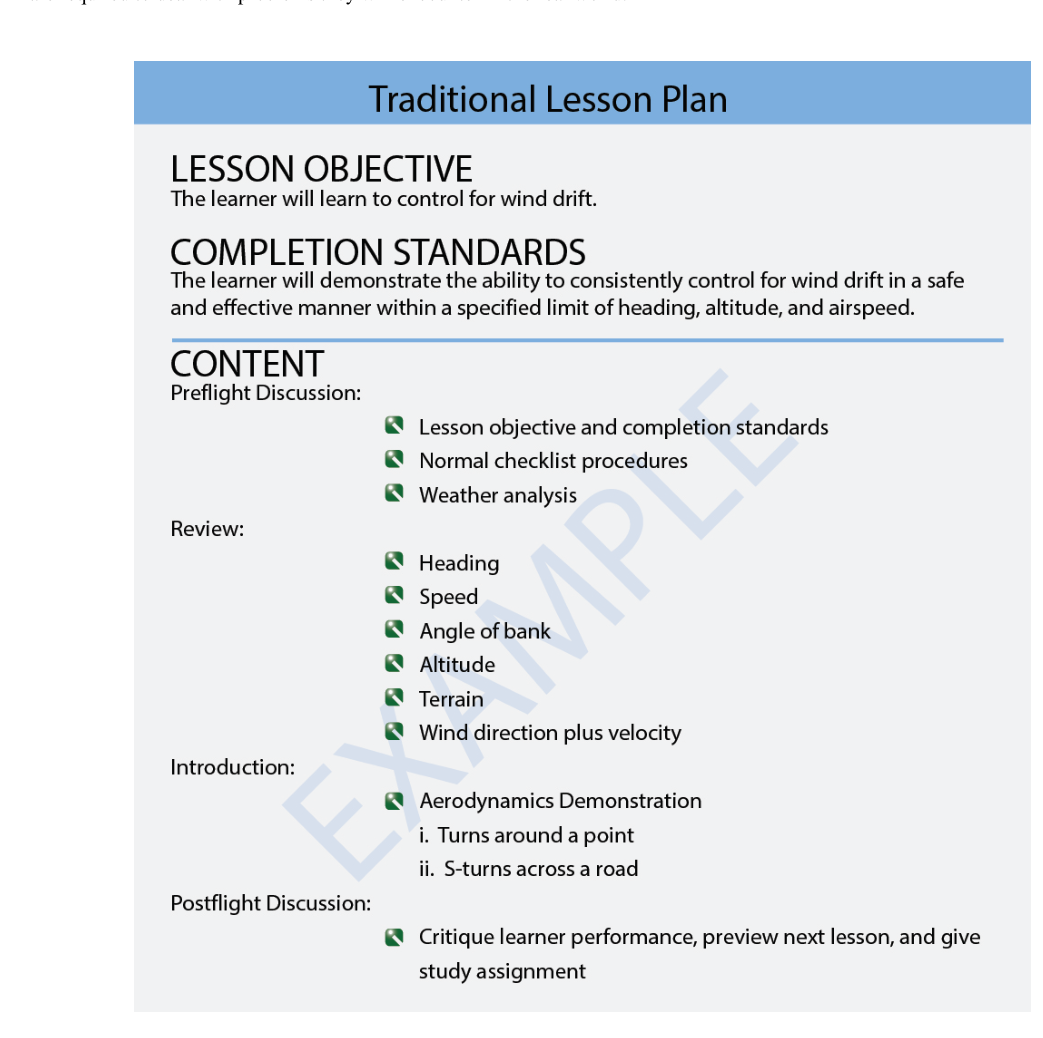
One of the most consequential decisions a flight or ground instructor makes is not simply what to teach, but in what context to teach it. Selecting appropriate training scenarios for each lesson sits at the intersection of instructional design, risk management, and human performance. The Aviation Instructor's Handbook (FAA-H-8083-9) is clear that effective instruction requires scenarios calibrated carefully to the student's current developmental stage — challenging enough to promote genuine learning yet structured to keep workload within manageable bounds. Get the calibration wrong in either direction and the consequences range from stunted progress to compromised safety.
This article explains what a training scenario is, how scenario-based training (SBT) works within the FAA's instructional framework, which variables drive sound scenario selection, and how to avoid the traps that appear most often on the Flight Instructor Knowledge Test and the Fundamentals of Instructing Knowledge Test.
What Is a Training Scenario?
A training scenario is the deliberate situational context — the who, what, where, when, and why — wrapped around a lesson objective. It is the difference between telling a student to "perform a power-off stall" and saying "you are flying a normal approach to an unfamiliar airport, the tower has just told you to extend your downwind, and you notice the airspeed is decaying." Both activities practice the same aerodynamic event, but the second embeds it in a decision-making environment that mirrors real flight.
The FAA defines scenario-based training (SBT) in FAA-H-8083-9 as a training system that uses structured real-world situations to teach technical and aeronautical decision-making (ADM) skills simultaneously. SBT is not a technique reserved for advanced ratings. The handbook explicitly endorses its use from the very first dual lesson, because waiting until a student is technically proficient before introducing realistic decision contexts produces pilots who can fly maneuvers in a vacuum but struggle to integrate them under real-world pressure.
The Learning Theory Behind Scenario Selection
Sound scenario selection rests on well-established principles from FAA-H-8083-9. Matching scenario complexity to a student's readiness and current stage of development — building each new challenge on skills already demonstrated, rather than assuming progress that has not been established — is not merely good practice but a prerequisite for learning to occur at all. Place a 10-hour student in a multi-leg cross-country with complex airspace transitions, marginal VMC, and ATC frequency changes on the same day, and the cognitive load exceeds capacity. The student stops learning and begins surviving. Conversely, a 40-hour student drilling the same calm-air rectangular course with no variation stagnates because there is no productive challenge.
FAA-H-8083-9 also describes the principle of readiness: students learn best when they are mentally and emotionally prepared for what comes next. An instructor who selects a simulated engine failure scenario before the student has established any confidence in basic aircraft control is not being demanding — they are introducing a stressor that hijacks the student's attention away from the intended learning objective.
Another key principle is primacy: the first experience or thing learned often creates a strong, lasting impression that is difficult to erase, whether that impression is correct or incorrect. This makes early scenario selection especially critical. If a student's first cross-country scenario involves shortcuts on preflight weather analysis because the instructor chose to press the lesson forward despite deteriorating conditions, the implicit lesson learned — that weather minimums are flexible — may prove far more persistent than any formal lesson on aeronautical decision-making.
Key Variables That Drive Scenario Selection
Student Experience and Performance History
Before designing the day's scenario, review the student's logbook and the previous lesson critique. Actual performance, not assumed progression, must anchor scenario complexity. A student who struggled with altitude control on the last lesson is not ready for a scenario in which altitude management is incidental to a larger task.
Lesson Objectives Tied to the ACS
Every scenario must serve at least one specific, measurable outcome drawn from the applicable Airman Certification Standards (ACS) or, for older certificates, the Practical Test Standards (PTS). The ACS defines the Task, the Conditions under which performance will be evaluated, and the Standards to which it will be judged. A well-designed scenario replicates realistic conditions so that the student's performance is genuinely analogous to what will be expected on a practical test. For example, if the objective is demonstrating proper go-around technique (Private Pilot ACS Area of Operation IV), the most effective scenario is one in which an unstabilized approach organically creates the need for a go-around decision — not an instructor verbal command issued at 200 feet AGL with a stabilized aircraft.
Environmental Variables as Controlled Teaching Tools
Weather, traffic density, airspace boundaries, and time-of-day visibility are not just background conditions — they are instructional levers. The skilled instructor introduces them one at a time, incrementally. A student learning crosswind landings should first encounter a steady, light crosswind before being exposed to gusting or variable conditions. Stacking environmental complexity before technical skill is consolidated prevents the student from isolating and correcting errors, which is the mechanism by which skill actually improves.
Risk Assessment
The Risk Management Handbook (FAA-H-8083-2) establishes that instructors must continuously assess risk even during training flights. A scenario that is pedagogically ideal may nonetheless be operationally unsafe on a given day. Simulating an engine failure over terrain with few forced-landing options, or practicing slow flight in turbulence while near Class B airspace, adds unplanned risk that the training environment cannot justify. Instructors must apply the same risk management framework during lesson planning that they teach students to apply during preflight planning — using tools such as the PAVE checklist (Pilot, Aircraft, enVironment, External pressures) and the 5 P's checklist (Plan, Plane, Pilot, Passengers, Programming), described in the Risk Management Handbook, to evaluate whether the proposed scenario is genuinely safe to execute.
Debriefability
A scenario should generate observable, concrete outcomes that lend themselves to a structured debrief. FAA-H-8083-9 emphasizes the debrief as one of the most powerful learning events in aviation training — often more influential than the flight itself. An effective debrief requires specific behaviors to discuss. If a scenario is so chaotic that neither the student nor the instructor can identify which decisions drove which outcomes, the instructional value collapses. Choose scenarios that isolate and illuminate the relationship between decisions and consequences.
Practical Scenario Sequencing
Effective course development means that scenarios build on each other in a deliberate progression. Early lessons should use scenarios with few variables and a single primary objective. As technical skills solidify, the instructor layers in additional demands: navigation while managing ATC communication, systems failures during routine phases of flight, weather deviations requiring replanning. This progressive complexity mirrors how real flight challenges accumulate and trains students to manage an expanding mental model without being overwhelmed.
- Introduce one new variable per scenario whenever possible, especially in early training.
- Use the ACS task listing as a sequencing guide — the order of areas of operation is not arbitrary and reflects a natural skill-building progression.
- Revisit earlier scenarios with added complexity as proficiency grows, reinforcing the skill while increasing the challenge.
- Pre-brief the scenario fully, including what the student should expect to encounter, so that cognitive resources are directed toward execution rather than surprise.
Common Test Traps
- SBT is for all stages of training. Knowledge test questions sometimes imply SBT is reserved for instrument or commercial training. The FAA endorses it from lesson one.
- A lesson plan is a guide, not a contract. If conditions change or the student is clearly not ready, modifying or abandoning a planned scenario mid-flight is the professional response — not a failure of preparation.
- Complexity does not equal learning. A harder scenario does not automatically produce deeper learning. Proper calibration to objective and student level is what drives progress.
- Objectives are ACS-driven, not instructor-preference-driven. If asked what should govern lesson content, the answer is always the applicable certification standards.
- Risk management applies to instructors, not just students. The FAA expects the instructor to be the final risk authority on any training flight, and scenario selection is a primary risk decision.