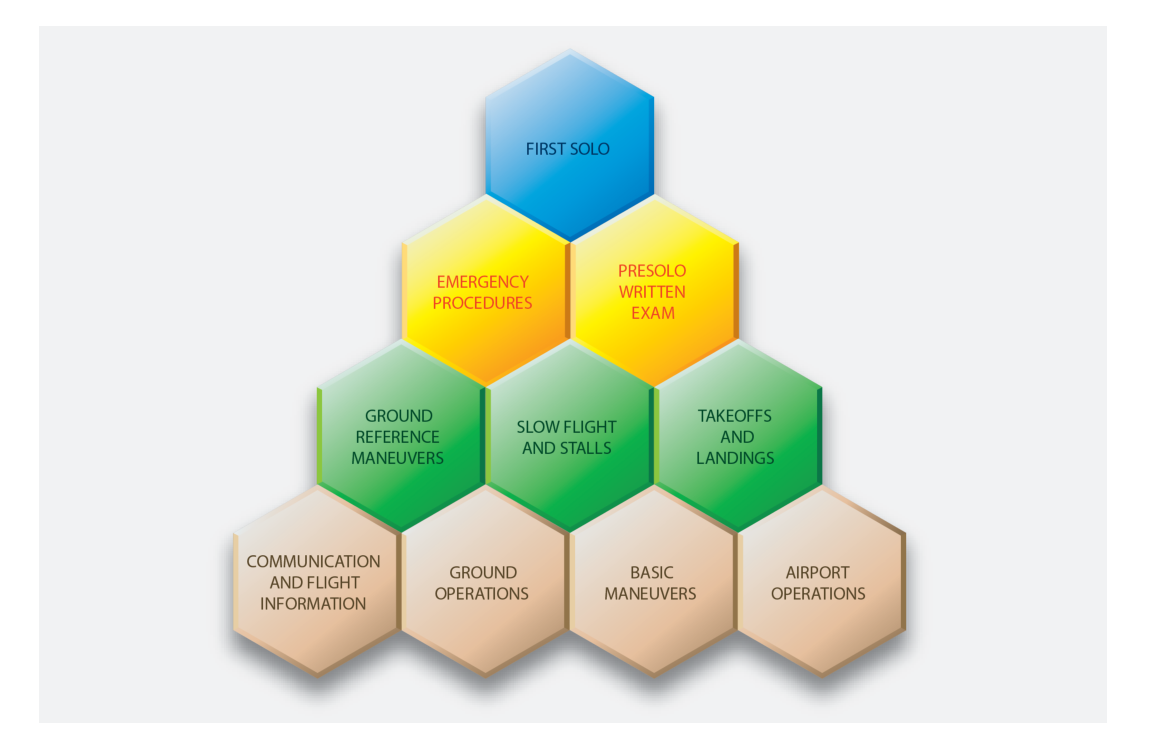
Imagine a student sitting in the left seat for the first time, nerves on edge, trying to process a crosswind correction while simultaneously figuring out which way to push the rudder pedals. The reason that scenario ends badly is almost always sequencing failure—someone tried to build the upper floors of a building before the foundation had cured. The blocks of learning concept, described in depth in the Aviation Instructor's Handbook (FAA-H-8083-9), is the FAA's answer to that problem. It is the principle that every aviation curriculum must be structured so that knowledge and skill are delivered in deliberately ordered, self-contained segments, each one mastered before the next is introduced. Understanding this principle deeply is essential for anyone pursuing the Flight Instructor or Ground Instructor certificate, because it underpins every lesson plan, every approved syllabus, and every ACS completion standard you will ever write or evaluate.
What Are Blocks of Learning?
A block of learning is a discrete segment of a training curriculum that can be taught, practiced, and evaluated as a coherent unit. The Aviation Instructor's Handbook describes the overall structure of a training course as a series of these blocks arranged so that each one rests on the one below it—a conceptual pyramid or staircase. At the base are the most foundational ideas: aircraft familiarization, the purpose of flight controls, and basic aerodynamic principles. Moving upward you find primary maneuvers (straight-and-level flight, climbs, descents, and turns), then coordinated maneuvers, then pattern operations, then cross-country skills, then emergency procedures and advanced techniques. The key structural rule is that no block may be introduced until its prerequisite blocks have been completed to a defined standard.
The word discrete is important. A block is not just a topic—it is a grouping of related knowledge and skill that has a clear beginning, a measurable completion standard, and a direct dependency relationship with blocks above and below it. That structure is what separates a thoughtfully sequenced syllabus from a loose collection of lesson topics.
How Sequencing Works in Practice
The staircase model
Picture each block as a stair step. The student must stand firmly on one step before taking the next. A private pilot curriculum might sequence its early flight blocks like this: (1) aircraft systems and cockpit familiarity on the ground, (2) effects of controls and attitude flying in visual conditions, (3) straight-and-level flight to a precision standard, (4) turns at standard and steep bank angles, (5) climbs and descents with and without power changes, (6) slow flight and recognition of the region of reversed command—the flight regime in which, because of the low airspeed, additional power rather than additional pitch is required to maintain altitude, (7) stall recognition and recovery, (8) traffic pattern and normal landings. Notice that step 7—stalls—cannot be meaningful until step 6 is solid, because slow flight is the very condition in which a stall becomes possible. And step 8—landings—requires the student to integrate every skill learned in steps 2 through 7 simultaneously. If any earlier step was rushed or incomplete, landing practice will be frustrating and repetitive.
Four sequencing principles from the handbook
The Aviation Instructor's Handbook articulates several ordering guidelines that instructors should apply when arranging blocks:
- Known to unknown. New material must be anchored to something the student already understands. A student who is comfortable with a standard level turn can be introduced to a chandelle by describing it as a maximum-performance climbing turn that results in a heading change of exactly 180 degrees, arriving at a specified pitch attitude at its completion—familiar elements repackaged in a new pattern.
- Simple to complex. Normal landings before crosswind landings; straight climbs before climbing turns; single-engine operations before multi-engine emergencies. Complexity is layered on only after simplicity is secure.
- Frequent to infrequent. Skills the student will use every flight—radio calls, traffic pattern entries, fuel management—are introduced and reinforced early. Low-probability emergency scenarios come later, once the student has a stable platform of routine skills from which to operate.
- Concrete to abstract. Hands-on experience in the aircraft or a simulator gives the student a concrete mental model. Ground school discussions of the same concept become far more meaningful when the student can relate abstract diagrams or formulas to something they have already physically done.
Defining completion standards for each block
One of the most commonly overlooked requirements is that every block must have a defined, measurable completion standard before training in that block begins. Without a standard, neither the instructor nor the student has a reliable way to know that the foundation is solid. The ACS documents published by the FAA serve this function for certificated training—they specify the knowledge, risk management, and skill elements a student must demonstrate, along with task-specific tolerances (for example, many private pilot tasks call for maintaining altitude within ±100 feet and airspeed within ±10 knots, while other tasks such as steep turns or certain performance maneuvers specify different tolerances). Part 141 approved training programs are required by 14 CFR Part 141 to include syllabi that demonstrate a clear, logical progression of subject matter, and 14 CFR 141.79 requires stage checks at the completion of each stage of training as defined in the approved course outline. The blocks-of-learning model is the conceptual engine behind that regulatory requirement, though the stages defined for stage-check purposes do not necessarily correspond one-to-one with every individual block of learning.
Why Blocks of Learning Matter for Flight Safety and Efficiency
The blocks-of-learning concept is not bureaucratic box-checking—it has direct safety consequences. When a student approaches a new maneuver that draws on thoroughly internalized prerequisite skills, their available cognitive workload capacity is high, because the underlying skills are running on something close to autopilot. The Aviation Instructor's Handbook discusses this in terms of the learning plateau: students who hit a wall often do so not because they lack ability but because a prerequisite block was inadequately mastered and is now consuming mental bandwidth that should be available for new learning. The instructor who diagnoses this correctly goes back and reinforces the missing foundation rather than pushing forward with repetition of the advanced skill.
From an efficiency standpoint, proper sequencing also reduces total training hours. A student who attempts night cross-country flight before achieving consistent day cross-country navigation skills will typically require more total repetitions to reach proficiency than one who follows a properly sequenced path. The time saved by apparently skipping a block is recovered many times over in remedial training later.
Blocks of Learning in Ground Training Curricula
It is a common misconception that blocks of learning apply only to flight maneuvers. The Aviation Instructor's Handbook makes clear that the principle governs ground instruction equally. A ground school curriculum for instrument rating, for example, should introduce basic instrument interpretation (attitude indicator, airspeed indicator, altimeter) before instrument scanning techniques, instrument scanning before partial-panel operations, and all of the above before full approach procedures. Attempting to teach an ILS approach to a student who has not yet mastered primary instrument interpretation produces the same outcome as teaching crosswind landings before basic control—confusion, frustration, and a weak foundation.
Key Rules and Numbers to Know
- Blocks of learning are a curriculum-level concept; a lesson plan is the instructor's written guide for a single instructional session. These are not the same thing, and the knowledge test frequently tests whether you can distinguish them.
- 14 CFR Part 141 requires approved course outlines to show a logical and progressive sequence of training, with stage checks required at the completion of each defined stage per 14 CFR 141.79—a direct regulatory expression of the blocks-of-learning concept.
- The ACS specifies task-specific performance tolerances (many private pilot tasks use altitude ±100 feet, heading ±10 degrees, airspeed ±10 knots, though other tasks carry their own distinct tolerances) that serve as the measurable completion standards for individual skill blocks.
- A block may include both ground and flight components. The ground component typically precedes the flight component so that the student arrives at the aircraft with the cognitive framework already in place.
- Skipping blocks is never justified by apparent student talent. The FAA position, supported throughout the Aviation Instructor's Handbook, is that every prerequisite block must be completed to standard before progression.
Common Test Traps
- Confusing blocks of learning with lesson plans. A block of learning is a segment of an overall curriculum; a lesson plan is a detailed written guide for one specific lesson within a block. Many knowledge test distractors blur this distinction.
- Assuming sequencing is optional for experienced students. Even a student with prior experience in a different aircraft category must be evaluated against each block's completion standard—assumed mastery is not demonstrated mastery.
- Overlooking ground-school sequencing. Questions about blocks of learning often present scenarios involving ground instruction only. The principle applies identically.
- Forgetting that completion standards must be predetermined. Setting the standard after observing the student's performance is not acceptable; the standard must exist before the block begins so that evaluation is objective.
- Treating the pyramid as rigid. While the overall sequence must be logical and progressive, an instructor may revisit an earlier block for reinforcement at any point. Sequencing prevents skipping prerequisites; it does not prevent review.