When a flight or ground instructor sits down to plan a student's aeronautical education, two structurally different planning documents immediately come into play: the course of training and the individual lesson plan. Many CFI candidates treat these as interchangeable—or at best as a vague hierarchy of "big" versus "small" planning—but the FAA draws a precise conceptual and, in certain contexts, a regulatory line between them. Mastering that line is essential for the FAA Flight Instructor Knowledge Test, the Fundamentals of Instructing knowledge exam, and—far more importantly—for building genuinely competent pilots in the real world.
What Is a Course of Training?
A course of training is the comprehensive, sequenced blueprint that describes the totality of instruction needed to move a student from a defined starting point to a specific aeronautical goal. As described in the Aviation Instructor's Handbook (FAA-H-8083-9), a well-constructed course of training identifies every subject area, maneuver, regulatory requirement, and performance standard that must be covered, and it arranges those elements in a logical, building-block progression. It is the macro-level document—equivalent to a semester syllabus in academic education.
The course of training answers three foundational questions: Where are we going? (the terminal objective—for example, earning a private pilot certificate under 14 CFR Part 61), What must be learned to get there? (all subject matter, maneuvers, and aeronautical experience requirements), and In roughly what order? (a rational sequence that builds skills progressively and satisfies any regulatory prerequisites). It does not script the words an instructor will say on a specific afternoon, specify which runway to use, or account for last Tuesday's crosswind.
Regulatory Weight of the Course of Training
Under 14 CFR Part 141, a course of training is not merely recommended—it is a legal prerequisite. A pilot school must submit its training courses to the FAA for approval before training begins. The approved course (often called a training course outline, or TCO) becomes part of the school's operations specifications. Changing a significant element typically requires FAA re-approval. This gives the course of training a formal, institution-level status: it protects the school's certification, assures the FAA that the curriculum meets regulatory minimums, and creates a consistent training product regardless of which individual instructor delivers it.
Under 14 CFR Part 61, no such formal approval process exists. There is no regulatory requirement for a written course of training, and independent flight instructors are not legally compelled to produce one. However, the Aviation Instructor's Handbook strongly recommends that every instructor—regardless of operating environment—develop and use a training syllabus. The rationale is pedagogical: without an overarching plan, training becomes reactive rather than deliberate, critical elements are easily skipped, and students receive inconsistent preparation for certification checkrides and, ultimately, real-world operations.
What Is an Individual Lesson Plan?
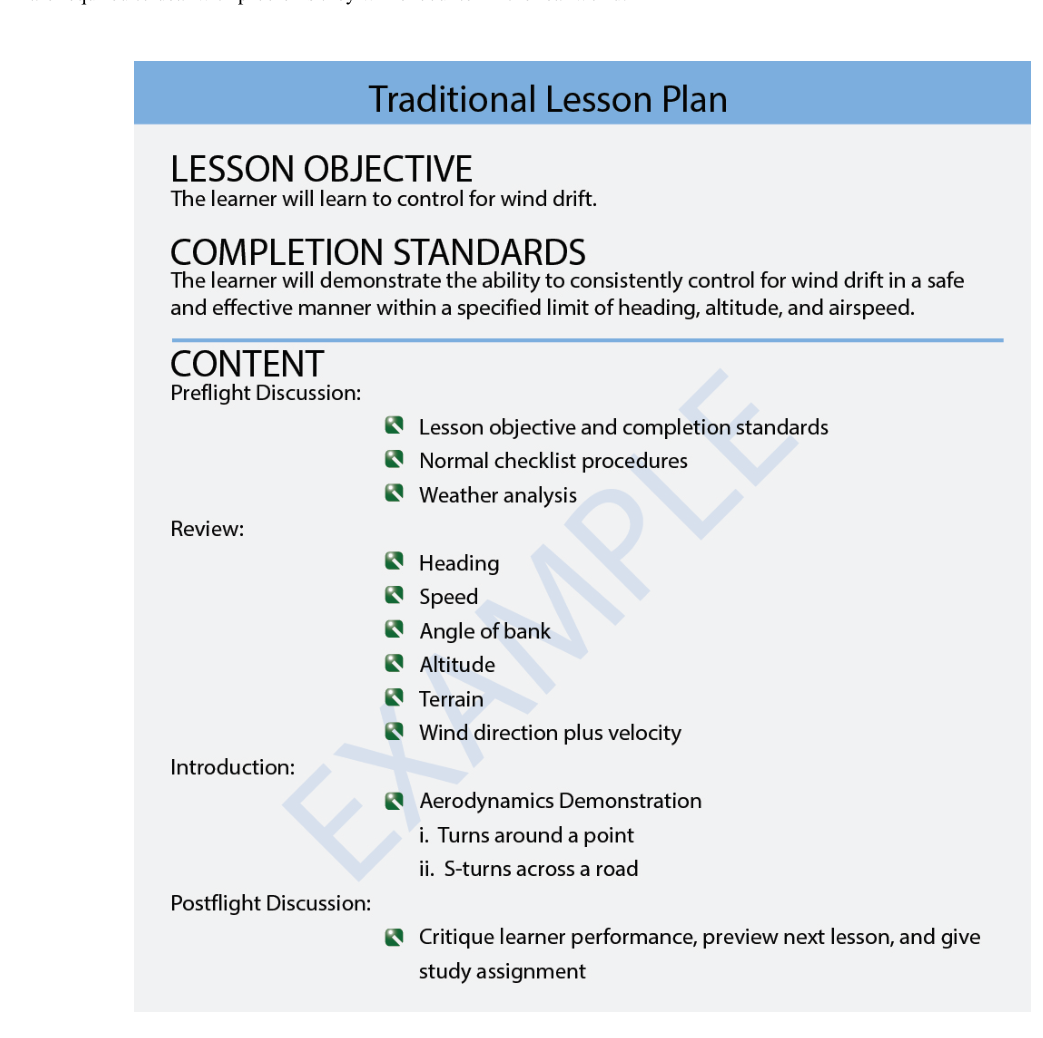
An individual lesson plan operates at the micro level. It is the detailed guide for a single instructional period—one flight session, one ground lesson, or one simulator period. According to the Aviation Instructor's Handbook, a properly constructed lesson plan contains at minimum: the objective (what the student will be able to do by the end of this lesson), the content (specific topics, maneuvers, or procedures to be covered), the schedule (time allocated to each element), the equipment and materials needed, the instructor actions (what the instructor will demonstrate, explain, or ask), the student actions (what the student is expected to practice or recite), and—critically—the completion standards (the measurable criteria that determine whether the lesson objective was achieved).
A lesson plan is specific enough that a substitute instructor, picking it up cold, could deliver a lesson consistent with the course of training. It answers the practical question: Exactly what will happen in the next 60 to 90 minutes, and how will we know whether it worked?
Completion Standards: The Most Commonly Overlooked Element
Of all the required components, completion standards receive the most FAA emphasis and are most frequently omitted by new instructors. Completion standards must be specific and measurable. For a ground lesson on weather theory, a vague standard like "student understands METARs" is inadequate. A proper standard reads: "Student correctly decodes all elements of a sample METAR and identifies ceiling, visibility, wind, and present weather with no more than one error." For a flight maneuver such as slow flight, the standard might reference the Airman Certification Standards tolerances directly—for example, the Private Pilot ACS specifies altitude within ±100 feet, heading within ±10°, and airspeed +10/-0 knots above stall warning speed. Without enforceable completion standards, an instructor has no objective basis for deciding when a student is ready to advance, which violates the foundational principle of criterion-referenced instruction described throughout FAA-H-8083-9.
How the Two Documents Interact
Think of the course of training as a river and each lesson plan as a daily paddling route within it. The river establishes the overall direction, the major landmarks, and the final destination. Each day's route must stay within the river's banks—it cannot suddenly head for a different watershed—but it can be adjusted for current water levels, the paddler's energy, and weather. In instructional terms: the course of training is relatively stable across students (especially in Part 141); individual lesson plans are adapted to each student's demonstrated ability, learning rate, and the conditions present on a given day.
This dynamic is what the FAA describes as flexibility within structure. A student who is struggling with crosswind landings may need the lesson plan revised to add more pattern work before progressing to short-field or soft-field techniques, even though the course of training lists all three techniques in a particular week. The instructor adjusts the lesson plan; the course of training itself does not change. This prevents scope creep, where ad hoc adjustments gradually distort the overall curriculum.
Key Numbers and Rules
- Part 141 training course outlines must be FAA-approved before training begins and must specify the number of flight hours, ground hours, and the content of each stage of training.
- Stage checks and end-of-course tests required under Part 141 must be aligned with the approved course of training—another reason the course document carries regulatory force.
- Individual lesson plans are not federally mandated for Part 61 operations but are explicitly recognized by the Aviation Instructor's Handbook as a professional standard for all instructors.
- A lesson plan should include the basic elements described in FAA-H-8083-9: objective, content, schedule, equipment, instructor actions, student actions, and completion standards. These are sometimes summarized as six elements (with schedule folded into content), so questions on the knowledge test may ask which element is missing from a partial list rather than testing an exact fixed count.
- Lesson plans are living documents—the FAA explicitly notes that they should be revised based on student progress, not treated as rigid scripts.
Common Test Traps
- Scope confusion: A question describes a document covering the entire private pilot curriculum—objectives, maneuvers, regulatory requirements, hour minimums—and asks what it is. The answer is a course of training (or syllabus/training course outline), not a lesson plan. If the document covers one session, it is a lesson plan.
- Mandatory vs. recommended: Lesson plans are not legally required under Part 61, but test distractors may imply they are purely optional. The FAA frames them as a professional obligation that defines instructional competence.
- Forgetting completion standards: Questions specifically probe whether candidates know that completion standards are a required lesson plan element. "Objectives" and "completion standards" are related but distinct—the objective states what will be taught; the completion standard states how success is measured.
- Part 141 approval timing: A Part 141 course of training must be approved before training begins—not retroactively. Test questions occasionally describe approval happening after training starts, which is incorrect.
- Flexibility misconception: Some candidates think that because lesson plans can be adapted, they are informal or optional. The FAA's position is the opposite: professional instructors plan carefully and adapt thoughtfully. Adaptability does not equal improvisation.
Memory Aid
Use "Course = Compass, Lesson = GPS Turn-by-Turn." The course of training establishes the overall heading for the entire journey—it tells you the destination and the major waypoints. The individual lesson plan provides the step-by-step, turn-by-turn directions for today's specific leg, including the confirmation that you actually arrived where you intended (completion standards). Both tools are required for a safe, efficient arrival at the student's aeronautical goal.