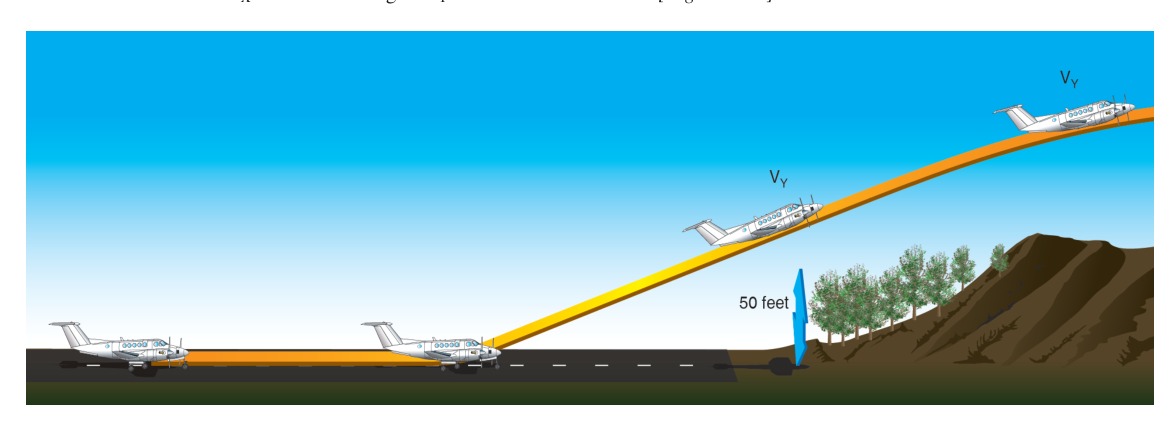
Building an effective lesson plan is one of the most important skills a flight instructor candidate must master before the practical exam. A well-structured lesson plan is not just a formality—it is a roadmap that ensures the student receives consistent, complete, and safety-focused instruction every time. Using the short-field takeoff as a concrete example, we can walk through exactly how the Aviation Instructor's Handbook (FAA-H-8083-9) expects a lesson plan to be constructed and delivered.
A short-field takeoff is a maximum-performance maneuver used when the available runway is limited or when obstacles near the departure end require the aircraft to climb steeply after liftoff. Because it demands precise airspeed control, proper configuration, and confident decision-making, it is an ideal maneuver around which to build a multi-element lesson plan that touches on knowledge, skill, and risk management simultaneously.
The Four Core Elements of Any Lesson Plan
According to the Aviation Instructor's Handbook, a complete lesson plan should include: (1) an objective, (2) content, (3) schedule, and (4) equipment. Each plays a specific role.
- Objective: State what the student should be able to do by the end of the lesson, under what conditions, and to what standard. For a short-field takeoff, a well-written objective might read: "The student will demonstrate a short-field takeoff and initial climb, configured per the POH, and maintain best-angle-of-climb speed (Vx) within ±5 knots until clearing an imaginary 50-foot obstacle, as outlined in the ACS."
- Content: Break the topic into its logical sub-elements. For short-field takeoffs, this includes: (a) reviewing the POH for flap setting and rotation speed, (b) brake-hold technique, (c) full-power check before brake release, (d) rotation at the POH-specified speed, (e) holding the aircraft just above the runway in ground effect briefly if needed, and (f) establishing Vx after liftoff to clear obstacles. After clearing obstacles, the pilot transitions to Vy for best rate of climb.
- Schedule: Allocate realistic time for each phase—preflight briefing, ground demonstration or chair flying, actual flight, and debrief. The Instructor's Handbook emphasizes that a schedule keeps instruction focused and prevents any single phase from consuming the entire lesson.
- Equipment: List everything needed: the aircraft, the POH, a whiteboard or lesson card for the briefing, and the relevant Airman Certification Standards (ACS) task sheet.
Sequencing the Ground Portion
Before going to the aircraft, the instructor should conduct a thorough ground lesson. Start with the why: what makes this takeoff different from a normal one? Discuss density altitude, obstacle clearance, and the critical importance of using the correct flap setting per the POH. Then walk through the procedure step by step, referencing the aircraft's checklist. Use chair flying—having the student verbalize and physically rehearse each control input while seated—to build the mental model before any engines start. The Aviation Instructor's Handbook identifies this kind of mental rehearsal as a powerful learning accelerator.
Why It Matters
A lesson plan keeps the instructor from drifting off-topic or forgetting safety-critical elements under the pressure of a busy lesson. It also demonstrates professionalism during a Designated Pilot Examiner (DPE) checkride evaluation. DPEs specifically look for whether the lesson plan has a clear, measurable objective tied to an ACS standard, whether the content flows logically from simple to complex, and whether the instructor has accounted for the student's current skill level and readiness to learn (concepts drawn from the Instructor's Handbook's discussion of the levels of learning—rote, understanding, application, and correlation, the highest level, in which the student associates learned material with other knowledge and experience). Importantly, a lesson plan is a living document—an instructor should annotate it after each use to record what worked, what didn't, and how long each phase actually took.
Memory Aid
Use O-C-S-E to remember the four parts of a lesson plan: Objective, Content, Schedule, Equipment. Before any lesson, ask yourself: "Have I defined all four?"
Common Test Traps
- Objective vs. purpose: The FAA distinguishes between a lesson objective (measurable, student-centered, tied to a standard) and a general purpose. Test questions often probe whether you know the objective must be specific and measurable.
- Leaving out the standard: An objective that says "the student will perform a short-field takeoff" is incomplete. It must reference the performance standard (e.g., ACS tolerances) to be considered a proper lesson plan objective.
- Lesson plan flexibility: The Instructor's Handbook states that a lesson plan should serve the instructor, not control the instructor. If a student is struggling, the instructor may deviate from the plan—but should note this and adjust future lessons accordingly.
- Confusing Vx and Vy: On knowledge tests, remember Vx (best angle) is used to clear obstacles; Vy (best rate) gives the greatest altitude gain per unit of time. Short-field technique uses Vx until obstacles are cleared, then transitions to Vy.