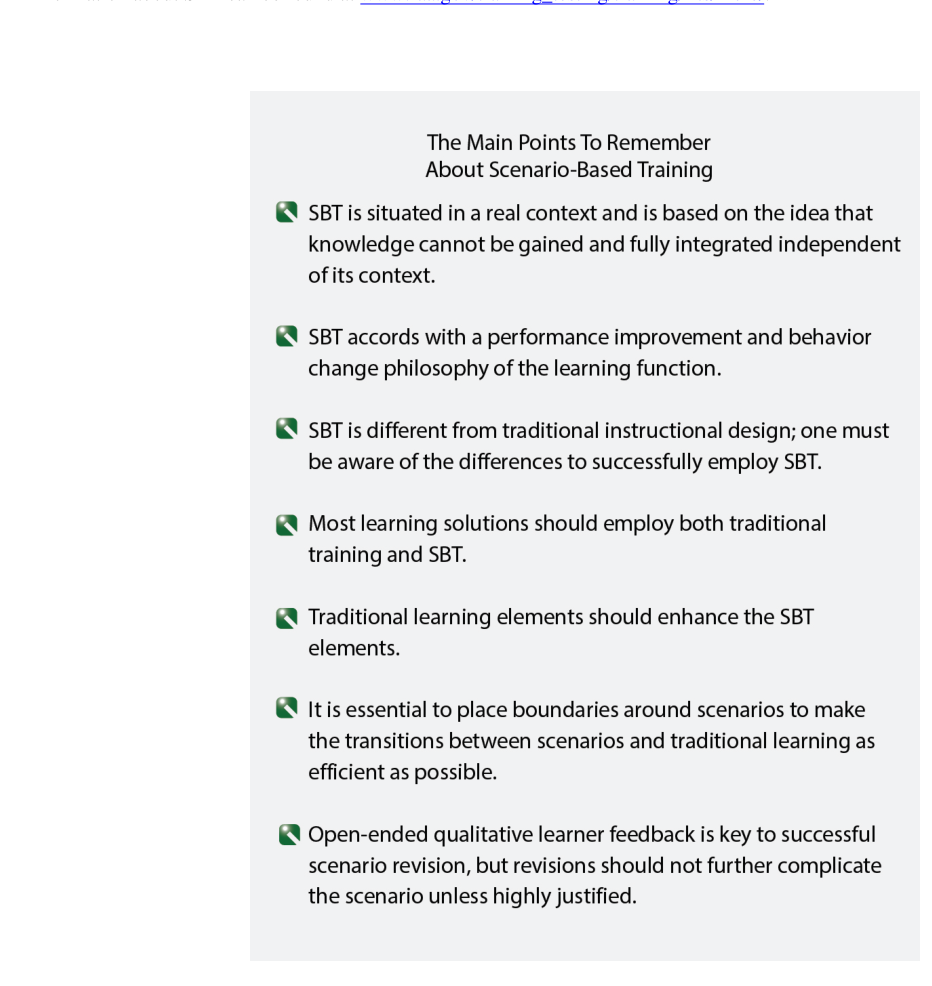
Traditional maneuver-based flight training treats each skill as a separate module: slow flight on Tuesday, steep turns on Thursday, ground reference maneuvers the following week. While that approach builds psychomotor proficiency, it often leaves a student unable to recognize when a skill is needed or why it matters in a real flight context. Scenario-Based Training (SBT) closes that gap by embedding required tasks inside a realistic, goal-driven flight story. The Aviation Instructor's Handbook (FAA-H-8083-9) defines SBT as a training system that uses a structured sequence of realistic events to engage both the student's cognitive decision-making processes and the required psychomotor skills simultaneously. The private pilot Airman Certification Standards (ACS) already evaluates risk management and aeronautical decision-making (ADM) alongside technical performance—meaning the practical test itself is a scenario. Designing every dual lesson the same way is the most direct path to checkride readiness.
What Scenario-Based Training Actually Is
SBT is not simply adding a story to a maneuver. It is a deliberate instructional architecture where a plausible narrative drives the selection of tasks, complications, and decision points. The scenario gives the flight a purpose—visiting a friend at a destination airport, ferrying a personal aircraft after maintenance, a cross-country to a fly-in—and that purpose creates natural stakes. When fuel planning is tied to actually reaching a destination rather than answering a quiz question, the student's brain encodes it differently. FAA-H-8083-9 describes this effect in terms of higher-order learning: SBT pushes students beyond rote recall into the application, correlation, and synthesis levels of learning that produce lasting aeronautical judgment.
The instructor's role in SBT is fundamentally different from the traditional demonstration-and-practice model. Rather than announcing each maneuver, the instructor acts as a facilitator and observer—posing open-ended questions, introducing realistic complications, and stepping back to let the student manage the flight. Intervention is reserved for genuine safety boundaries or for a Socratic question that redirects dangerously flawed thinking. This restraint is uncomfortable for many new instructors, but it is essential: if the instructor constantly corrects or prompts, the student never develops independent judgment.
How to Build an Effective SBT Lesson Plan
Step 1 — Write the Scenario Narrative
The narrative is a one- to two-paragraph story that establishes departure airport, destination, stated purpose, passenger or cargo context, and weather appropriate to the student's training stage. Early-stage scenarios keep weather benign and airspace simple; later scenarios introduce marginal VFR ceilings, temporary flight restrictions, or high-density-altitude destinations. The narrative should be specific enough to feel real—name a destination airport, give it an identifier, mention actual field elevation and typical terrain—without being so complex that the student spends lesson time decoding logistics rather than flying.
Step 2 — Map Learning Objectives to ACS Tasks
Every complication you plan must link to at least one published ACS task and risk-management element. Write objectives in measurable terms as required by FAA-H-8083-9: the student will evaluate a deteriorating METAR and make a documented go/no-go decision using personal minimums, or the student will perform a diversion to an alternate airport within published ACS heading and altitude tolerances. Listing objectives before the flight is not bureaucratic formality—it is the legal and pedagogical foundation of the lesson plan. An instructor who improvises objectives in the air is not conducting SBT; they are simply flying with a student.
Step 3 — Pre-Plan Scenario Injects
Injects are the complications the instructor introduces at predetermined points in the flight. Two or three injects per lesson is a practical limit for early students; instrument-phase students can handle more. Effective injects include: a METAR at the destination that has dropped below personal minimums since departure; a NOTAM closing the destination runway and requiring a divert; a simulated rough engine requiring an off-airport landing evaluation; or an ATC frequency change that reveals the student has drifted into Class C airspace. Each inject should be realistic—something an actual pilot could encounter—and should naturally surface the target ACS skill without feeling contrived. Document each inject in the lesson plan with a precise trigger point (over a named fix, at a specific altitude) so the lesson is repeatable and reviewable.
Step 4 — Identify Decision Gates
A decision gate is a natural moment in the flight where a go/no-go, continue/divert, or climb/descend decision must be made. These are the primary ADM teaching moments. FAA-H-8083-9 notes that ADM is a teachable, trainable skill, not an innate talent, and that structured opportunities to practice decisions—not just maneuvers—are what build aeronautical judgment over time. For each gate, the instructor's lesson plan should note the realistic options available, the consequences of each, and the personal minimums or regulatory limits that bound the decision. During the flight, the instructor may ask: "What are your options right now?" and then remain silent long enough for the student to actually think.
Step 5 — Define Instructor Actions and Safety Boundaries
Write explicit notes in the lesson plan identifying when the instructor will remain silent, when they will ask a Socratic question, and the precise conditions that require immediate dual control input. These boundaries protect both safety and the integrity of the SBT experience. An instructor who takes control too early trains a student to wait for rescue; one who intervenes too late creates a safety hazard. FAA-H-8083-9 is clear that the instructor retains pilot-in-command responsibility throughout the lesson regardless of how much decision-making authority is delegated to the student. This is a frequently tested concept on the Fundamentals of Instructing knowledge test.
Step 6 — Build the Debrief Guide
The post-flight debrief is where the majority of ADM learning is consolidated. FAA-H-8083-9 describes the debrief as a structured review of what happened, why it happened, and what the student would do differently. Prepare open-ended questions before the flight: "At what point did you first sense the situation was changing?" "What options did you consider when the ceiling dropped?" "What personal minimum would have prevented that diversion surprise?" Closed yes/no questions short-circuit the reflection process. Avoid lecturing during the debrief; the goal is for the student to articulate lessons, not to receive them passively. A thorough debrief typically takes 20 to 30 minutes for a one-hour scenario flight.
Why SBT Works — The Learning Science Behind It
FAA-H-8083-9 frames effective learning in terms of the laws of learning, particularly the law of primacy (first experiences are retained longest) and the law of emotion (experiences with emotional salience are learned more deeply). A student who sweated through a simulated fuel exhaustion scenario at 45 minutes into a planned 90-minute flight will carry that lesson permanently. The same student who answered a multiple-choice question about fuel reserves may forget it before the next lesson. SBT leverages both laws deliberately: by making the scenario feel real and consequential, the instructor creates conditions for durable learning. Additionally, integrating multiple ACS tasks into one narrative—cross-country planning, weather evaluation, airspace management, and diversion technique all in a single lesson—produces the correlation-level learning that FAA-H-8083-9 identifies as the hallmark of truly qualified pilots.
Key Rules and Numbers to Know
- ACS tolerances are non-negotiable inside a scenario. SBT provides context, not forgiveness. Private pilot altitude tolerance of ±100 feet and heading tolerance of ±10 degrees still apply during scenario flight.
- Objectives must be written before the flight per FAA-H-8083-9. A lesson plan without stated, measurable objectives is incomplete regardless of how realistic the narrative is.
- Two to three injects per lesson is a practical target for early students; more than that can overwhelm working memory rather than develop judgment.
- Instructor remains PIC at all times (14 CFR 61.195 governs what flight instructor actions are permissible). SBT does not transfer legal responsibility.
- DECIDE model (Detect, Estimate, Choose, Identify, Do, Evaluate) is one of several ADM frameworks in FAA-H-8083-9 that instructors can use to structure both injects and debrief questions.
- Debrief is not optional. FAA-H-8083-9 describes the debrief as an integral lesson component, not an add-on. Omitting it discards the highest-value portion of the SBT experience.
Common Test Traps
- SBT does not mean unplanned flying. The scenario feels spontaneous to the student but must be thoroughly pre-planned by the instructor, with written objectives, documented injects, and defined safety limits.
- Facilitator does not mean passive. The instructor actively monitors, poses targeted questions, and intervenes at safety boundaries. SBT requires more preparation and in-flight vigilance than traditional instruction, not less.
- ADM is testable content, not soft skill filler. The Fundamentals of Instructing knowledge test includes questions on learning theory, lesson plan components, and the elements of ADM—all of which underpin SBT design.
- Early-stage students need bounded scenarios. Placing a student solo in a scenario before they have sufficient stick-and-rudder skill defeats the purpose. SBT scales with proficiency; complexity of injects increases as the student advances.