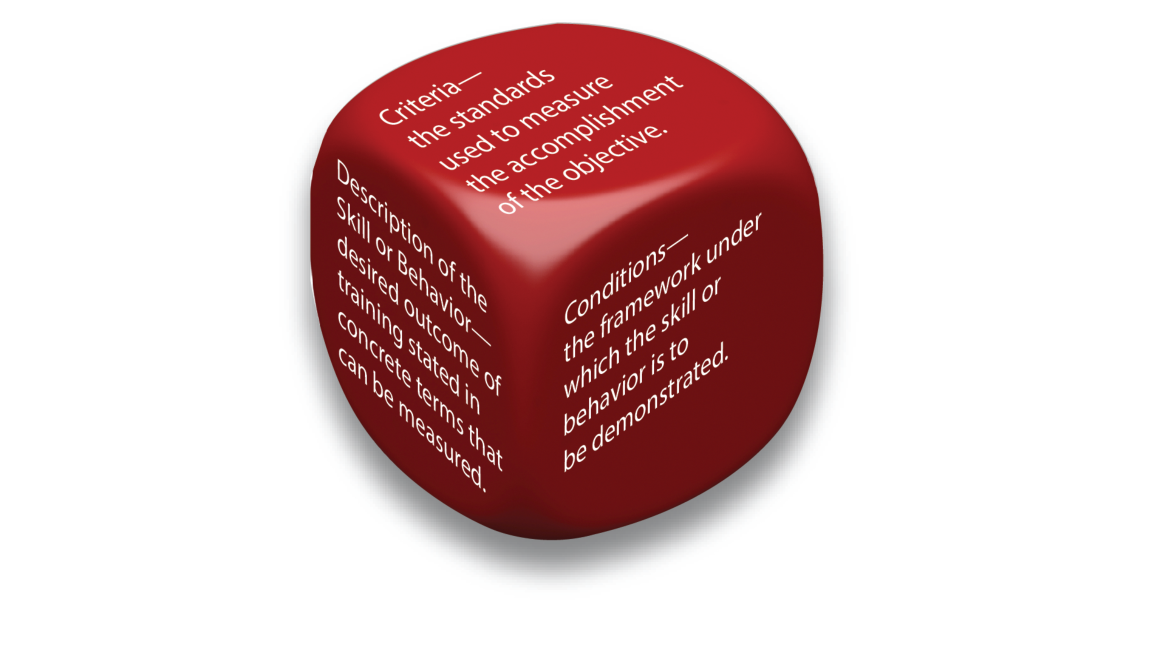
When a flight instructor sits down to design a lesson, the single most important structural decision is how to write the objective. A vague aim like "cover steep turns today" tells neither the instructor nor the student what success actually looks like. A performance-based objective, by contrast, describes exactly what the student will be able to do at the end of instruction, under what circumstances that performance will occur, and to what measurable standard it must be demonstrated. This three-part architecture is not an academic nicety—it is the operational core of effective flight training, and it is examined directly on the Flight Instructor Knowledge Test and the Fundamentals of Instructing Knowledge Test. The Aviation Instructor's Handbook (FAA-H-8083-9) treats performance-based objectives as a foundational element of every well-constructed lesson plan.
The Three Required Components
The FAA specifies that every performance-based objective must contain three distinct, explicitly stated elements. Understanding each one deeply—and being able to distinguish it from the others—is critical both for writing effective lesson plans and for answering knowledge test questions correctly.
1. Description of the Skill or Behavior
The behavior component answers the question: What observable action will the student perform? The key word is observable. Verbs like "understand," "appreciate," or "know" are not acceptable here because they describe internal states that cannot be directly measured. Instead, use action verbs: demonstrate, identify, calculate, perform, explain verbally, plot, or recite. For example, "the student will perform a power-off stall" describes a specific, observable action. "The student will understand stalls" does not—it is a goal, not an objective. This distinction is one of the most frequently tested concepts on the Fundamentals of Instructing Knowledge Test.
2. Conditions
The conditions component answers: In what situation or environment will the behavior be performed? Conditions set the context and make the objective realistic and fair. Relevant conditions in flight training include the type of aircraft ("in a Cessna 172"), the phase of flight ("during the approach to landing"), the weather environment ("in VMC"), the available equipment ("using a sectional aeronautical chart"), or any constraint on the task ("without reference to outside visual cues" for an instrument lesson). Conditions matter because a skill demonstrated in a simulator under calm conditions is not the same as the same skill performed in light turbulence in an actual aircraft. Omitting conditions leaves ambiguity about whether the student has truly met the standard in a realistic operational setting.
3. Criteria (the Standard)
The criteria component answers: How well must the performance be executed to be considered successful? Criteria must be measurable and, wherever possible, expressed in quantitative terms. Common examples drawn from the Airman Certification Standards (ACS) include altitude tolerances (±100 feet), heading tolerances (±10°), airspeed tolerances (±10 knots), bank angle tolerances (±5°), and time or distance constraints. For ground instruction, criteria might be expressed as a percentage score ("with 100% accuracy") or a zero-error standard ("correctly identifies all required items on a VFR sectional chart"). Criteria also serve a legal and ethical function: when a student knows the standard in advance, evaluation at debrief is objective rather than subjective, and the instructor's sign-off carries defensible meaning.
A Fully Written Example
To see how the three components work together, consider a complete objective for steep turns: "The student will perform a 360° steep turn to the left and right at 45° of bank (behavior), in a Cessna 172 during a local dual training flight in VMC (conditions), maintaining altitude within ±100 feet, airspeed within ±10 knots, and rolling out within ±10° of the entry heading (criteria)." Every piece of ambiguity has been removed. Both the instructor and student can evaluate the maneuver objectively the moment it is complete. Compare that with "today we will work on steep turns"—no behavior specified beyond a maneuver name, no conditions, and no standard. A student could fly a sloppy 360° losing 400 feet and the instructor would have no written basis for saying the lesson objective was not met.
Now consider a ground-lesson example: "Given a current sectional aeronautical chart and a printed airport/facility directory excerpt (conditions), the student will correctly identify and verbally describe the airspace classification, entry requirements, and communications requirements for five randomly selected airports (behavior), with zero errors (criteria)." This illustrates that performance-based objectives are not limited to flight maneuvers—every preflight briefing, ground school session, and simulator period should be anchored to a written objective of this quality.
Why Performance-Based Objectives Drive Better Instruction
The FAA-H-8083-9 explains that performance-based objectives serve multiple overlapping functions that compound across an entire training syllabus. First, they focus attention. When an instructor enters a lesson knowing the precise endpoint, every explanation, demonstration, and practice repetition can be evaluated against that endpoint. Instructional drift—spending an entire hour on tangential material without advancing the student toward a measurable skill—is far less likely. Second, they directly scaffold the ACS. Because the ACS itself is structured around objective, measurable performance tolerances, a student who has trained to explicitly stated performance criteria is essentially practicing checkride performance from lesson one. The alignment reduces the risk of a student who "flies okay" but cannot meet published standards under evaluator observation.
Third, performance-based objectives support course sequencing. When building a training syllabus, each objective becomes a prerequisite check for the next. The FAA describes this as building on prior learning: a student should not advance to stall series work until the objective for slow flight has been demonstrably met. This sequencing is not merely pedagogically sound—it has safety implications. An instructor who can point to a written, passed objective for each prerequisite skill has a defensible record that the student was prepared for progressive training.
Fourth, these objectives protect both student and instructor. If a dispute arises about whether a student was adequately prepared for solo or for a practical test, lesson plans containing clear, documented performance-based objectives provide an objective record. The FAA's focus on safety management and risk mitigation extends to training documentation, and well-written objectives are part of that record.
Key Numbers and Rules to Know
- Three required components: behavior, conditions, and criteria—all three must be present; an objective missing any one is incomplete by FAA definition.
- Observable action verbs only: verbs such as "understand" or "know" do not satisfy the behavior component; use "demonstrate," "calculate," "identify," or "perform."
- ACS alignment: ACS performance tolerances (e.g., ±100 ft altitude, ±10 kt airspeed, ±10° heading for many maneuvers) are the natural source for the criteria component in flight lesson objectives.
- Applicability: performance-based objectives are required for both flight lessons and ground lessons; every lesson plan element in an FAA-compliant syllabus should carry one.
- Distinction from a course goal: a goal is a broad, inspirational statement about end-of-course outcomes; an objective is a specific, lesson-level, measurable target. Both are legitimate planning tools, but only objectives are performance-based in the FAA sense.
Common Test Traps
- Goal versus objective confusion: The knowledge test frequently presents broad, vague statements and asks whether they constitute performance-based objectives. If no measurable standard or explicit condition is present, it is a goal, not an objective.
- Confusing conditions with criteria: Conditions describe the situation (aircraft type, weather, equipment available). Criteria describe the level of performance required. These are distinct components; substituting one for the other is a common wrong-answer trap.
- Omitting one component: A behavior plus criteria with no conditions, or a behavior plus conditions with no criteria, is still an incomplete objective. All three elements must appear explicitly.
- Restricting objectives to maneuvers: Objectives govern every instructional unit—preflight briefings, weather decision-making discussions, chart-reading exercises, and simulator sessions all require their own performance-based objectives.
- Using passive or internal verbs: Writing "the student will be aware of" or "the student will appreciate" fails the observable-behavior requirement, even if conditions and criteria are otherwise present.
Memory Aid
A widely used memory device for the three components is BCS: Behavior (what the student does), Conditions (the situation), and Standard (how well). Some instructors prefer to phrase it as a three-question check they ask themselves while drafting every objective: What will the student do? Where or under what constraints? How well must they do it? If any question cannot be answered by reading the objective, the objective is not yet complete.