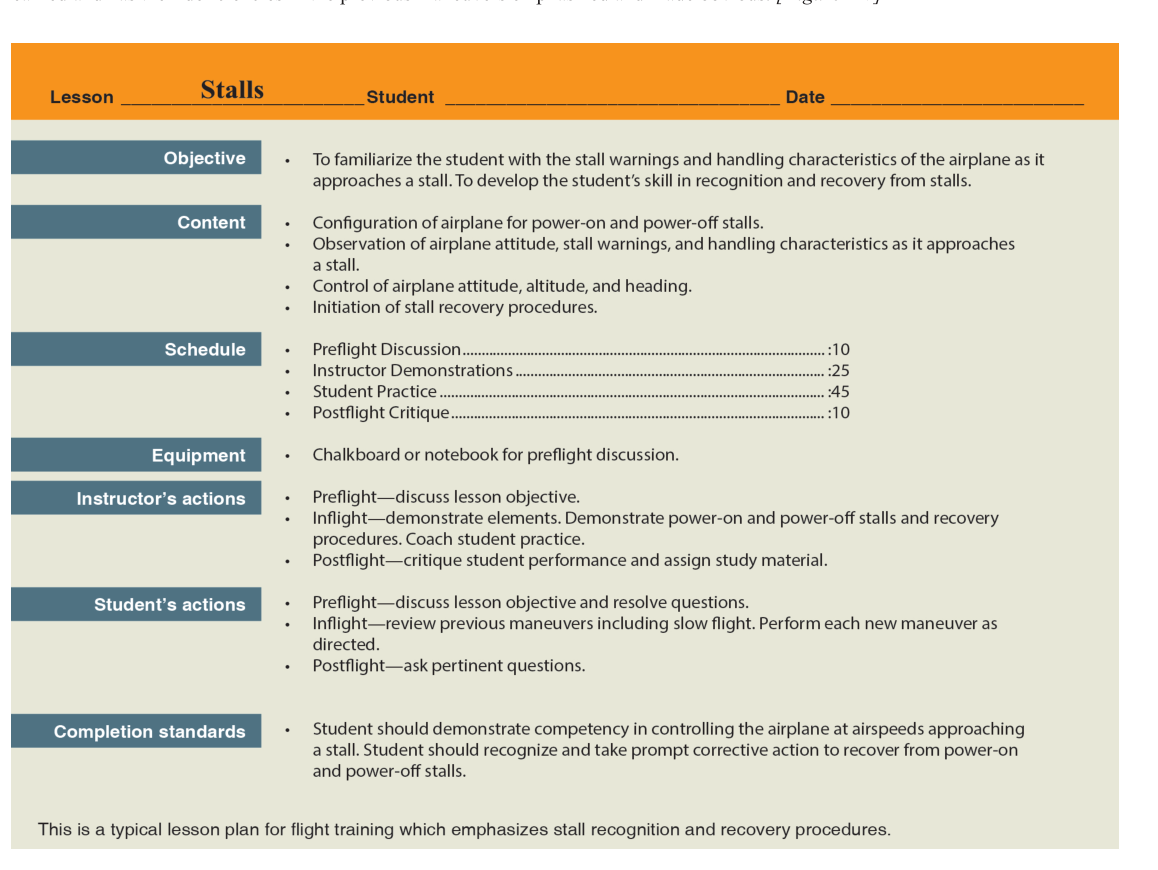
A lesson plan is a carefully organized, written outline that guides an instructor through a single unit of ground or flight instruction. The FAA's Aviation Instructor's Handbook (FAA-H-8083-9) defines a lesson plan as an organized, written outline of a single instructional period. The key word is written: an instructor who relies solely on memory risks omitting critical elements, losing consistency between students, and failing to meet the systematic training requirements that the FAA expects of certificated flight instructors (CFIs) and ground instructors alike.
Every effective lesson plan serves three purposes simultaneously: it tells the instructor what to teach, how to teach it, and how to measure whether the student actually learned it. Without all three purposes working together, instruction becomes uneven and accountability disappears. When the FAA evaluates an applicant for a flight instructor certificate, examiners look closely at the quality and completeness of lesson plans as evidence that the applicant can teach—not just fly.
Required Components of a Lesson Plan
The Aviation Instructor's Handbook identifies the following essential elements that every lesson plan should contain:
- Objective – A clear statement of what the student should be able to do at the end of the lesson. Objectives must be specific and measurable, not vague. For example, "The student will demonstrate slow flight at minimum controllable airspeed while maintaining ±100 feet altitude and ±10 knots airspeed" is a proper objective; "learn about slow flight" is not.
- Content – The specific facts, concepts, procedures, and skills that will be covered during the lesson. This is the body of the lesson—the material the instructor will actually present or demonstrate.
- Schedule – A time allocation for each phase of the lesson, including introduction, development (the main instructional period), and conclusion. Scheduling forces the instructor to plan realistically and prevents any one segment from consuming the entire lesson.
- Equipment – A list of all materials, references, aircraft, simulators, charts, checklists, or training aids needed. Arriving at the aircraft without a required checklist or chart wastes valuable training time and student funds.
- Instructor's Actions – A description of what the instructor will do: demonstrate, explain, question, or observe. This keeps the instructor's role deliberate rather than reactive.
- Student's Actions – A parallel description of what the student will do: practice, respond, perform, or answer. This component reinforces that learning is an active process—the student must do something, not just watch.
- Completion Standards – The specific performance benchmarks the student must meet for the lesson to be considered complete. Completion standards are typically drawn from the relevant Airman Certification Standards (ACS) or Practical Test Standards (PTS) and define the minimum acceptable performance.
Why It Matters
Lesson plans protect both the student and the instructor. For the student, a well-written plan ensures that every training hour has a clear purpose aligned with certification requirements—no accidental gaps, no repeated topics crowding out new skills. For the instructor, a written plan creates a defensible training record: if a student later claims they were never taught a certain procedure, the instructor's lesson plans provide documented evidence to the contrary. Additionally, the FAA expects training conducted under 14 CFR Part 141 to follow an approved course of training with lesson plans that meet the school's operations specifications. Even under Part 61, the spirit of organized, documented instruction is central to instructor professionalism.
Memory Aid
Use the acronym O-C-S-E-I-S-C to recall all seven components in order: Objective, Content, Schedule, Equipment, Instructor's actions, Student's actions, Completion standards. A simple phrase: "Old Cats Sleep Easily In Small Cages"—not glamorous, but it covers every box on the plan.
Common Test Traps
- Objectives vs. completion standards are not the same thing. The objective states the intent of the lesson; the completion standard defines the measurable performance level that proves the objective was met. Confusing the two is a frequent knowledge-test error.
- A lesson plan is not a training syllabus. A syllabus is the overall course outline covering many lessons; a lesson plan covers a single instructional period. Know which is which.
- "Flexible" does not mean "optional." The handbook notes that lesson plans should be flexible enough to adapt to student progress, but that flexibility applies to pacing—not to skipping required components entirely.
- Completion standards should reference ACS/PTS standards where applicable. Instructors who write vague standards like "student does okay" have no defensible basis for signing off a student or progressing to the next lesson.