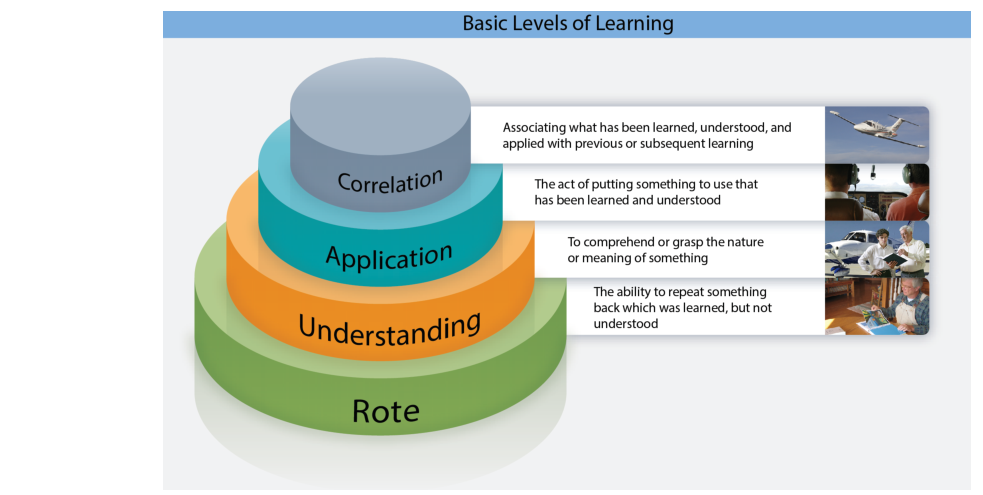
When you sit down with a flight instructor, the goal is never just to help you memorize facts. The FAA's Aviation Instructor's Handbook identifies four distinct levels of learning that describe how thoroughly a student has internalized new knowledge or skill. Think of these levels as a ladder: each rung represents deeper, more flexible mastery. A well-prepared instructor designs lessons that push students up every rung—and the FAA knowledge test expects you to know exactly what each level looks like.
The Four Levels Explained
Rote is the lowest level. At this stage a student can repeat back information that was presented—names, numbers, steps—without truly understanding what they mean or why they matter. A student who can recite "GUMPS" (Gas, Undercarriage, Mixture, Prop, Seatbelts) before landing but has no idea why each item is checked is operating at the rote level. Rote learning is a necessary starting point, but it is dangerously thin on its own. A student stuck at rote will fail the moment a situation differs even slightly from what was memorized.
Understanding moves the student one rung higher. Here the learner grasps the principle behind the fact—they know not just that carburetor heat is applied in certain conditions, but why: that moist air at certain temperature–pressure combinations causes ice to form in the carburetor throat, reducing engine power. Understanding lets a student answer "why" questions and recognize concepts when they appear in a new context. Most FAA written-test questions probe for understanding, not mere rote recall.
Application is the first level at which a student can actually use what they have learned. They can correctly apply a procedure, rule, or concept to a real task without prompting. A student who not only understands the density altitude formula but can correctly calculate performance data for a hot, high airport and adjust a takeoff technique accordingly is working at the application level. This is the minimum level required for a student to operate safely and independently in most flight maneuvers.
Correlation is the highest level and the ultimate goal of flight training. At this level the student can relate what they have learned to other knowledge and experience, drawing connections across different subject areas, and can adapt smoothly when situations change. A pilot who recognizes that a combination of high density altitude, a short runway, and a gusty crosswind all interact to demand a modified departure plan—without being told—is correlating. Correlation produces flexible, creative problem-solving rather than rigid procedure-following.
Why It Matters
Understanding the levels of learning shapes how an effective instructor teaches and evaluates students. If a student can only recite a checklist (rote), the instructor knows more teaching is needed before solo flight. If a student can correlate knowledge across weather, aircraft performance, and airspace rules, the instructor knows the student is developing real aeronautical decision-making ability. The FAA expects instructors to identify which level a student has reached and to teach deliberately toward correlation—especially because emergencies rarely look exactly like the textbook scenario.
Memory Aid
Use the simple acronym RUAC (pronounced "ROO-ak") to remember the order:
- R – Rote
- U – Understanding
- A – Application
- C – Correlation
Or remember the phrase: "Repeat it, Understand it, Use it, Connect it." Each word maps directly to the level's defining action.
Common Test Traps
- Rote is not enough for safe flight. The FAA is explicit that rote alone is insufficient—expect a question that asks which level is the minimum required for safe pilot performance. The answer is application, not rote or understanding.
- Correlation is not just "advanced application." The key distinction is the ability to relate new situations to previously learned, seemingly unrelated knowledge. If a question describes a pilot making connections across multiple subject areas, that is correlation.
- Order matters. Questions may list the levels out of order and ask you to identify the correct sequence. Always go: Rote → Understanding → Application → Correlation.
- Understanding does not guarantee application. A student can fully understand a concept in a classroom but still struggle to apply it in the cockpit under pressure. The levels are sequential—each builds on the one below it.