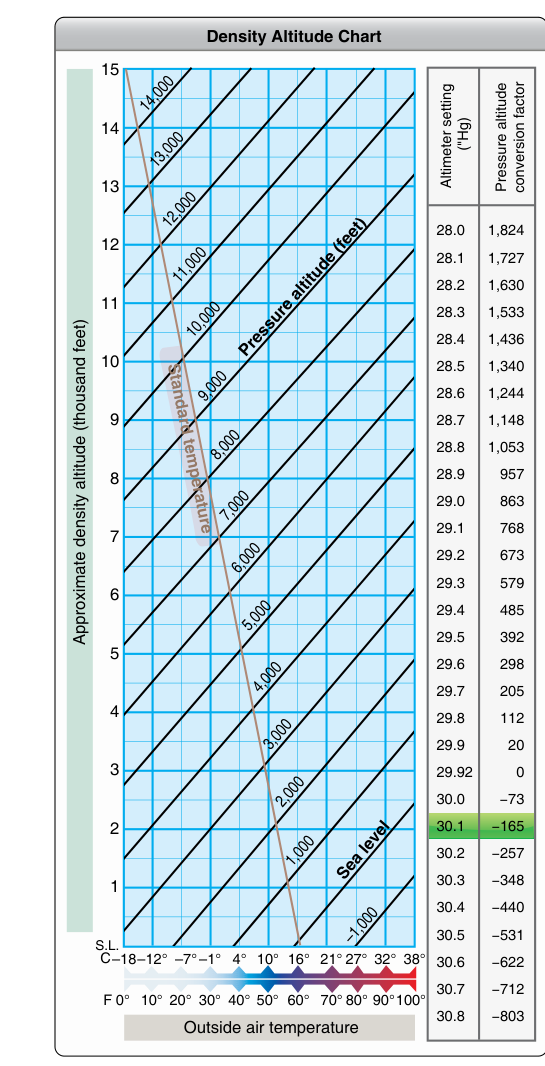
When most new remote pilots think about weather, they focus on wind, rain, or visibility — things that are obviously dangerous. Density altitude is subtler, but it can quietly rob your small unmanned aircraft system (sUAS) of the performance you are counting on. Understanding density altitude is not just an FAA knowledge test requirement; it is a concept that directly influences whether your aircraft will climb, hover, or safely lift a payload on a hot summer afternoon at a high-elevation job site.
The FAA defines density altitude as pressure altitude corrected for nonstandard temperature. In plain language, it is the altitude at which your aircraft's propulsion system and aerodynamic surfaces "think" they are operating, based on how thick or thin the air actually is. When air is less dense than the standard atmosphere defines for a given elevation, the aircraft performs as though it is flying much higher than it physically is. That difference can be dramatic — and dangerous if you are unprepared.
How Density Altitude Works
The International Standard Atmosphere (ISA) defines sea level air as having a temperature of 15 °C (59 °F) and a pressure of 29.92 inches of mercury (inHg). Air density decreases predictably as altitude increases under these standard conditions. Any deviation from standard — higher temperature, lower pressure, or higher humidity — further reduces air density, driving density altitude upward even when your drone is sitting on the ground at a relatively low field elevation.
Three factors push density altitude up:
- High temperature: Hot air expands and becomes less dense. On a 38 °C (100 °F) day at a 2,000-foot field elevation, density altitude can rise to approximately 4,500–5,500 feet, depending on the exact pressure altitude and altimeter setting at the time.
- Low atmospheric pressure: When a low-pressure system moves through, the atmosphere is literally thinner. Lower barometric pressure means fewer air molecules per cubic foot, raising density altitude.
- High humidity: This surprises many students. Water vapor (H₂O) is lighter than the nitrogen and oxygen molecules it displaces in moist air, so humid air is actually less dense than dry air at the same temperature and pressure. High humidity therefore increases density altitude further.
To calculate density altitude precisely, you start with pressure altitude — the altitude indicated when the altimeter is set to 29.92 inHg. From there, temperature correction is applied. A widely used rule of thumb, cited in FAA materials, is that for every 1 °C above standard temperature at a given pressure altitude, density altitude rises approximately 120 feet above pressure altitude — though this figure is an approximation that can vary somewhat by source and conditions, not a fixed universal constant. Density altitude charts in FAA handbooks are developed for manned-aircraft performance planning; sUAS manufacturers, not the FAA, provide the specific performance data for their own aircraft, though the same underlying physics apply.
Effects on Small UAS Performance
Electric-motor-driven multirotors and fixed-wing sUAS are affected by density altitude in ways that parallel manned aircraft but with some important distinctions.
Reduced Propeller (Rotor) Thrust
A propeller or rotor blade generates thrust by accelerating a mass of air downward (for a multirotor) or rearward (for a fixed-wing). When air density drops, each cubic foot of air passing through the rotor disk has less mass. To generate the same thrust force, the motors must spin the rotors faster or move more air volume — both of which demand more electrical current. In practical terms, a quadcopter hovering at its normal throttle setting at sea level on a cold day may struggle to maintain altitude on a hot, high-elevation afternoon at the same throttle setting.
Reduced Motor Efficiency and Battery Stress
Unlike a piston engine that can partially compensate for thin air through mixture adjustment, an electric motor simply draws more current to spin faster when it needs more thrust. This increased current draw means batteries discharge faster. Flight times that are 20 minutes at standard conditions may shrink significantly in high-density-altitude environments. Additionally, motors and electronic speed controllers (ESCs) can overheat under sustained high-current operation, raising the risk of in-flight component failure.
Reduced Climb Rate and Control Authority
High density altitude reduces the maximum climb rate available to an sUAS. This is especially critical during takeoff from confined areas, when operating near obstacles, or when an emergency maneuver demands maximum performance. On fixed-wing sUAS, higher density altitude also means the airframe must fly at a higher true airspeed to generate the same lift, affecting launch and recovery distances. For multirotors, reduced rotor efficiency translates directly into reduced control authority — the margins between commanded movement and maximum possible output shrink, making the aircraft less responsive in gusty conditions.
Payload Reduction
Every kilogram of payload requires additional thrust to lift. When density altitude is high, the aircraft may not be able to safely lift its rated payload while still maintaining adequate control margins and reserve thrust. Operators using sUAS for aerial imaging, inspection, or delivery must account for this by reducing payload on high-density-altitude days or accepting reduced performance envelopes.
Why Density Altitude Matters for Part 107 Operators
Under 14 CFR Part 107, the remote pilot in command (RPIC) is responsible for determining that the operation can be conducted safely. That responsibility explicitly includes assessing weather conditions and their effects on aircraft performance. An RPIC who launches without considering density altitude and then loses control of the aircraft — or crashes because the UAS could not climb over an obstacle — has failed a fundamental duty.
High-density-altitude scenarios are common in parts of the western United States where airports and job sites routinely sit above 5,000 feet MSL, and summer temperatures can push ambient density altitude above 8,000 or even 10,000 feet. In these environments, an sUAS with rated performance figures measured at sea level standard conditions may be operating near or beyond its actual performance limits at takeoff.
The Aviation Weather Handbook (FAA-H-8083-28) reinforces that pilot performance planning must account for density altitude as a critical preflight element. While this handbook addresses manned aviation broadly, the underlying physics apply equally to sUAS operations, and FAA guidance consistently directs remote pilots to apply the same weather awareness standards.
Key Numbers and Rules
- Standard sea-level conditions: 15 °C (59 °F) and 29.92 inHg pressure — this is the baseline against which density altitude is measured.
- Temperature lapse rate (ISA): Standard temperature decreases by approximately 2 °C (3.5 °F) per 1,000 feet of altitude gain under standard conditions.
- Density altitude rule of thumb: For every 1 °C above standard temperature at a given pressure altitude, density altitude increases by approximately 120 feet — an approximation, not an exact constant.
- Humidity effect: High relative humidity further increases density altitude; the effect is most pronounced on hot days when absolute moisture content is highest.
- Combined impact: On a hot (38 °C / 100 °F), humid, low-pressure day at a 5,000-foot field elevation, density altitude may approach or exceed 9,000–10,000 feet under extreme combined conditions — a rough approximation illustrating a significant performance reduction, not a precise universal figure.
- RPIC responsibility: 14 CFR §107.49 requires the remote PIC to assess conditions prior to flight and determine the operation can be safely conducted.
Memory Aid
Use the phrase "High, Hot, and Humid" to remember the three conditions that drive density altitude up and aircraft performance down. Each word starts with H:
- High elevation — less atmospheric pressure, thinner air.
- Hot temperature — expanded, less dense air masses.
- Humid — water vapor displacing heavier molecules, reducing density.
When any one of these factors is present, performance margins decrease. When all three combine — the so-called "High, Hot, and Humid" scenario — the effect can be severe enough to make an operation unsafe with aircraft or payload configurations that seemed routine under standard conditions.
Common Test Traps
- Confusing pressure altitude with density altitude: Pressure altitude is simply the altitude with the altimeter set to 29.92 inHg. Density altitude corrects pressure altitude for temperature (and humidity). They are equal only when temperature is exactly standard for that altitude — otherwise density altitude will be higher on warm days.
- Assuming humidity helps performance: Many students guess that moist air is "heavier" and therefore denser. In fact, water vapor is lighter than the dry-air molecules it replaces, so higher humidity means lower density and higher density altitude — worse performance, not better.
- Ignoring density altitude at low field elevations: A site at 500 feet MSL on a 38 °C day can still have a significant density altitude well above standard — density altitude is not only a mountain flying concern.
- Forgetting battery and motor stress: The FAA knowledge test may ask about the effect of high density altitude on sUAS systems. The key answer is that motors draw more current, batteries deplete faster, and flight times decrease — not just that climb rate is reduced.
- Overlooking the RPIC's pre-flight duty: The Part 107 test expects you to know that assessing weather, including density altitude effects, is a legal responsibility of the remote PIC before every flight, not an optional best practice.