Two of the most insidious hazards in high-altitude flying share a common cause: thin air. When you climb above sea level, the atmosphere grows less dense. That reduced density simultaneously starves your brain of the oxygen it needs to think clearly and robs your aircraft's engine, propeller, and wings of the molecular "grip" they depend on to produce thrust and lift. Understanding how hypoxia affects the pilot and how density altitude degrades the aircraft — and how the two conspire together — is one of the most practically important topics in the Private Pilot curriculum.
Neither hazard announces itself politely. Hypoxia is famous for producing euphoria and overconfidence rather than alarm, and density altitude is invisible on any instrument in a typical light trainer. That combination makes them disproportionately deadly in accidents involving mountain airports, hot summer days, and pilots who underestimated the thin air.
Understanding Hypoxia
Hypoxia is a state of oxygen deficiency in the body's tissues. The FAA classifies four types, but for Private Pilot purposes the most relevant is hypoxic hypoxia — the kind caused directly by reduced partial pressure of oxygen at altitude. As you climb, the percentage of oxygen in the atmosphere stays roughly constant at about 21%, but the total atmospheric pressure falls. That drop in pressure means each breath delivers fewer oxygen molecules to the lungs, and arterial oxygen saturation begins to fall.
Symptoms and Onset
What makes hypoxia so dangerous is that it impairs judgment before it impairs awareness. Early symptoms include a sense of well-being (euphoria), impaired judgment, decreased reaction time, and subtle memory lapses — none of which feel alarming to the person experiencing them. As oxygen deprivation deepens, symptoms progress to headache, fatigue, tunnel vision (loss of peripheral vision), cyanosis (bluish fingernails or lips), and eventually loss of consciousness.
The FAA's Pilot's Handbook of Aeronautical Knowledge explains that the time of useful consciousness (TUC) — the period after oxygen deprivation begins during which a pilot can still take meaningful corrective action — decreases dramatically with altitude. At 25,000 feet, TUC may be only three to five minutes; at 30,000 feet, just one to two minutes. While Private Pilots are unlikely to reach those altitudes without a pressurized aircraft, the principle is important: at even moderately high altitudes, hypoxia can impair you faster than you expect.
Night vision is particularly vulnerable. The retina's rod cells, responsible for low-light vision, require more oxygen than most other tissues. Research cited in FAA materials notes that night vision begins to degrade at altitudes as low as 5,000 feet MSL, even when a pilot feels no other symptoms. This is one reason the FAA recommends supplemental oxygen use during night flight at or above 5,000 feet as a best practice, even though it is not legally required at that altitude.
Regulatory Oxygen Requirements
Under 14 CFR Part 91, the rules for supplemental oxygen are straightforward and frequently tested:
- Above 12,500 feet MSL up to and including 14,000 feet MSL: Flight crew must use supplemental oxygen for any portion of the flight that lasts more than 30 minutes at those altitudes.
- Above 14,000 feet MSL: Flight crew must use supplemental oxygen continuously for the entire time spent above this altitude.
- Above 15,000 feet MSL: Each passenger must be provided with supplemental oxygen (though they are not required to use it).
These are the minimum legal requirements. Many flight physiologists recommend using oxygen at much lower altitudes, particularly at night or during long flights, because sub-clinical impairment can occur well below the legal thresholds.
Density Altitude and Aircraft Performance
Density altitude is pressure altitude corrected for non-standard temperature. It is the altitude at which the aircraft "thinks" it is flying, based purely on how dense the surrounding air actually is. When air density is low — whether because of high elevation, high temperature, or high humidity — performance suffers on every front.
How Density Altitude Is Calculated
The starting point is pressure altitude, which you get by setting your altimeter to 29.92 in. Hg. If the temperature is also standard (15°C at sea level, decreasing at approximately 2°C per 1,000 feet of altitude), then density altitude equals pressure altitude. But whenever temperature is warmer than standard, density altitude is higher than pressure altitude — sometimes dramatically so.
A commonly used rule of thumb from FAA performance charts is that density altitude increases by roughly 120 feet for every 1°C above standard temperature. So if you are departing from a mountain airport at 6,000 feet elevation on a hot afternoon with an outside air temperature 20°C above standard, your density altitude could easily exceed 8,400 feet — even though you are physically sitting at 6,000 feet. The aircraft does not care about your field elevation; it only responds to the actual air density around it.
Humidity also plays a role. Moist air is actually slightly less dense than dry air (water vapor molecules are lighter than the nitrogen and oxygen they displace). FAA guidance acknowledges that high humidity compounds the density altitude effect, though it is less significant than temperature in most practical scenarios.
Performance Impacts on the Aircraft
High density altitude degrades aircraft performance in three interconnected ways:
- Reduced engine power: Naturally-aspirated (non-turbocharged) piston engines produce power in proportion to the mass of air ingested per intake stroke. At high density altitude, each stroke draws in less air mass, so power output falls significantly. A normally-aspirated engine loses roughly 3% of its power for every 1,000-foot increase in density altitude above sea level.
- Reduced propeller efficiency: A propeller is an airfoil. Just like a wing, it depends on air density to generate thrust. At high density altitude, the propeller must spin faster to move the same mass of air — but because the engine itself has less power, it cannot compensate fully. The result is reduced thrust for a given RPM.
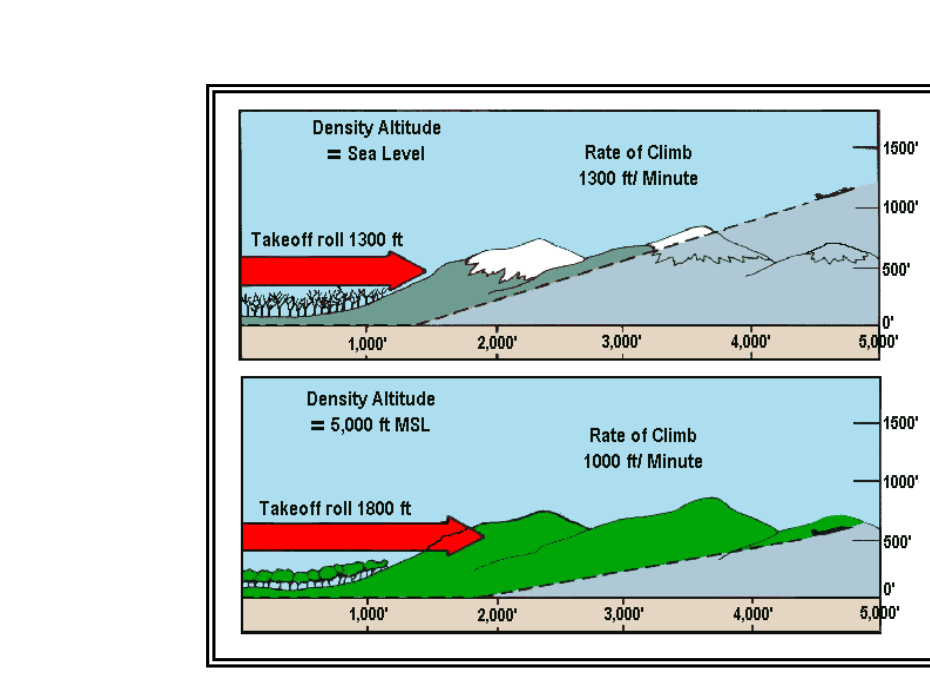
- Reduced aerodynamic lift: Lift is proportional to air density. At high density altitude, the wings must fly at a higher true airspeed to generate the same lift force as at sea level. This means the aircraft's indicated stall speed stays the same (because the pitot-static system measures dynamic pressure, not air density), but the true airspeed at stall — and therefore the actual ground speed — is higher. Takeoff rolls become longer, climb rates diminish, and landing distances increase.
The combined effect can be startling. An aircraft that climbs at 800 feet per minute at sea level on a standard day might achieve only 200–300 feet per minute on a hot afternoon at a high-altitude airport. On an extreme day, the aircraft's service ceiling — the altitude at which the best rate of climb drops to 100 feet per minute — may be below the elevation of nearby terrain. Departures from airports like Telluride, Colorado (9,070 feet MSL) require careful density altitude performance planning on any warm day.
Why Both Hazards Matter Together
Here is the particularly dangerous synergy: on the exact type of day most likely to produce a high density altitude situation (hot, high-elevation, summer afternoon), the pilot is also more susceptible to hypoxia than usual. A pilot departing a 7,000-foot airport is already beginning to experience some degree of reduced oxygen saturation, and the aircraft is already operating at reduced capability. Errors in judgment — like overloading the aircraft, misjudging obstacle clearance, or not aborting a struggling takeoff roll — are precisely the errors hypoxia makes more likely.
This interaction is a classic error chain: high terrain requires performance; high temperature and altitude reduce that performance; reduced oxygen impairs the very judgment needed to recognize and respond to the situation. Breaking any link in that chain — using supplemental oxygen, reducing weight, waiting for cooler conditions, or simply not departing — can prevent the accident.
Key Numbers and Rules
- Night vision begins degrading at approximately 5,000 feet MSL.
- Supplemental oxygen required for crew above 12,500 feet MSL for more than 30 minutes (14 CFR 91.211).
- Supplemental oxygen required continuously above 14,000 feet MSL for crew.
- Passengers must be provided oxygen above 15,000 feet MSL.
- Engine power decreases roughly 3% per 1,000 feet of density altitude for normally-aspirated engines.
- Density altitude increases approximately 120 feet per 1°C above standard temperature.
- Standard temperature at sea level is 15°C (59°F), decreasing ~2°C per 1,000 feet.
Common Test Traps
- Hypoxia feels good. The FAA frequently tests whether students know that early hypoxia produces euphoria and overconfidence, not discomfort or alarm. If a test question describes a pilot who feels unusually well at altitude and makes poor decisions, hypoxia is the answer.
- Density altitude vs. pressure altitude confusion. Pressure altitude is what your altimeter reads at 29.92; density altitude is pressure altitude corrected for temperature. On a hot day, density altitude is always higher than pressure altitude. Students often mix these up.
- Indicated vs. true airspeed at stall. The stall speed on the airspeed indicator does not change with density altitude because the indicator measures dynamic pressure. But the true airspeed and ground speed at stall are higher — meaning the aircraft hits the runway faster on landing even though the airspeed indicator looks normal.
- The 30-minute rule applies only between 12,500 and 14,000 feet. Above 14,000, there is no 30-minute grace period — oxygen is required immediately. Students sometimes apply the grace period to all altitudes above 12,500, which is incorrect.
- High humidity increases density altitude. Students sometimes assume humid air is denser (it feels heavier), but water vapor actually reduces air density, raising density altitude and worsening performance. This is a frequent distractor on the knowledge test.