Modern transport-category and high-performance aircraft rely on hydraulic power for some of the most critical functions imaginable: flight control actuation, landing gear extension and retraction, wheel braking, nose wheel steering, and thrust reverser deployment. All of that authority depends on pressurized fluid being delivered reliably and continuously. What happens when the primary source of that pressure disappears—due to engine failure, pump failure, or fluid loss? The answer lies in a carefully layered set of emergency and backup hydraulic power systems designed to ensure that pilots always retain control over at least the most safety-critical functions, long enough to complete a safe landing.
The FAA's Aviation Maintenance Technician Airframe Handbook (FAA-H-8083-31) addresses these systems in the context of aircraft hydraulic system design. Understanding how each backup source works, when it activates, and what it can and cannot power is essential knowledge for the AMT Airframe written exam and for safe maintenance practice in the field.
Why Multiple Hydraulic Sources Are Required
Aircraft hydraulic systems are typically designed with redundancy built in from the ground up. Most transport-category aircraft feature two, three, or even four independent hydraulic systems, each powered by engine-driven pumps (EDPs) and supplemented by electric motor-driven pumps (EMDPs or ACMPs). These primary sources are robust during normal flight operations. However, catastrophic failures—dual-engine flameout, multiple pump failures, or a ruptured hydraulic line—can deprive all primary systems of power simultaneously. Emergency and backup systems are the final safety net when that happens. They are not designed to restore full system capability; they are designed to deliver just enough pressure and flow to allow a safe landing.
Ram Air Turbines (RATs)
The ram air turbine, universally abbreviated as the RAT, is perhaps the most dramatic of the emergency power sources. A RAT is a small propeller-and-turbine assembly stowed flush with the aircraft's fuselage or wing. When deployed—either automatically by system logic or manually by the crew—it swings out into the airstream. The relative wind spins the turbine, which in turn drives either a hydraulic pump, an electric generator, or both, depending on the aircraft design.
RAT deployment is typically triggered automatically when both main AC buses lose power or when hydraulic pressure drops below a design threshold, signaling a catastrophic power loss. RAT configurations vary by aircraft design—some units drive a hydraulic pump directly, some drive an electrical generator that in turn powers electric motor-driven hydraulic pumps, and some combined units provide both hydraulic and electrical output simultaneously. The specific configuration depends entirely on the airframe's design philosophy, and no single arrangement is more prevalent than the others across the fleet. Either way, the output is limited—RATs are sized to power flight-critical systems only, not the full aircraft electrical or hydraulic load.
Key characteristics of RAT systems include:
- Deployment speed: RATs are designed to generate usable output across a wide range of flight speeds, typically becoming effective at relatively low airspeeds—well below a normal approach speed—so they can continue supplying power during descent and approach to landing. They are not effective on the ground.
- Output limitations: A RAT-powered hydraulic pump produces significantly less flow rate than an engine-driven pump. Actuator movement may be slower, and non-essential systems are typically isolated automatically to conserve capacity.
- Self-stow prevention: Once deployed in flight, many RAT designs cannot be retracted until the aircraft is on the ground, preventing an inadvertent loss of the only remaining power source.
- Maintenance considerations: RATs must be inspected and tested per the aircraft maintenance manual (AMM). Static deployment tests and load tests verify that the turbine, pump or generator, and automatic deployment mechanism function correctly. Lubrication of pivot bearings and inspection of propeller blades are routine tasks.
Hydraulic Accumulators
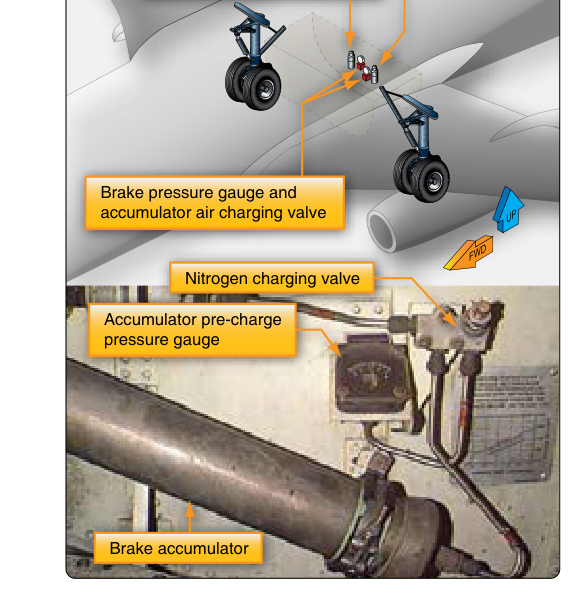
A hydraulic accumulator is a pressure-storage device that holds a reserve of hydraulic energy available for immediate use without requiring a running pump. It consists of a cylindrical pressure vessel divided internally by either a piston, a bladder, or a diaphragm into two chambers: one pre-charged with nitrogen gas (the dry side) and one connected to the hydraulic system (the fluid side).
During normal operation, system pressure compresses the nitrogen and forces hydraulic fluid into the accumulator, storing energy. When system demand spikes—such as during rapid brake application or landing gear retraction—the accumulator releases this stored fluid to supplement pump output, preventing pressure fluctuations. In an emergency, the accumulator can supply pressure to critical systems even after all pump sources have failed, acting as a true backup.
Common uses of accumulators in emergency scenarios include:
- Emergency braking: Aircraft accumulators are sized to provide a defined number of full brake applications after hydraulic pump failure, giving the crew enough braking capacity to stop the aircraft on landing without relying on any active pump. The exact number of applications varies significantly by aircraft type and is specified in the applicable AMM or type certificate data sheet, so technicians must always verify the figure for the specific airframe rather than assume a generic value.
- Landing gear blow-down assistance: Some designs use accumulator pressure to assist emergency free-fall gear extension.
- Damping pressure surges: Even outside emergency use, accumulators absorb pressure spikes that would otherwise stress lines and seals.
The pre-charge pressure of the nitrogen side is critical. It must be set correctly—per the AMM—before any hydraulic fluid is introduced to the system. If the nitrogen pre-charge is too low, the accumulator will not store an adequate fluid reserve. If it is too high, it can prevent the system from reaching design operating pressure. AMTs must always check and set nitrogen pre-charge with the hydraulic fluid side fully depressurized, using only dry nitrogen (never oxygen or compressed air, due to explosion risk with hydraulic fluid).
Accumulators are inspected for proper pre-charge pressure, freedom from fluid contamination on the gas side (which indicates a failed piston seal or ruptured bladder), and structural integrity of the pressure vessel. Many aircraft require pre-charge checks at every scheduled maintenance interval.
Hand Pumps
The hydraulic hand pump is the simplest and most direct form of backup hydraulic power. It is a manually operated reciprocating pump connected to the hydraulic system that allows maintenance personnel—or in some aircraft designs, crew members—to build system pressure by physical effort alone.
In maintenance applications, hand pumps are invaluable. They allow technicians to pressurize the system for leak checks, actuator rigging, and functional testing without running engines or connecting external ground support equipment. They are also used to extend or retract landing gear during maintenance when electrical and engine power is unavailable.
In some older or smaller aircraft designs, the hand pump serves as a genuine in-flight backup. A crew member can pump the handle repeatedly to build enough pressure to lower the landing gear or operate brakes if all powered pump sources fail. The rate of flow is low and requires sustained physical effort, but for a limited number of actuations it is effective.
Important maintenance points for hand pumps include verifying that the pump's check valves are seating properly (a faulty check valve allows fluid to backflow and means the pump cannot build pressure), that the pump body and fittings are free of leaks, and that the handle mechanism moves freely through its full stroke. Hand pumps must always be connected to the correct reservoir or system port per the AMM to avoid cross-contamination.
How These Systems Work Together
In a well-designed hydraulic architecture, these three backup technologies are layered and complementary. During normal flight, accumulators are kept charged by the primary pumps. If a primary pump fails, electric motor-driven backup pumps activate automatically. If those also fail—or if total electrical power is lost—the RAT deploys to restore at least partial hydraulic and electrical power. Meanwhile, the pre-charged accumulator stands ready to supply braking energy the moment the crew needs it on landing rollout, independent of whether any pump is running at all. Hand pumps fill the maintenance and ground-operation role, and in some aircraft serve as a last resort in flight.
Key Numbers and Rules
- Accumulator nitrogen pre-charge: Always set per AMM with fluid side depressurized; use only dry nitrogen—never oxygen or air.
- Typical accumulator brake reserve: Designed for a specified minimum number of full brake applications after pump failure—this number varies by aircraft type, so always verify the exact figure in the specific AMM.
- RAT minimum airspeed: Effective across a wide range of flight speeds, typically becoming useful at relatively low airspeeds well below normal approach speed; output is limited to flight-critical loads only.
- Hand pump check valves: Must seat correctly in both directions; backflow prevents pressure buildup.
- Contamination rule: Gas-side fluid contamination in an accumulator indicates seal or bladder failure—remove and overhaul before return to service.
- RAT stow restriction: Most designs prohibit in-flight stowage once deployed to prevent loss of the only remaining power source.
Common Test Traps
- Confusing accumulator pre-charge media: Exam questions often test whether you know that accumulators use dry nitrogen, not air or oxygen. Using oxygen with hydraulic fluid creates an explosion hazard.
- RAT output limitations: Students often assume a RAT restores full hydraulic capacity. It does not—it powers flight-critical systems only, and actuator response may be slower than normal.
- Pre-charge pressure timing: Nitrogen pre-charge must be checked and set with the hydraulic fluid side depressurized. Checking it with system pressure applied gives a falsely high reading.
- Hand pump check valve direction: A common question involves which direction a failed check valve causes problems. Both intake and discharge check valves must function correctly; failure of either prevents effective pressure buildup.
- Accumulator vs. reservoir: The accumulator stores pressurized energy (nitrogen-charged); the reservoir stores unpressurized fluid supply. These are different components with different inspection requirements—do not confuse them on the exam.