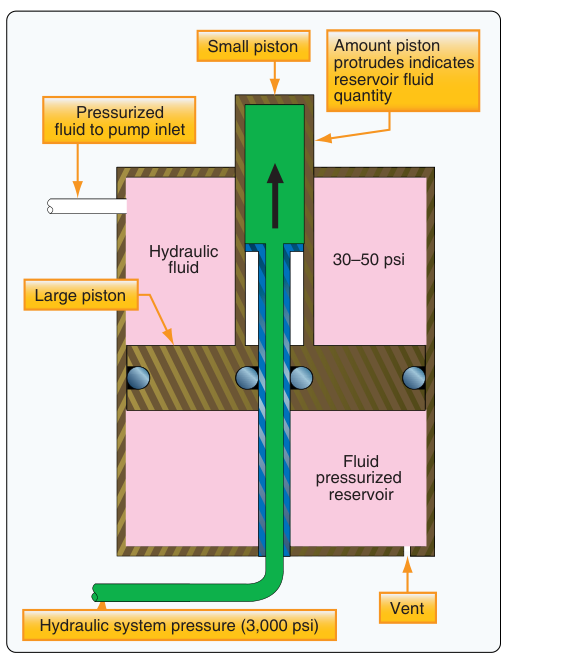
Every aircraft hydraulic system needs a place to store its working fluid, accept returned fluid, and supply a steady, bubble-free source to the pump. That storage and supply device is the hydraulic reservoir. While all reservoirs serve the same basic function, the way they are pressurized—or kept from becoming pressurized—has a profound effect on pump performance, system reliability, and the maintenance procedures you must follow as an aviation maintenance technician (AMT). Understanding the distinction between pressurized and unpressurized reservoirs is a core topic on the FAA AMT Airframe knowledge test and directly affects safe aircraft maintenance practice.
This article covers how each reservoir type works from first principles, why aircraft designers choose one over the other, the specific numbers and markings you need to know, and the pitfalls that appear on FAA test questions.
The Job of a Hydraulic Reservoir
Before distinguishing the two types, it helps to be clear about what every reservoir must accomplish. First, it serves as the fluid supply for the hydraulic pump. Second, it accepts fluid returning from actuators and components after work is done. Third, it provides a space where entrained air and foam can separate from the fluid before it cycles back to the pump. Fourth, it accommodates volume changes caused by thermal expansion of the fluid and by actuators extending and retracting.
A typical reservoir is a cylindrical or rectangular tank made from aluminum alloy or, on some modern aircraft, from corrosion-resistant composite or stainless steel materials. Inside you will find a standpipe (also called a supply tube), a filler neck with a filter screen, a return port, a vent or pressurization port, a quantity sight gauge or indicator, and sometimes a sediment bowl at the lowest point for servicing. The standpipe extends up from the bottom so that even if fluid level drops, only fluid above the standpipe mouth—not any sludge that settles at the bottom—is drawn into the pump.
Unpressurized Reservoirs
An unpressurized reservoir is open, through a filtered vent, to the atmosphere or to the cockpit ambient pressure. Fluid in the reservoir sits at whatever pressure surrounds the aircraft—essentially atmospheric pressure at low altitude, or cabin pressure if the reservoir is located inside a pressurized fuselage.
On many light general aviation aircraft and some older transport-category aircraft, the reservoir is vented directly to the atmosphere through a small filter to keep contamination out. Gravity and atmospheric pressure push fluid down into the pump inlet. This works well as long as the pump is mounted below the reservoir (a gravity feed arrangement) or the altitude is low enough that atmospheric pressure is adequate to push fluid to the pump without cavitating. Cavitation—the formation and collapse of vapor bubbles inside the pump—damages pump components rapidly and reduces output pressure.
The limitation of an unpressurized system becomes apparent at high altitude. As ambient pressure drops, there is less force pushing fluid toward the pump. If the pump demands more fluid than the gravity and low ambient pressure can supply, cavitation results. For this reason, unpressurized reservoirs are generally limited to lower-altitude aircraft or are positioned physically above the pump so gravity provides reliable feed.
Unpressurized reservoirs are simpler to maintain. Servicing typically involves removing a filler cap, checking the sight gauge, and adding approved fluid (most commonly MIL-PRF-5606, MIL-PRF-83282, or MIL-PRF-87257 mineral-based fluids, or Skydrol phosphate-ester fluid on turbine airliners) up to the appropriate level marking. Because the system is not pressurized, there is no risk of pressurized fluid escaping when the filler cap is removed—though caution is still warranted when any hydraulic system may have residual pressure in lines downstream of check valves.
Pressurized Reservoirs
A pressurized reservoir maintains a positive pressure above the fluid at all times. This positive pressure, typically supplied by engine bleed air or by a small hydraulic pressure source taken from system pressure through a pressure reducer, ensures that fluid is forced toward the pump inlet regardless of altitude or aircraft attitude. The result is a guaranteed positive head pressure at the pump inlet, which prevents cavitation even at high altitude or during unusual flight attitudes such as negative-g maneuvers.
On most large transport-category aircraft, the reservoir is pressurized with engine bleed air regulated down to a relatively low pressure—commonly cited in the range of 20 to 45 psi, with the exact value varying by aircraft type—though you should always verify the specific value in the AMM. Some reservoirs use a hydraulic bootstrap arrangement where a portion of the system's own high-pressure output is tapped, reduced through a pressure reducer valve, and applied to the top of the fluid in the reservoir. This keeps the reservoir pressurized even when engine bleed is unavailable.
The pressurized reservoir has an important safety implication for maintenance. Before any maintenance involving removal of the filler cap, a line, or any reservoir fitting, the technician must depressurize the reservoir following the aircraft maintenance manual (AMM) procedure. Failing to do so can result in a sudden release of pressurized fluid capable of causing serious injury. Most pressurized reservoirs incorporate a depressurization valve or a manual bleed fitting specifically for this purpose. Some aircraft require that multiple hydraulic system circuit breakers be pulled and the reservoir bleed valve actuated before a filler cap may be safely removed.
Pressurized reservoir design also includes a relief valve (sometimes called a pressurization relief valve) that limits reservoir air pressure to a safe maximum, protecting the reservoir shell and connected lines from over-pressurization. This valve typically cracks open at a pressure somewhat above the normal operating pressurization level.
Reservoir Quantity Indication and the Standpipe
Both reservoir types use quantity indication to allow ground crews and pilots to verify adequate fluid level. Indications may be a direct-reading sight glass built into the side of the reservoir, a mechanical float-type quantity transmitter sending a cockpit indication, or simple full/low markings on a transparent tube. On aircraft with two or three independent hydraulic systems, each system has its own reservoir and its own quantity indication.
The standpipe inside the reservoir serves a dual purpose in some designs. On aircraft that use this arrangement, a normal supply standpipe draws fluid from the upper portion of the reservoir while a separate emergency supply line draws from lower down, nearer the bottom. If normal system operation consumes fluid (for example, through a leak), the level can drop below the top of the normal standpipe, cutting off normal supply while still reserving the lower fluid volume for the emergency system. This passive design, where used, helps ensure that landing gear and brakes retain hydraulic power even after significant fluid loss. The exact standpipe arrangement and terminology vary by aircraft model, so always confirm the specific design against that aircraft's AMM rather than assuming a universal configuration.
Why It Matters: Safety and System Reliability
Cavitation is one of the most destructive failure modes for a hydraulic pump. When vapor bubbles collapse inside the pump, they release intense localized energy that erodes pump housing and gear surfaces, reduces output, and can ultimately destroy the pump. A pressurized reservoir prevents cavitation by ensuring the pump inlet always sees fluid under positive pressure. This is why every high-performance jet transport uses pressurized reservoirs.
For the AMT, understanding reservoir type guides proper servicing. Using the wrong fluid type, overfilling, or failing to depressurize before opening the reservoir can cascade into much larger problems: fluid fires (phosphate-ester and petroleum-based fluids react differently with ignition sources), seal damage from incompatible fluid mixing, or serious technician injury from pressurized fluid release.
Key Numbers and Rules
- Reservoir pressurization range (typical transport aircraft): commonly cited around 20–45 psi supplied by bleed air or hydraulic bootstrap; always verify the specific value in the AMM.
- Depressurization before service: mandatory on all pressurized reservoirs; the AMM procedure must be followed exactly before removing filler caps or any reservoir fittings.
- Standpipe function: where a dual-standpipe design is used, normal supply draws from the top of the standpipe; emergency supply draws from below—this reserves fluid for emergency braking and gear extension. Verify the specific arrangement against the aircraft's AMM.
- Relief/pressurization relief valve: protects the reservoir from over-pressurization; set above normal pressurization pressure.
- Fluid compatibility: petroleum-based hydraulic fluids (MIL-PRF-5606, MIL-PRF-83282) use red dye; phosphate-ester fluids (Skydrol) are typically dyed purple; these fluids must never be mixed and require different seal materials.
- Vent filter: unpressurized reservoirs use a micronic filtered vent to prevent contamination while allowing pressure equalization.
- Sight glass or quantity gauge: both pressurized and unpressurized reservoirs require a means to check fluid quantity during preflight and servicing checks.
Common Test Traps
- Assuming all reservoirs are safe to open without depressurizing: A common test scenario asks what must be done before opening a pressurized reservoir. The answer is always to follow the AMM depressurization procedure—never assume residual pressure has escaped on its own.
- Confusing the standpipe's purpose: Students often think the standpipe is only to keep sediment out. In dual-supply designs, it also reserves emergency fluid. Know both purposes.
- Mixing fluid types: FAA test questions may describe symptoms of fluid contamination. Mixing petroleum-based and phosphate-ester fluids destroys seals throughout the entire system and requires a full system flush and seal replacement—not just topping off with the correct fluid.
- Thinking unpressurized means zero pressure: An unpressurized reservoir may still be located inside a pressurized fuselage and will see cabin differential pressure. It is called unpressurized because no additional pressurization is applied beyond ambient, but fluid in lines can still be under system pressure—always treat hydraulic lines with caution.
- Reservoir overfilling: Overfilling beyond the full mark does not provide more fluid reserve; it removes the air space needed for thermal expansion and can cause pressure spikes or reservoir damage when hot fluid expands. Fill only to the marked level.