An emergency descent is one of the most consequential maneuvers in a commercial pilot's repertoire. It is a deliberate, precisely controlled procedure designed to lose altitude as rapidly as the aircraft's structural and aerodynamic limits allow. Unlike routine descents where comfort and fuel economy dominate, an emergency descent trades everything non-essential for one currency: time. Whether the triggering event is a sudden cabin depressurization at flight level, smoke or fire in the cabin, a passenger medical emergency requiring immediate access to a hospital, or an engine fire demanding rapid descent below a critical altitude, the ability to execute this maneuver correctly — without hesitation, without over-speeding the aircraft, and without losing situational awareness — separates a proficient commercial pilot from an unprepared one.
What Triggers an Emergency Descent?
The three most commonly tested scenarios on the FAA Commercial Pilot Airplane Knowledge Test and the Airman Certification Standards (ACS) practical test are cabin depressurization, smoke or fire, and passenger medical emergency. Each carries a different urgency profile, but all share the same core requirement: get lower, fast.
In a depressurization event, the physiological stakes are immediate. The atmosphere above 10,000 feet MSL does not provide enough partial pressure of oxygen for normal human function without supplemental oxygen or pressurization. According to the FAA's Pilot's Handbook of Aeronautical Knowledge (PHAK, FAA-H-8083-25), time of useful consciousness (TUC) — the interval during which a pilot can take meaningful corrective action — drops dramatically with altitude. At 25,000 feet, TUC is roughly three to five minutes; at 30,000 feet, it may be as short as one to two minutes; at 40,000 feet, TUC can be as short as 15 to 20 seconds (some references cite figures as low as 9 to 12 seconds), so pilots should treat published TUC figures as approximate planning values rather than precise guarantees. The primary physiological goal of an emergency descent in a depressurization scenario is to reach an altitude at or below 10,000 feet MSL, where the unpressurized atmosphere sustains adequate consciousness without supplemental oxygen.
In a smoke or fire situation, the mission shifts: get the aircraft on the ground as quickly as possible. Airborne fires can become uncontrollable within minutes, and smoke incapacitates crew before structural failure even becomes a factor. Speed of descent and proximity to a suitable landing surface govern everything.
How the Maneuver Works
The standard technique, as described in the Airplane Flying Handbook (FAA-H-8083-3), involves three simultaneous or near-simultaneous initial actions: reduce power, establish the target airspeed, and roll into a steep bank. These actions are not sequential steps to check off a list — they are a coordinated, rapid response.
Power Reduction
Power is reduced to idle or as low as practically achievable given the aircraft's systems. In a turboprop or jet, this means retarding throttles to flight idle. In a piston aircraft, it means mixture, throttle, and propeller adjustments per the POH. Reducing power to idle eliminates thrust as a factor and allows aerodynamic drag to dominate the energy equation. Note: in some aircraft, especially turboprops, manufacturer-specific procedures may call for a specific power setting rather than full idle to protect engine integrity — always follow the POH or AFM.
Airspeed Target
Airspeed selection is where aerodynamic knowledge directly informs the maneuver. The Airplane Flying Handbook describes the target airspeed as typically VNO (maximum structural cruising speed) or a manufacturer-specified emergency descent speed, which in high-performance aircraft may approach VMO/MMO. This is a deliberate choice: the goal is to maximize descent rate within structural limits, and VA (maneuvering speed) is not the target speed for this maneuver since VA is defined for protecting the airframe during abrupt full control deflections in turbulence, not for maximizing descent rate. Pilots should still be aware that VA decreases as the aircraft becomes lighter, but many POHs publish VA only at maximum gross weight without interpolation charts for lighter weights, so pilots must follow the specific guidance in their POH or AFM rather than assume a precise interpolated value is available.
The aircraft must never exceed VNE (never-exceed speed) under any circumstances. VNE is marked by the red radial line at the top of the yellow arc (caution range) on the airspeed indicator — the green arc represents the normal operating range, and the yellow arc represents the caution range where operations should only be conducted in smooth air. An emergency does not grant permission to exceed published limits — it demands you exploit the full envelope up to those limits.
Steep Bank and the Spiral Descent
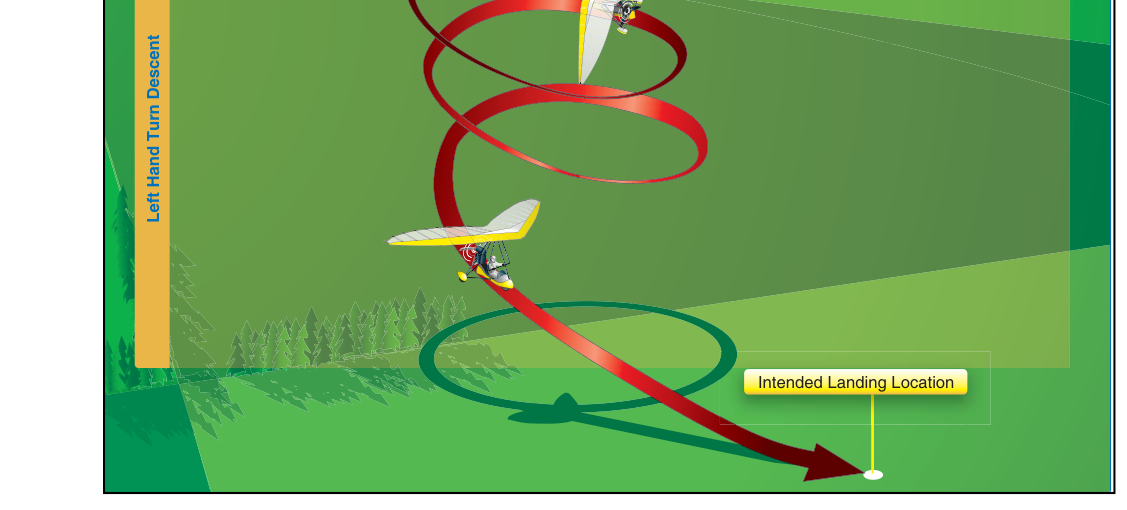
Rolling into a bank of 30 to 45 degrees serves two distinct purposes that are frequently misunderstood. First, it keeps the aircraft over a defined geographic area — critical if the descent must terminate at a specific runway or forced landing site. Second, the increased load factor inherent in a banked turn requires a slightly higher angle of attack to maintain airspeed, which actually helps moderate the descent rate and keeps the pilot actively engaged in airspeed control rather than passively watching the altimeter unwind. The bank is not cosmetic; it is structurally and operationally integral to the maneuver.
Configuration for Drag
Once the airspeed is stabilized at or below the appropriate limit speed, additional drag devices may be deployed. If the POH recommends landing gear extension for drag, the gear may be lowered only after confirming the airspeed is at or below VLO (maximum gear-operating speed) — the speed limit that governs the act of extending or retracting the gear. Once the gear is fully extended and locked, the airspeed limit is governed by VLE (maximum gear-extended speed), which in many aircraft is higher than VLO. Flaps follow gear, and only within the approved flap operating speed range for the selected flap setting. Deploying flaps or gear above their limit speeds risks structural damage to the doors, actuators, or wing structure — defeating the entire purpose of a controlled emergency descent.
The Communications and ATC Picture
An emergency descent does not happen in a communications vacuum. The pilot should declare an emergency with ATC on the current frequency, squawk 7700 on the transponder, and if contact is lost, attempt contact on 121.5 MHz (the international emergency frequency monitored by most ATC facilities and many aircraft). AIM guidance supports declaring an emergency early — there is no penalty for declaring and canceling versus failing to declare and suffering a worse outcome. ATC can provide traffic advisories, clear airspace below, and coordinate with emergency services at the destination.
Key Numbers and Rules
- 10,000 feet MSL — the physiological target altitude for depressurization; supplemental oxygen or pressurization generally required above this altitude for sustained operations.
- VNO — typical target airspeed for maximizing descent rate within structural limits; some aircraft use a manufacturer-specified emergency descent speed instead, which for high-performance aircraft may approach VMO/MMO.
- VNE — absolute structural limit, marked by the red radial line at the top of the yellow arc; must not be exceeded even in an emergency.
- VLO vs. VLE — VLO is the max speed for operating (moving) the gear and governs the moment of extension; VLE is the max speed for flying with gear already extended and locked. Both must be respected in sequence.
- Bank angle: 30–45 degrees — enough to spiral over a defined area; beyond 45 degrees, load factor increases sharply and complicates airspeed management.
- Squawk 7700 / 121.5 MHz — standard emergency communications per the AIM.
Common Test Traps
- The target airspeed is not VA. Commercial pilot knowledge test questions may try to trick applicants into selecting maneuvering speed as the emergency descent target. VA protects the airframe during abrupt control inputs in turbulence; the actual target is typically VNO or a manufacturer-specified emergency descent speed, chosen to maximize descent rate within structural limits.
- VLO governs gear extension, not VLE. Gear must be operated (extended or retracted) within VLO; VLE only applies once the gear is down and locked. Confusing these two speeds is a classic trap.
- Flaps are not automatically part of the maneuver. Some POHs do not recommend flap deployment during emergency descent because the airspeed at which maximum drag is achieved may exceed flap limit speeds. Always follow the specific POH — do not assume flaps.
- The bank is not just for navigation. Examiners probe whether the applicant understands the aerodynamic and operational rationale for the bank angle, not merely that a bank is performed.
- TUC figures are approximate and individual. The PHAK notes that physical fitness, prior hypoxia exposure, and other factors affect TUC. The published figures are averages used for planning — actual incapacitation could come faster.
- Emergency descent ≠ uncontrolled dive. Structural limits still apply. Exceeding VNE risks catastrophic failure; the goal is to maximize the legal descent rate, not to ignore engineering limits.
Memory Aid
The sequence Power — Pitch — Bank — Configure captures the core actions: reduce Power to idle, Pitch to the target emergency airspeed, Bank 30–45 degrees for a controlled spiral, then Configure drag devices (gear, then flaps) within approved speed limits. This four-step phrase is consistent with how the Airplane Flying Handbook presents the general technique, and it reinforces the priority order that protects the airframe while maximizing descent rate.
Proficiency in this maneuver requires regular practice under instruction — not because the individual steps are complicated, but because the speed and coordination required in a genuine emergency leave no room for hesitation. On the commercial ACS practical test, the evaluator will expect smooth, deliberate execution, accurate airspeed control within the specified tolerances, and a clear oral explanation of why each step is performed. Understanding the aerodynamics, physiology, and regulatory context behind the procedure is what elevates a rote response into genuine airmanship.