An emergency descent is one of the most urgent maneuvers a pilot can perform. When a situation demands that you get the airplane on the ground — or at least to a much lower altitude — as quickly as possible, the emergency descent gives you a structured, controlled way to do exactly that without overstressing the airframe or losing control of the aircraft. Whether you are dealing with an engine fire, a pressurization failure, smoke in the cockpit, or a structural concern, the emergency descent is your tool for rapid altitude loss while keeping the aircraft intact and flyable.
Understanding the technique requires more than just memorizing a checklist. You need to understand why each step is taken, which airspeeds are safe, how the airplane's aerodynamics change during the maneuver, and how to make good decisions under pressure. This article covers all of those dimensions so you can both answer FAA knowledge test questions correctly and, more importantly, execute the maneuver safely if you ever need it.
Why an Emergency Descent Is Needed
Several in-flight emergencies create an immediate need to descend as fast as possible. The most common scenarios include an engine fire or engine compartment fire, a cabin or electrical fire, smoke of unknown origin, loss of pressurization in a high-altitude aircraft, or severe structural damage that makes prolonged flight inadvisable. In each case, time is the enemy: a fire can destroy critical components within minutes, and smoke inhalation can incapacitate a pilot surprisingly quickly. The objective of the emergency descent is to reduce altitude to a point where the emergency can be resolved — landing on a suitable surface, opening cabin doors, or where oxygen is plentiful without supplemental equipment.
The Airplane Flying Handbook (FAA-H-8083-3) identifies the emergency descent as a maneuver designed to bring the aircraft down at the maximum rate without exceeding the aircraft's structural limitations. That last phrase is critical: the goal is maximum safe descent rate, not simply the fastest possible rate regardless of consequences. Exceeding structural limits during an already-stressed situation would turn a survivable emergency into a catastrophic one.
How the Maneuver Works
The emergency descent procedure varies somewhat by aircraft type and manufacturer, so always defer to the Pilot's Operating Handbook (POH) for your specific airplane. However, the general technique described in the Airplane Flying Handbook follows a consistent pattern for piston-powered light aircraft.
Configuring the Aircraft
The first action after recognizing the need for an emergency descent is to simultaneously apply maximum allowable power reduction and configure the aircraft to achieve the highest safe descent rate. In most light single-engine airplanes, this means:
- Throttle to idle. Reducing power removes thrust and allows the aircraft to descend. In a fire scenario, reducing fuel flow may also help starve the fire.
- Mixture to idle cutoff or rich, as appropriate. If an engine fire is suspected, cutting fuel is a priority. If the emergency is not fire-related, follow the POH guidance.
- Propeller to high RPM (if equipped). Moving the prop control forward increases drag from the propeller, which helps the aircraft descend more rapidly. This is a commonly tested detail — high RPM on a constant-speed propeller increases aerodynamic drag, aiding the descent.
- Extend landing gear (if retractable). Lowering the gear adds significant aerodynamic drag, dramatically increasing the descent rate. This is done only within or below the landing gear extension speed (VLO).
- Extend flaps as appropriate. Partial or full flaps may be used if airspeed is within the flap extension speed (VFE). Flaps increase both lift and drag; at the speeds used in an emergency descent they primarily add drag and help slow the aircraft or maintain a slower speed during the descent.
Bank Angle and Descent Path
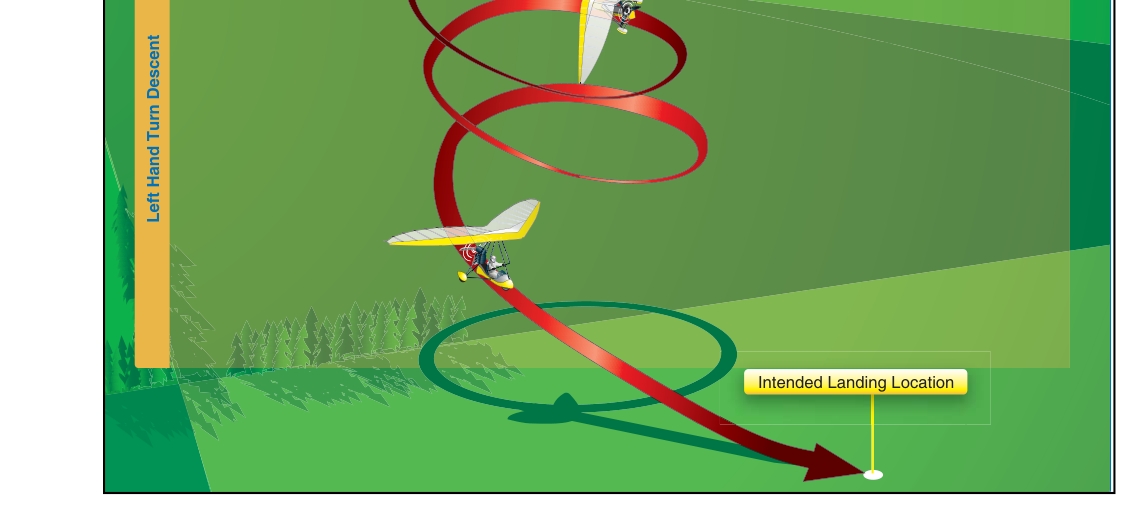
The aircraft is typically placed in a steep bank — commonly 30 to 45 degrees — while simultaneously pushing the nose down toward the desired descent attitude. The bank serves two purposes: it helps the pilot maintain situational awareness of the ground below and ahead, and it allows the aircraft to lose altitude without accelerating to potentially dangerous airspeeds. A wings-level, nose-low attitude with idle power and drag-producing configuration can sometimes result in rapid airspeed buildup; the bank angle helps manage that acceleration. Throughout the descent, the pilot continuously monitors airspeed to remain within limits.
Airspeed Considerations — The Most Testable Element
Airspeed management during an emergency descent is where most FAA knowledge test questions are focused, and it is also where the real safety risk lies. There are several speeds you must understand and apply correctly.
VA — Maneuvering Speed
Maneuvering speed is the maximum speed at which full, abrupt control inputs can be applied without risking structural damage. During an emergency descent, the aircraft may be subject to turbulence or abrupt pilot inputs, so many POHs recommend initiating and conducting the emergency descent at or below VA. Critically, VA decreases as the aircraft's weight decreases — a fact the FAA loves to test. At lighter weights, the wing will stall before structural limits are exceeded, but that stall speed moves lower, which means VA is also lower. Always use the VA appropriate to your current weight.
VNE — Never-Exceed Speed
VNE is the red line — the speed above which flight is not permitted under any circumstances because structural failure becomes possible. During an emergency descent with idle power, a nose-low attitude, and possibly turbulence, it is entirely possible to exceed VNE if the pilot is not actively managing airspeed. This is why configuration changes (gear down, props forward, partial flaps if within VFE) are so important: they create drag that limits airspeed buildup and keeps the aircraft safely below VNE.
VLO and VLE
VLO is the maximum speed for extending or retracting the landing gear. VLE is the maximum speed at which the aircraft may be flown with the gear extended. Before extending the gear during an emergency descent, the pilot must slow to at or below VLO to avoid damaging the gear doors or retraction mechanism. Once extended, the pilot must stay at or below VLE for the remainder of the descent.
VFE — Maximum Flap Extended Speed
Flaps must only be extended when airspeed is at or below VFE. Extending flaps above this speed can cause structural failure of the flap system and potentially the flap hinges. In a rapidly unfolding emergency, it is easy to become distracted and overlook airspeed; disciplined scan habits prevent this error.
Leveling Off and Recovery
As the aircraft approaches the target altitude, the pilot begins a smooth pull-out. Waiting until you are exactly at the desired altitude to begin recovery is too late — the aircraft has inertia and will continue descending through your target if you delay. Begin the pull-out early enough to arrest the descent at the desired altitude. Then, as appropriate, retract the gear and flaps in sequence (per the POH), add power as needed, and transition to normal or emergency approach procedures depending on the nature of the original emergency.
Key Numbers and Rules
- Bank angle during descent: typically 30–45 degrees, as recommended in the AFH for most light aircraft.
- Propeller control: move to high RPM (full forward) to increase propeller drag during descent.
- Gear extension: must be at or below VLO before lowering; must remain at or below VLE while extended.
- Flaps: use only at or below VFE; adding flaps early helps limit airspeed buildup.
- VA is weight-dependent: lighter aircraft have a lower VA.
- Never exceed VNE under any circumstances, including during emergency descent.
- Begin level-off before reaching target altitude to account for aircraft inertia.
Common Test Traps
- Prop control direction: Many students assume that moving the prop to low RPM reduces noise and drag. In fact, high RPM (full forward) creates more propeller disc drag and is used to maximize descent rate. The FAA test exploits this confusion frequently.
- VA and weight: The test may state that VA is always a fixed number. It is not — it decreases with decreasing weight. Know your published VA values for different weight conditions.
- Gear before flaps: The question may ask about the sequence of drag-adding steps. Landing gear typically creates more drag and should generally be considered first (within VLO), but always follow the specific POH procedure.
- Recovery timing: Questions may ask when to begin pulling out of the descent. The correct answer is before reaching the target altitude, not at it, to allow for the aircraft's momentum.
- Fire vs. non-fire procedures: Mixture and ignition procedures differ depending on whether fire is involved. For engine fires, fuel is typically cut; for other emergencies, the POH may specify differently. Know the distinction and always reference the POH.