Holding patterns look deceptively simple on a chart — an oval racetrack overlaid on a fix — but the procedural precision required to fly one correctly in a turbojet demands a thorough understanding of both speed restrictions and entry geometry. For airline transport pilot candidates, examiners expect mastery of AIM 5-3-8, the governing guidance for all holding operations. Getting either element wrong can push the aircraft outside the protected airspace buffer that designers painstakingly calculated around the pattern.
This article walks through the published speed limits for turbojets at every altitude band, explains the geometry behind all three standard entry techniques, and highlights the real-world considerations that separate a competent hold from a dangerous one.
The Purpose and Structure of a Holding Pattern
A holding pattern is a predetermined maneuver that keeps an aircraft within specified airspace while awaiting further clearance. The standard pattern is defined by an inbound leg toward the holding fix, a 180-degree outbound turn, an outbound leg away from the fix, and another 180-degree inbound turn back to the fix. Unless otherwise depicted or instructed, all turns are made to the right (standard direction). Left-hand patterns are specifically charted or assigned by ATC.
The inbound leg is nominally 1 minute at or below 14,000 feet MSL and 1.5 minutes above 14,000 feet MSL, timed from the point abeam the fix (or the start of the inbound turn if abeam cannot be determined). ATC may also assign distance-based holds defined by DME or RNAV, in which case timing is replaced by a specified mileage for the outbound leg.
Holding Pattern Speed Restrictions for Turbojets
Speed is the single most critical factor in holding pattern containment. The protected airspace surrounding a hold is sized using published maximum airspeeds; exceeding them can place the aircraft outside the obstacle-cleared buffer. AIM 5-3-8 specifies the following maximum holding airspeeds, expressed in knots indicated airspeed (KIAS):
- At or below 6,000 feet MSL: 200 KIAS
- 6,001 feet through 14,000 feet MSL: 230 KIAS
- Above 14,000 feet MSL: 265 KIAS
These limits apply to all aircraft unless a published procedure depicts a different speed or ATC assigns a specific speed restriction. When a holding pattern chart depicts a maximum speed (e.g., MAX 210 KIAS), that speed governs regardless of altitude. Some terminal area and RNAV holds at lower altitudes may carry speeds as low as 175 KIAS to keep the pattern within confined airspace.
For turbojets, the practical challenge is decelerating to holding speed before reaching the fix. AIM 5-3-8 guidance calls for beginning speed reduction to the applicable maximum holding airspeed when the aircraft is 3 minutes or less from the holding fix. For long-range cruise at high altitudes, that may mean initiating the deceleration 50 or more nautical miles out depending on the aircraft's deceleration capability and any speed restrictions along the arrival route. Descent may also be needed to reach an altitude where the specified speed is operationally manageable with flap or slat schedules.
The Three Standard Holding Pattern Entry Techniques
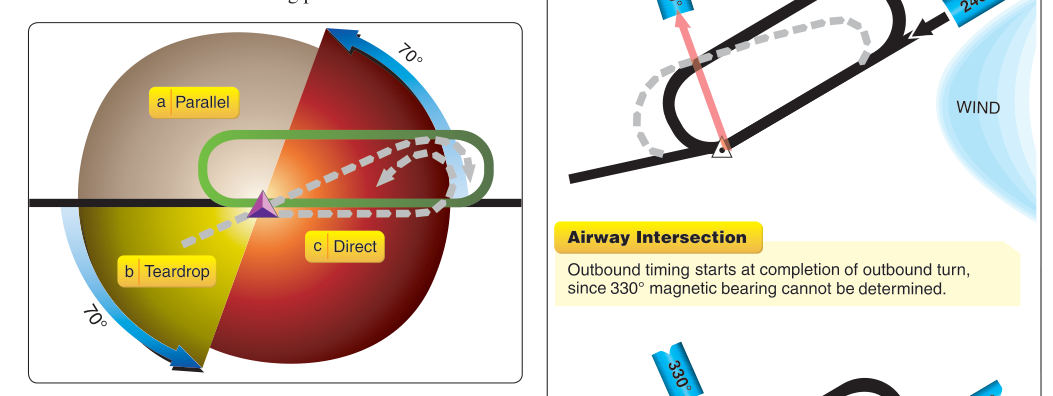
Once established at the fix, the entry technique determines whether you immediately begin the correct pattern or waste fuel and time correcting a bad entry. AIM 5-3-8 divides the airspace around the holding fix into three sectors — parallel, teardrop, and direct — based on the aircraft's magnetic heading upon arrival at the fix relative to the holding course.
Determining Which Sector You Are In
Draw the inbound holding course through the fix. Then draw a line perpendicular to that course through the fix. The holding side (the side on which the pattern lies) and the non-holding side divide the airspace into sectors. Specifically:
- The parallel entry sector occupies roughly 70 degrees on the non-holding side, measured from the inbound course extended outbound.
- The teardrop entry sector occupies roughly 100 degrees on the holding side, measured from the outbound course, and it is located on the holding side of the inbound course extended.
- The direct entry sector occupies the remaining approximately 180 degrees.
In practice, a 70°/100°/180° breakdown is the commonly taught approximation, but examiners expect students to know that these are guidance values designed to keep the aircraft within protected airspace, not precise mathematical boundaries. When an arrival heading places the aircraft near a sector boundary, the direct entry is the safest and most common choice.
Parallel Entry
Used when arriving from the non-holding side of the inbound course. The pilot crosses the fix, turns to a heading parallel to the inbound course but in the outbound direction, flies the outbound leg for the appropriate time (1 or 1.5 minutes), then makes a turn toward the holding side — turning more than 180 degrees to intercept and fly the inbound course. The result is a smooth join of the inbound leg with the aircraft already established on the holding side. Wind correction must be applied on the outbound leg just as in the established pattern.
Teardrop Entry
Used when arriving from the holding side, offset from the direct entry sector. The pilot crosses the fix, turns to a heading approximately 30 degrees toward the holding side of the outbound course (i.e., 30 degrees off the outbound heading into the pattern), flies outbound for the appropriate time, then turns in the direction of the holding pattern to intercept the inbound course. The 30-degree offset angling away from the inbound course creates the characteristic teardrop shape and ensures the aircraft drifts back into the protected area before turning inbound.
Direct Entry
The simplest entry: the pilot crosses the fix and immediately turns in the direction of the holding pattern to fly the outbound leg, then turns inbound at the appropriate time. Direct entry is used when arriving from the large sector on the holding side of the inbound course. It is also the most commonly used entry because the direct entry sector is the largest of the three. Although a direct entry results in a slightly short first inbound leg, the aircraft stays within protected airspace, and the pattern self-corrects on subsequent circuits.
Timing and Wind Correction Adjustments
Standard holding assumes no wind. In reality, turbojets operating at altitude regularly encounter winds of 50–100 knots or more, which can dramatically distort the pattern. AIM 5-3-8 provides the following guidance:
- Outbound leg timing: Adjust the outbound leg so the inbound leg is the target time (1 or 1.5 minutes). If the inbound leg is longer than target, shorten the outbound leg on the next circuit; if shorter, lengthen it.
- Turn lead: Pilots may need to lead the inbound turn based on groundspeed and bank angle. A standard turn rate of 3 degrees per second or 30-degree bank angle, whichever requires the lesser bank, applies.
- Triple drift correction: Apply triple the wind correction angle used on the inbound leg to the outbound heading (not to exceed 45 degrees) to compensate for the longer outbound time in a crosswind.
Why These Rules Matter for Airline Operations
In turbojet operations, holding is rarely discretionary — it is assigned, often at short notice, and must be flown precisely while the crew manages fuel calculations, ATIS updates, approach briefings, and company communication. Understanding speed containment keeps the aircraft in charted obstacle-clear airspace. Correct entry technique prevents track deviations that could conflict with other IFR traffic using adjacent holding stacks or approach corridors.
Fuel burn is another critical operational factor. A large turbojet can burn hundreds of pounds per minute in a hold at low altitude. Flight crews must continuously evaluate holding fuel versus alternate fuel minimums and must be ready to declare minimum fuel or divert before reaching bingo fuel. The hold airspeed also affects fuel burn: flying slower in a hold may seem fuel-efficient, but in some aircraft the drag rise at very low speeds can actually increase fuel consumption compared to flying near the optimum holding speed for that altitude.
Key Numbers and Rules Summary
- Max holding speed at or below 6,000 feet: 200 KIAS
- Max holding speed 6,001–14,000 feet: 230 KIAS
- Max holding speed above 14,000 feet: 265 KIAS
- Begin deceleration to holding speed: 3 minutes or less from the fix
- Inbound leg timing: 1 minute at or below 14,000 feet; 1.5 minutes above 14,000 feet
- Standard turns: right-hand (unless otherwise specified)
- Triple drift correction capped at: 45 degrees
- Chart-published speed restrictions override the standard AIM speed limits
Common Test Traps
- Confusing altitude bands: The 230 KIAS limit applies from 6,001 to 14,000 feet, not 14,001 and above. Examiners write distractors using 14,000 as the dividing line for both the 230 and 265 KIAS bands.
- Applying 1-minute timing above 14,000 feet: Outbound legs above 14,000 feet are 1.5 minutes, not 1 minute — a common reversal error under exam pressure.
- Choosing the wrong entry sector: Near a sector boundary, especially between parallel and teardrop, candidates often select incorrectly. When in doubt, direct entry keeps you within protected airspace.
- Ignoring chart-published speed restrictions: Assuming the standard AIM speeds apply when a lower maximum speed is depicted on the plate is a frequently tested scenario.
- Forgetting the deceleration rule: Waiting until the fix to begin slowing is too late in a high-performance jet. The 3-minute rule is tested directly on ATP written exams.