Every time an aircraft touches down, the landing gear must absorb and dissipate a tremendous amount of kinetic energy. On most modern aircraft—from light singles to airliners—this task falls to the oleo-pneumatic shock strut, often simply called an oleo strut. Unlike a simple spring or solid strut, the oleo uses a cleverly engineered two-stage system that combines hydraulic fluid and compressed gas (almost always dry nitrogen) to cushion the impact and then return the gear to its normal extended position. Understanding how this system works, how to service it correctly, and what can go wrong is essential knowledge for the FAA Airframe knowledge test and for safe maintenance practice in the field.
This article walks through the operating principles of the oleo-pneumatic strut, the correct servicing procedure, common faults, and the key numbers and traps that show up on FAA written exams.
How the Oleo-Pneumatic Strut Works
The oleo strut is essentially a two-chambered hydraulic-pneumatic cylinder. The outer cylinder is attached to the aircraft structure; the inner cylinder (called the piston or inner barrel) slides telescopically inside it and connects to the wheel axle. The strut is filled with two substances: hydraulic fluid (typically MIL-PRF-5606 mineral-based fluid or MIL-PRF-83282 fire-resistant fluid, per the aircraft maintenance manual) occupying the lower portion, and compressed dry nitrogen occupying the upper chamber above the fluid.
Energy Absorption—The Two-Stage Process
When the aircraft contacts the runway, the inner barrel is forced upward into the outer cylinder. In the first stage, hydraulic fluid is metered through a small orifice (and sometimes through a tapered metering pin) as the strut compresses; in many designs the fluid and nitrogen are kept separated (for example by a floating piston), so the exact internal arrangement varies by strut design. The restricted flow of fluid through this orifice converts kinetic energy into heat, which is then dissipated to the surrounding air. This is the hydraulic damping phase—it controls the rate of compression so the aircraft does not bounce violently.
In the second stage, as the strut continues to compress, the nitrogen gas in the upper chamber is further compressed. Compressed gas acts like a spring: it stores energy and then releases it, pushing the inner barrel back down to extend the strut after the landing impact. This is the pneumatic spring phase. The combination of hydraulic damping and pneumatic spring action is what gives the oleo its smooth, progressive feel compared to a steel coil spring, which would simply bounce.
Many struts also incorporate a snubber or check valve in the orifice assembly. This check valve allows fluid to flow relatively freely in one direction during extension (so the strut returns smoothly) but restricts flow in the opposite direction during compression (so it damps the shock). This asymmetric damping is intentional and is why a properly serviced strut extends slowly and deliberately rather than snapping out.
Torque Links (Scissors)
Because the inner barrel must be free to slide up and down, it cannot be rigidly keyed to the outer cylinder—it would rotate freely. To prevent the wheel from turning about the strut axis (which would make steering impossible and impose torsional loads), torque links—also called scissors or torsion links—connect the inner and outer cylinders while still allowing telescopic movement. Torque links must be inspected for wear at the pivot points; excessive play allows shimmy.
Servicing the Oleo-Pneumatic Strut
Proper servicing is a two-part process: checking and correcting the hydraulic fluid level and checking and correcting the nitrogen (gas) charge. These two factors are interdependent, and doing them in the wrong order or under the wrong conditions leads to an improperly serviced strut.
Step 1 — Check and Service Fluid Level
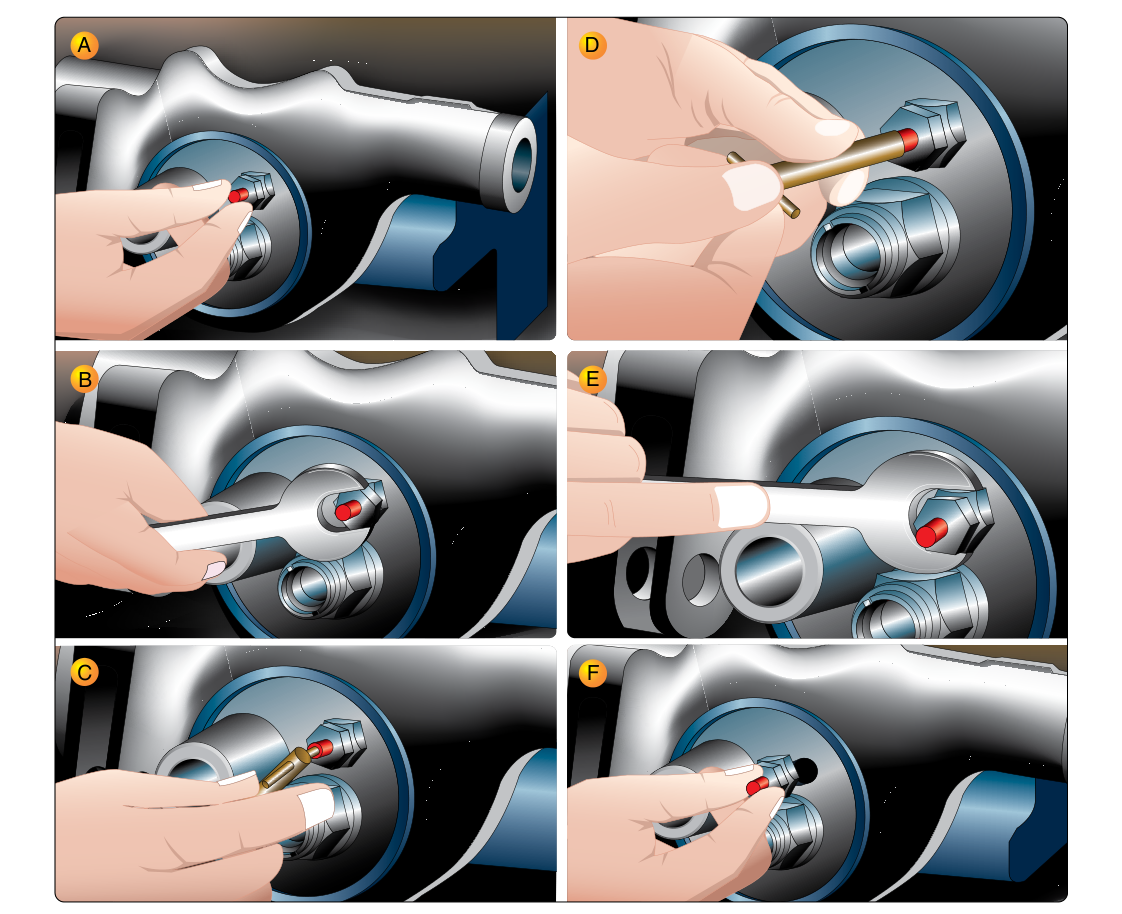
Before checking the fluid, the aircraft must be jacked so the strut is fully extended (unloaded). With the strut fully extended, the nitrogen pressure is at its lowest point and the fluid occupies its maximum volume. Remove the valve core from the service valve slowly to release any residual pressure, then remove the filler plug. The correct fluid level is typically specified as the fluid being visible at or near the top of the inner cylinder or at a marked level—the exact specification is always in the aircraft's maintenance manual. If the fluid is low, add the correct grade of hydraulic fluid per the manual. Never mix fluid types. Reinstall the filler plug before re-pressurizing.
Step 2 — Inflate with Dry Nitrogen
After confirming or correcting the fluid level, re-pressurize the strut with dry nitrogen—never shop air or oxygen. Oxygen mixed with hydraulic fluid creates a fire and explosion hazard, and moisture in shop air can cause internal corrosion and freeze at altitude. Connect a nitrogen servicing cart with a calibrated pressure gauge, and inflate to the pressure specified in the maintenance manual for the ambient temperature and aircraft weight condition. Strut servicing pressures vary widely by aircraft type, with no standard typical range—always use the specific value in the AMM.
Step 3 — Verify Strut Extension
Once the aircraft is lowered off the jacks and returned to normal ground attitude, check the strut extension. The correct extension is measured as the exposed length of the inner barrel (chrome piston) visible below the outer cylinder. This measurement is published in the AMM. A properly inflated strut will show the exact amount of chrome specified in the aircraft's maintenance manual, which varies by aircraft type. Too little extension means the strut is either under-inflated on nitrogen or overfilled with fluid. Too much extension means it is over-inflated on nitrogen or low on fluid. If the strut is bottomed out (no chrome visible), it offers no cushioning and all landing loads go directly into the airframe—a serious structural concern.
Fluid Contamination and Leaks
The primary seals in a strut are O-rings and packing seals on the inner barrel. Wear or damage to these seals allows fluid to leak past and appear as a wet, oily film on the chrome surface of the inner barrel. A light film of fluid is normal and actually helps lubricate the seals; a heavy drip or visible accumulation of fluid on the ground beneath the strut indicates seal failure and the strut must be disassembled, inspected, and resealed. The chrome surface of the inner barrel must be smooth and free of pits, nicks, or corrosion—damage to the chrome will destroy new seals quickly.
Why It Matters
A strut that is under-serviced (low fluid or low nitrogen) is a direct flight safety hazard. It may bottom out on landing, transmitting unattenuated shock loads into the wing attach fittings, fuselage frames, and other primary structure. Over time this causes fatigue cracking that may not be visible during routine inspection. Conversely, an over-inflated strut is excessively stiff, causes the aircraft to bounce on landing, and can make ground handling unpredictable. For multiengine aircraft or aircraft with retractable gear, improper fluid level can also affect the hydraulic system supply if the strut shares fluid with the aircraft hydraulic system—though most modern designs keep these separate.
Correct servicing also matters for weight-and-balance and ground clearance. An aircraft with a collapsed nose strut sits in a nose-low attitude that can affect propeller-to-ground clearance during run-up and taxi, creating a prop-strike risk.
Key Numbers and Rules
- Always use dry nitrogen to pressurize struts—never oxygen, never shop air. This is a hard safety rule with no exceptions.
- Always jack the aircraft (strut fully extended, unloaded) before checking or adding hydraulic fluid to get an accurate reading.
- Service sequence: fluid first, then nitrogen. If you inflate first, you cannot accurately assess fluid level.
- Strut extension check is performed with the aircraft in its normal ground/static attitude (off the jacks), per the specific loading and attitude condition specified in the AMM.
- MIL-PRF-5606 (red mineral oil) and MIL-PRF-83282 (fire-resistant synthetic) are common strut fluids—always use the grade specified by the aircraft manufacturer; mixing types is prohibited.
- Torque links must be lubricated per the lubrication chart (typically with grease at the pivot bushings) and inspected for wear.
- Strut pressure specifications are temperature-sensitive—some AMMs provide a pressure-temperature chart so the mechanic can correct the charge for ambient temperature.
Common Test Traps
- Oxygen vs. nitrogen: The FAA test frequently asks what gas is used to service shock struts. The answer is always dry nitrogen—never oxygen (explosion risk) and never compressed air (moisture and contamination risk).
- Order of servicing: A common distractor asks whether to add nitrogen or fluid first. The correct answer is fluid first (strut on jacks, fully extended), then inflate with nitrogen. Reversing the order gives an inaccurate fluid reading.
- What a bottomed-out strut indicates: If the strut shows no exposed inner barrel chrome when the aircraft is on the ground, it may be low on nitrogen, overfilled with fluid, or both—not just low on air.
- Torque link function: Test questions sometimes describe scissors/torque links as being related to retraction; their actual purpose is to prevent rotation of the inner barrel relative to the outer cylinder while allowing telescopic movement.
- Fluid film vs. leak: A light oily film on the inner barrel is normal lubrication of the packing seals. An active drip or pooling under the aircraft indicates seal failure requiring disassembly—students sometimes confuse the two.