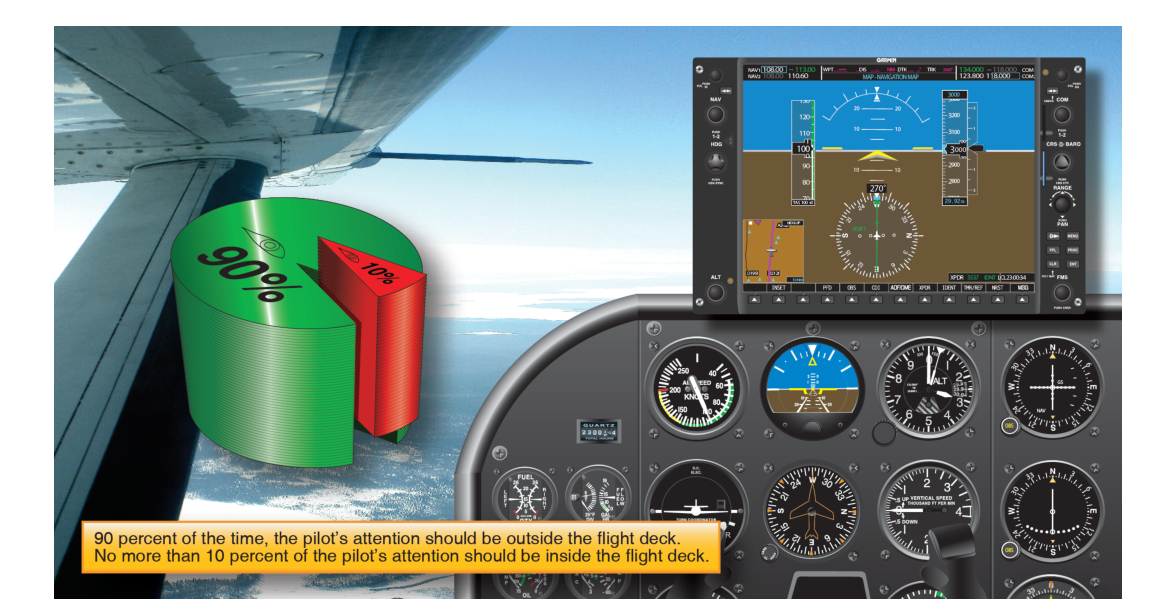
One of the most important skills a pilot develops — long before earning an instrument rating — is the ability to read and trust the cockpit instruments while simultaneously maintaining situational awareness through outside visual references. This teaching philosophy is called integrated flight instruction, and the FAA considers it a foundational element of modern pilot training. Rather than treating visual flying and instrument flying as two separate disciplines learned in sequence, integrated instruction weaves instrument reference into every stage of flight training from the very first lesson.
When a student later begins formal instrument training, integrated flight instruction pays enormous dividends. The pilot who has spent dozens of hours glancing at the attitude indicator, altimeter, and heading indicator during normal VFR maneuvers is far better prepared to transition to flying by instruments alone than one who relied exclusively on outside visual references. Understanding how integration works, why the FAA mandates this approach, and what changes when the outside visual world is taken away is essential knowledge for both the instrument knowledge test and for safe instrument flight.
The Philosophy of Integrated Instruction
The Airplane Flying Handbook describes integrated flight instruction as the technique of teaching students to use both outside visual references and cockpit flight instruments from the beginning of training — not as alternatives, but as complementary sources of information that reinforce each other. During a normal VFR climb, for example, a student learns to select a pitch attitude by referencing the horizon visually, then confirm that attitude using the attitude indicator, and then cross-check the airspeed indicator and vertical speed indicator to verify the airplane is performing as expected.
This dual-reference habit accomplishes two things simultaneously. First, it builds the instrument scan naturally and progressively, so the student is not starting from scratch when instrument training begins. Second, it trains the pilot to trust cockpit instruments rather than treating them as an afterthought or a backup only consulted when something seems wrong. Because disorientation and spatial confusion are leading factors in loss-of-control accidents, building instrument trust early is a genuine safety multiplier across a pilot's entire career.
How the Transition to Instrument Reference Works
When a pilot moves from VFR to instrument meteorological conditions (IMC), the outside visual reference that has anchored every attitude change disappears. The natural horizon — the single most intuitive reference for pitch and bank — is replaced by the attitude indicator, an electro-gyroscopic (or, in modern aircraft, solid-state) instrument that displays a miniature aircraft symbol against an artificial horizon line. Learning to accept and act on this artificial reference takes deliberate practice.
The Instrument Cross-Check
Attitude instrument flying is built on the concept of a disciplined, continuous cross-check — also called a scan. The Instrument Flying Handbook identifies the attitude indicator as the primary pitch and bank instrument during most instrument maneuvers because it gives the most direct and immediate picture of aircraft attitude. However, no single instrument tells the whole story. The cross-check integrates information from the full panel:
- Attitude Indicator (AI): Shows pitch and bank attitude directly and immediately. The primary reference for establishing and maintaining attitude.
- Altimeter: Confirms whether pitch attitude is producing the desired vertical result. If altitude is creeping up or down unexpectedly, the pilot re-examines pitch attitude.
- Airspeed Indicator (ASI): Reflects the energy state of the aircraft. Airspeed trends confirm whether pitch and power settings are correct.
- Heading Indicator (HI) / Directional Gyro: Confirms that wings-level flight is actually producing straight flight. A creeping heading change reveals an undetected bank.
- Vertical Speed Indicator (VSI): A trend instrument — it shows the rate of altitude change, giving an early warning of pitch deviations before the altimeter moves significantly.
- Turn Coordinator: Shows roll rate and, through the ball (inclinometer), whether the airplane is in coordinated flight.
A well-practiced cross-check visits these instruments in a logical, rhythmic pattern. The pilot does not stare at any single instrument but instead spends the greatest proportion of time on the attitude indicator while making brief, purposeful glances at the supporting instruments to verify that the attitude being flown is producing the desired performance. This is fundamentally the same skill a VFR pilot uses when checking instruments during maneuvers — just without the comfort of an outside horizon to fall back on.
Attitude, Power, Trim: The Control Hierarchy
Instrument flying is organized around a simple three-step control philosophy: Attitude + Power = Performance. The pilot selects a specific pitch and bank attitude on the attitude indicator, sets the appropriate power, and the airplane delivers a predictable performance (climb, cruise, descent, turn). Trim is then used to relieve control pressures so the pilot is not fighting the airplane while trying to maintain a precise attitude. This principle is identical in VFR and IFR flight — integrated instruction teaches it the same way from the first lesson, making the transition feel evolutionary rather than revolutionary.
Why Integrated Instruction Matters for Safety
The dangers of relying solely on outside visual references become acute when those references degrade. A pilot who has never developed a meaningful instrument scan is poorly equipped to handle inadvertent IMC — the scenario in which a VFR pilot encounters clouds or reduced visibility and suddenly has no reliable outside reference. Statistics compiled over decades of accident investigation point consistently to continued VFR flight into IMC as one of the most lethal categories of general aviation accidents. Pilots without strong instrument scanning habits are highly susceptible to spatial disorientation — the condition in which the body's vestibular and proprioceptive senses provide attitude information that directly contradicts what the instruments indicate.
The vestibular system is subject to well-documented illusions in the absence of visual references. The leans, the graveyard spiral, and the coriolis illusion can all convince a pilot that the aircraft is in a different attitude than it actually occupies. The only reliable countermeasure is to trust the instruments and fly the numbers — a habit that integrated instruction builds over hundreds of hours before a pilot ever encounters actual IMC.
Key Numbers and Rules
- To exercise instrument-rating privileges, a pilot must have logged at least 50 hours of cross-country flight time as pilot in command (with at least 10 hours in airplanes, for an instrument-airplane rating) and 40 hours of actual or simulated instrument time, of which at least 15 hours must be instrument flight training received from an authorized instructor (14 CFR 61.65).
- To remain instrument current, a pilot must complete within the preceding 6 calendar months: 6 instrument approaches, holding procedures, and intercepting/tracking courses (14 CFR 61.57(c)).
- The standard bank angle for a standard-rate turn in instrument flight is approximately 15–25 degrees of bank depending on airspeed, producing a turn rate of 3 degrees per second (360 degrees in 2 minutes).
- A half-standard-rate turn produces 1.5 degrees per second and is used at higher speeds or on certain instrument approaches.
- The attitude indicator should be checked against the altimeter and heading indicator periodically; gyroscopic precession can cause slow drift, and the heading indicator should be synchronized with the magnetic compass approximately every 15 minutes during flight.
- During simulated instrument flight under a view-limiting device (hood or foggles), a safety pilot who holds at least a private pilot certificate and is rated for the aircraft category and class must occupy the other control seat (14 CFR 91.109).
Memory Aid: AVIATE, NAVIGATE, COMMUNICATE
This classic instrument flying priority sequence reminds pilots what to do first when workload spikes. Aviate means maintain aircraft control — keep the attitude indicator in check and the airplane flying. Navigate means know where you are and where you are going — maintain the desired track and altitude. Communicate means talk to ATC or other parties — last in priority because a controlled airplane on course buys you time, while an out-of-control airplane does not. Integrated flight instruction drives this hierarchy home from the beginning: controlling the aircraft through instrument reference always comes first.
Common Test Traps
- Confusing primary and supporting instruments: The FAA distinguishes between the primary instrument (the one that gives the most direct indication of a specific parameter at a given moment) and supporting instruments. Many students incorrectly think the attitude indicator is always the primary instrument — but during a constant-airspeed climb, for example, the airspeed indicator becomes the primary pitch instrument because it most directly reflects whether the desired performance is being achieved.
- Misidentifying the function of the VSI: The vertical speed indicator is a trend instrument, not a precision instrument. It lags several seconds behind actual altitude changes and should not be used as a primary reference for altitude control.
- Forgetting the safety pilot requirement: Students sometimes assume that any certificated pilot can serve as safety pilot. In fact, the safety pilot must hold at least a private pilot certificate and must be rated for the same category and class of aircraft being flown.
- Overlooking the currency grace period structure: If a pilot fails to meet instrument recency requirements within the preceding 6 calendar months, 14 CFR 61.57(d) allows an additional 6-month grace period (12 months total since last current) to regain currency simply by flying the required tasks with a safety pilot or instructor. Only if that additional 6-month window also lapses — meaning more than 12 months have passed since the pilot was last current — does an instrument proficiency check (IPC) with an authorized instructor become required.
- Trusting the body over the instruments: A classic scenario on the knowledge test involves a pilot in IMC who feels the aircraft is in a bank but the attitude indicator shows wings level. The correct answer is always to trust the instruments, because vestibular illusions are well-documented and the attitude indicator is a calibrated, reliable reference.