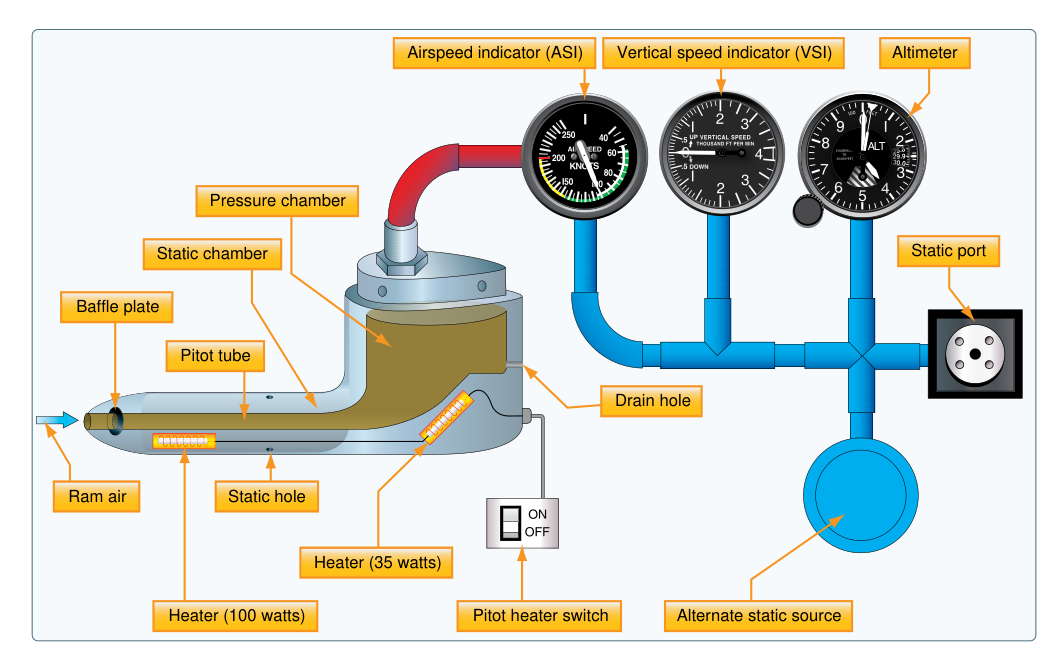
The pitot-static system is the invisible backbone of three of your most critical flight instruments: the airspeed indicator (ASI), the altimeter, and the vertical speed indicator (VSI). Under normal conditions, this network of tubes and ports feeds ram air pressure and atmospheric static pressure to each instrument, letting them compute reliable flight data. But when ice, insects, moisture, or a forgotten cover blocks any part of this system, the results range from subtly misleading to dangerously wrong — and the failure is silent. There is no warning horn, no red light, and no obvious buffet. You have to know how each blockage behaves to catch it before it leads you astray.
This article walks through the physics behind each blockage scenario, explains exactly which instruments are affected and in what direction, and gives you the diagnostic instincts to recognize a failure in flight. This is a high-priority topic both for the FAA knowledge test and for real-world airmanship.
How the Pitot-Static System Works
The system has two pressure sources. The pitot tube faces directly into the airflow and captures ram air pressure — total pressure that increases as the aircraft moves faster through the air. This ram pressure feeds only the airspeed indicator. The static ports, usually flush openings on the side of the fuselage (or sometimes incorporated into the pitot mast), sense ambient static pressure — the undisturbed atmospheric pressure at your current altitude. Static pressure feeds the altimeter and VSI directly, and it also feeds the low-pressure side of the ASI so the instrument can compute the difference between ram pressure and static pressure, which corresponds to airspeed.
Because these two sources serve different instruments in different ways, a blockage in one part of the system has a unique, predictable signature. Understanding that signature is your diagnostic key.
Pitot Tube Blockage
The pitot tube is vulnerable to icing (especially in visible moisture below about 0 °C), insect nests on the ground, and — embarrassingly common — a pitot cover left in place after preflight. Most light aircraft pitot tubes are equipped with an electric pitot heat system designed to prevent ice accumulation; 14 CFR 91.205(d)(3) requires pitot heat for IFR operations in IMC.
What Happens to the Airspeed Indicator
When the pitot tube is completely blocked but the static port remains open, the ram pressure side of the ASI is sealed. The static port side continues to sense changing atmospheric pressure as you climb or descend. This creates a counterintuitive but testable behavior:
- In level flight: Airspeed freezes at the reading it had when the blockage occurred. The sealed ram pressure does not change, and neither does static pressure (if you maintain altitude), so the difference stays constant and the needle stays put.
- During a climb: Static pressure decreases as you ascend. Because the low-pressure (static) side of the ASI drops while the sealed high-pressure (ram) side stays constant, the difference increases — and indicated airspeed rises, even though your actual airspeed may not be changing or may even be decreasing.
- During a descent: Static pressure increases as you go lower. This compresses the static side of the ASI relative to the frozen ram side, decreasing the difference — so indicated airspeed falls, potentially all the way to zero, while your actual airspeed may be dangerously high.
This descending scenario is particularly lethal: a pilot in IMC who sees airspeed bleeding off may instinctively push the nose over to regain speed, accelerating into terrain or structural failure. Recognizing a pitot blockage early — especially by cross-checking with engine power, attitude, and groundspeed on GPS — is essential.
Pitot Drain Hole Blockage
Many pitot tubes have a small drain hole near the bottom to allow water to escape. If the main pitot opening is blocked by ice but the drain hole remains open, the situation changes: ram pressure bleeds off to the atmosphere through the drain hole, equalizing with static pressure. In this case the ASI reads zero (or very low) regardless of altitude changes, because both sides of the instrument see the same pressure. This is actually easier to recognize than the full blockage scenario.
Static Port Blockage
A blocked static port — from ice, tape (yes, it happens during painting or washing), or a clogged vent — affects all three pitot-static instruments simultaneously. This is the more dangerous and harder-to-detect scenario because multiple instruments go wrong at once.
Altimeter
The altimeter is essentially a barometer measuring static pressure. When the static port blocks, the altimeter freezes at the altitude where the blockage occurred. It will not respond to climbs or descents. If you climb after the blockage, the altimeter will read lower than your actual altitude (it's stuck below where you are). If you descend, it reads higher than your actual altitude — a dangerous illusion during an approach.
Vertical Speed Indicator
The VSI works by measuring the rate of change of static pressure through a calibrated leak. With a blocked static port, the pressure inside the VSI case cannot change relative to a reference — the VSI needle freezes at zero, giving you a constant false indication of level flight even during a steep climb or dive. This is one of the most dangerous single-instrument failures because a zero VSI looks perfectly normal.
Airspeed Indicator with a Blocked Static Port
When the static port is blocked but the pitot tube is open, the ram pressure side of the ASI continues to change with airspeed, but the static reference side is sealed at the pressure from the moment of blockage.
- During a climb: Your actual static pressure decreases, but the sealed reference stays at the higher (lower-altitude) value. The ASI sees a smaller difference than it should, so it under-reads actual airspeed.
- During a descent: Actual static pressure increases, but the sealed reference stays at the lower (higher-altitude) value. The ASI sees a larger difference than it should, so it over-reads actual airspeed.
- In level flight: If altitude doesn't change, static pressure doesn't change, and the ASI reads approximately correctly — masking the problem until you change altitude.
The Alternate Static Source
Most training aircraft provide an alternate static source, usually a valve that connects the static system to the cabin interior instead of the blocked external port. Cabin pressure is slightly lower than outside static pressure (because the cabin airflow creates a mild venturi effect), which means using the alternate static source will cause the altimeter to read slightly higher than actual altitude, the VSI to momentarily show a climb before stabilizing, and the ASI to read slightly faster than actual airspeed. The Pilot's Operating Handbook (POH) for your specific aircraft will state the correction factors. Knowing these deviations is critical for IFR flying; for VFR, the alternate source is still far better than a blocked system.
If no alternate static source is available, some manufacturers permit breaking the glass of the VSI — since it is the least critical of the three instruments — to vent the static system directly to cockpit air. Always confirm this procedure in your POH before relying on it.
Why It Matters
Pitot-static failures are directly linked to fatal accidents. Ice-induced pitot tube blockages have contributed to large-transport crashes when crews did not recognize conflicting instrument indications early enough. In a light aircraft, the same insidious process occurs: everything looks normal except one or two needle positions that don't quite match power and attitude. The Pilot's Handbook of Aeronautical Knowledge (FAA-H-8083-25) emphasizes that thorough preflight inspection of the pitot tube opening and static ports, along with proper use of pitot heat in icing conditions, is the first line of defense.
Key Numbers and Rules
- Pitot heat required: 14 CFR 91.205(d)(3) — IFR flight in IMC (certificated aircraft with pitot heat must use it).
- Blocked pitot, climbing: ASI over-reads (indicates faster than actual).
- Blocked pitot, descending: ASI under-reads (indicates slower than actual — most dangerous scenario).
- Blocked static, all altitudes: Altimeter freezes, VSI freezes at zero, ASI error depends on altitude change direction.
- Alternate static source effect: Altimeter reads slightly high, ASI reads slightly fast, VSI shows momentary climb.
- Preflight check: Inspect pitot tube opening for obstructions (insects, ice, covers), verify static port is clear and unobstructed — both required by good airmanship and the preflight inspection checklist.
Common Test Traps
- Trap 1 — Climbing with a blocked pitot: Many students instinctively think a blocked pitot means zero airspeed. In fact, with the drain hole also blocked, airspeed increases during a climb because decreasing static pressure widens the apparent differential. The FAA loves to test this specific scenario.
- Trap 2 — Blocked static vs. blocked pitot: A blocked static port affects three instruments; a blocked pitot affects only the ASI. Students confuse which failure is broader in scope.
- Trap 3 — VSI reads zero with blocked static: Zero does not mean level. A frozen VSI at zero is a failure indication, not a normal reading — always cross-check with the altimeter trend and attitude indicator.
- Trap 4 — Alternate static source altimeter correction: The altimeter reads higher (not lower) when using alternate static because cabin pressure is slightly below ambient. Students often guess the wrong direction.
- Trap 5 — Descent with blocked pitot: Indicated airspeed drops toward zero as you descend with a blocked pitot (and open static). This looks like an impending stall and can provoke a dangerous nose-down input. Recognizing this failure requires trusting attitude and power, not the ASI alone.